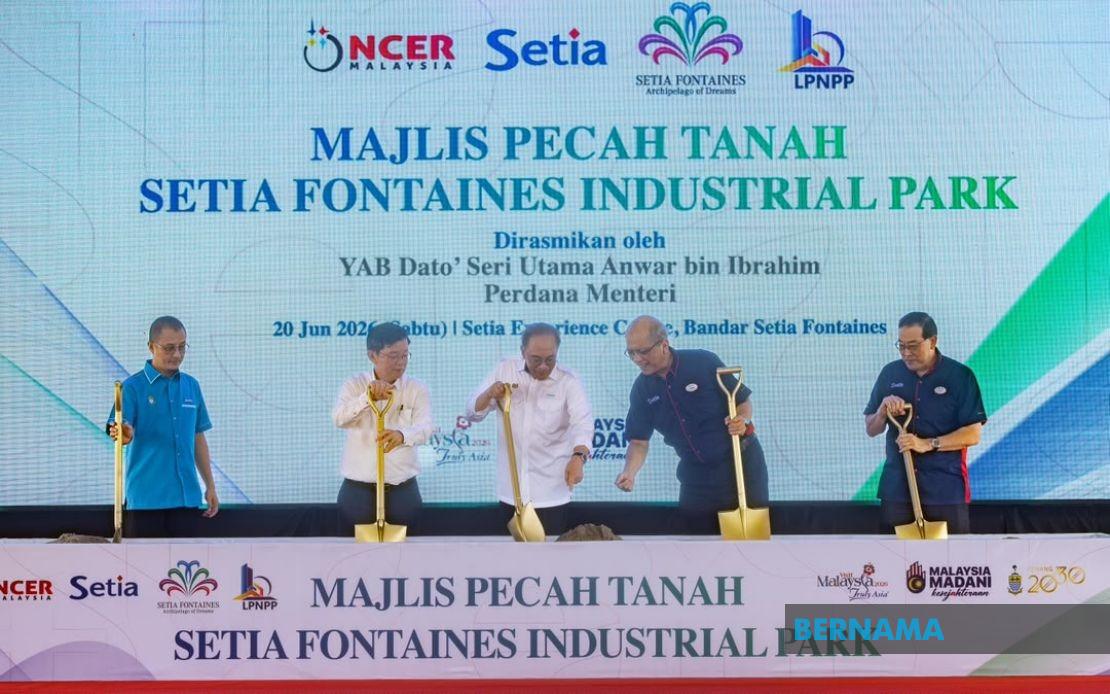
Prime Minister Datuk Seri Anwar Ibrahim has issued a direct call to government-linked companies and private sector operators to anchor their development initiatives in inclusive growth that reaches beyond wealthy segments of society. Speaking at the groundbreaking ceremony for the Setia Fontaines Industrial Park in Bandar Setia Fontaines today, Anwar emphasised that rapid economic expansion coupled with surging investment flows must be deliberately structured to prevent the emergence of deeper divides between different income brackets.
The Prime Minister's intervention reflects mounting concerns within government circles that Malaysia's development trajectory risks reproducing patterns of inequality despite overall macroeconomic gains. Anwar articulated this concern with particular force, suggesting that approvals granted to major institutional investors—whether Khazanah Nasional Berhad, Permodalan Nasional Berhad, the Employees Provident Fund, or private corporations—should come bundled with measurable pathways for lower- and middle-income Malaysians to participate meaningfully in the resulting economic value. Without such safeguards, he warned, disadvantaged communities would find themselves progressively squeezed out of emerging opportunities.
This framing represents a shift in how Malaysia's political leadership is discussing development outcomes. Rather than treating growth metrics and foreign direct investment figures as ends in themselves, Anwar has positioned inclusive participation as a prerequisite for legitimacy. The distinction matters because it reframes how success should be evaluated—not merely through statistical aggregates but through the tangible ways ordinary Malaysians experience improved living standards and economic mobility. Such rhetoric carries particular resonance in Seberang Perai, a region historically characterised by lower average incomes relative to Penang Island and southern Penang State.
The Setia Fontaines Industrial Park development initiative takes on heightened significance within this broader policy context. The project has been positioned as a mechanism for ensuring that industrial expansion on the Seberang Perai mainland accelerates in tandem with development momentum observed elsewhere in the state, rather than exacerbating regional disparities. Anwar suggested that the facility could generate quality employment across sectors increasingly pivoting toward advanced manufacturing and technology-intensive production, moving away from Malaysia's historical reliance on lower-value back-end assembly operations.
However, the Prime Minister's remarks also acknowledged an underlying structural challenge that purely policy directives cannot resolve: the persistent skills gap between available jobs and the workforce capacities of workers from lower-income backgrounds. Anwar flagged a critical vulnerability—that even when high-value employment opportunities materialise, benefit realisation depends on having sufficient numbers of suitably qualified candidates ready to fill positions. This observation implicitly recognises that inclusive growth requires investment in human capital development, not merely project approvals.
To address this challenge, Anwar has called for substantially deepened collaboration between industrial operators, technical and vocational education providers, and universities including Universiti Sains Malaysia. The proposal reflects acknowledgment that educational institutions must operate in closer synchronisation with labour market demands, allowing curricula to remain responsive to rapidly evolving sectoral requirements. Anwar specifically noted that technological change occurs at an accelerated pace—shifts materialising within one or two years—making static skills training models obsolete.
The emphasis on alignment between industry, vocational institutions, and universities carries practical implications for how Malaysian educational policy should be calibrated going forward. Rather than allowing technical schools and universities to operate according to self-contained institutional logics, the Prime Minister's remarks suggest that government will increasingly expect these entities to function as active partners in workforce development pipelines. For private sector operators, this implies expectations that they engage with educational institutions not merely as recruitment pools but as collaborative partners in curriculum design.
Anwar's intervention also carries implicit messaging about the accountability framework governing major development approvals. By publicly stating that government expects recipient entities to demonstrate inclusive outcomes, the Prime Minister has established parameters against which performance will be assessed. This approach differs from traditional Malaysian governance models where approvals are typically granted with minimal conditionality regarding distributional outcomes. The shift suggests tightening linkages between project approval and measurable commitments to lower-income participation.
For regional observers, Anwar's emphasis on inclusive development holds relevance beyond Malaysia's borders. Southeast Asian economies broadly face similar tensions between rapid capital accumulation and widening inequality, with development projects frequently concentrating benefits among already-advantaged populations. Malaysia's articulated commitment to structured inclusivity offers a model—whether practically implementable remains to be seen—for how state actors might use approval mechanisms to channel development benefits more equitably.
Yet significant implementation challenges persist. Monitoring compliance with inclusivity requirements demands robust institutional capacity that Malaysian authorities have historically struggled to maintain. Questions also arise regarding whether private sector entities, operating under profit-maximisation imperatives, can authentically accommodate lower-margin employment creation without government subsidies or mandates. The willingness of educational institutions to rapidly retool curricula toward industry specifications also remains uncertain.
The groundbreaking ceremony itself symbolised broader government positioning on Seberang Perai's economic trajectory. By personally appearing for the Setia Fontaines launch and using the platform to articulate inclusive growth principles, Anwar signalled that this industrial park was not merely a routine infrastructure project but rather a test case for integrating social equity considerations into development planning. Success in demonstrating that quality employment opportunities genuinely reached lower-income beneficiaries could reshape how subsequent major projects are conceived and evaluated.
As Malaysia navigates post-pandemic economic recovery and grapples with intensifying global competition for investment, the balance between growth maximisation and distributional fairness will likely remain contentious. Anwar's remarks indicate that his administration is moving toward privileging the latter consideration more explicitly, at least rhetorically. Whether this rhetorical commitment translates into enforceable mechanisms, sustained institutional commitment, and measurable outcomes will largely determine whether Malaysia's development model becomes more equitable or merely more sophisticated in managing inequality's appearance.
%22%2F%3E%3C%2Fpattern%3E%3C%2Fdefs%3E%3Crect%20width%3D%22100%25%22%20height%3D%22100%25%22%20fill%3D%22url(%23ph4xpndg)%22%2F%3E%3Crect%20width%3D%22100%25%22%20height%3D%22100%25%22%20fill%3D%22url(%23ph4xpndp)%22%2F%3E%3Ctext%20x%3D%2250%25%22%20y%3D%2250%25%22%20text-anchor%3D%22middle%22%20dominant-baseline%3D%22central%22%20fill%3D%22rgba(255%2C255%2C255%2C0.95)%22%20font-family%3D%22Georgia%2C%20'Times%20New%20Roman'%2C%20serif%22%20font-weight%3D%22700%22%20font-size%3D%22320%22%20letter-spacing%3D%22-0.02em%22%3ETV3%3C%2Ftext%3E%3C%2Fsvg%3E)
%22%2F%3E%3C%2Fpattern%3E%3C%2Fdefs%3E%3Crect%20width%3D%22100%25%22%20height%3D%22100%25%22%20fill%3D%22url(%23ph4p6tog)%22%2F%3E%3Crect%20width%3D%22100%25%22%20height%3D%22100%25%22%20fill%3D%22url(%23ph4p6top)%22%2F%3E%3Ctext%20x%3D%2250%25%22%20y%3D%2250%25%22%20text-anchor%3D%22middle%22%20dominant-baseline%3D%22central%22%20fill%3D%22rgba(255%2C255%2C255%2C0.95)%22%20font-family%3D%22Georgia%2C%20'Times%20New%20Roman'%2C%20serif%22%20font-weight%3D%22700%22%20font-size%3D%22170%22%20letter-spacing%3D%22-0.02em%22%3EMalaysia%3C%2Ftext%3E%3C%2Fsvg%3E)
%22%2F%3E%3C%2Fpattern%3E%3C%2Fdefs%3E%3Crect%20width%3D%22100%25%22%20height%3D%22100%25%22%20fill%3D%22url(%23ph26rx5g)%22%2F%3E%3Crect%20width%3D%22100%25%22%20height%3D%22100%25%22%20fill%3D%22url(%23ph26rx5p)%22%2F%3E%3Ctext%20x%3D%2250%25%22%20y%3D%2250%25%22%20text-anchor%3D%22middle%22%20dominant-baseline%3D%22central%22%20fill%3D%22rgba(255%2C255%2C255%2C0.95)%22%20font-family%3D%22Georgia%2C%20'Times%20New%20Roman'%2C%20serif%22%20font-weight%3D%22700%22%20font-size%3D%22320%22%20letter-spacing%3D%22-0.02em%22%3EPM%3C%2Ftext%3E%3C%2Fsvg%3E)