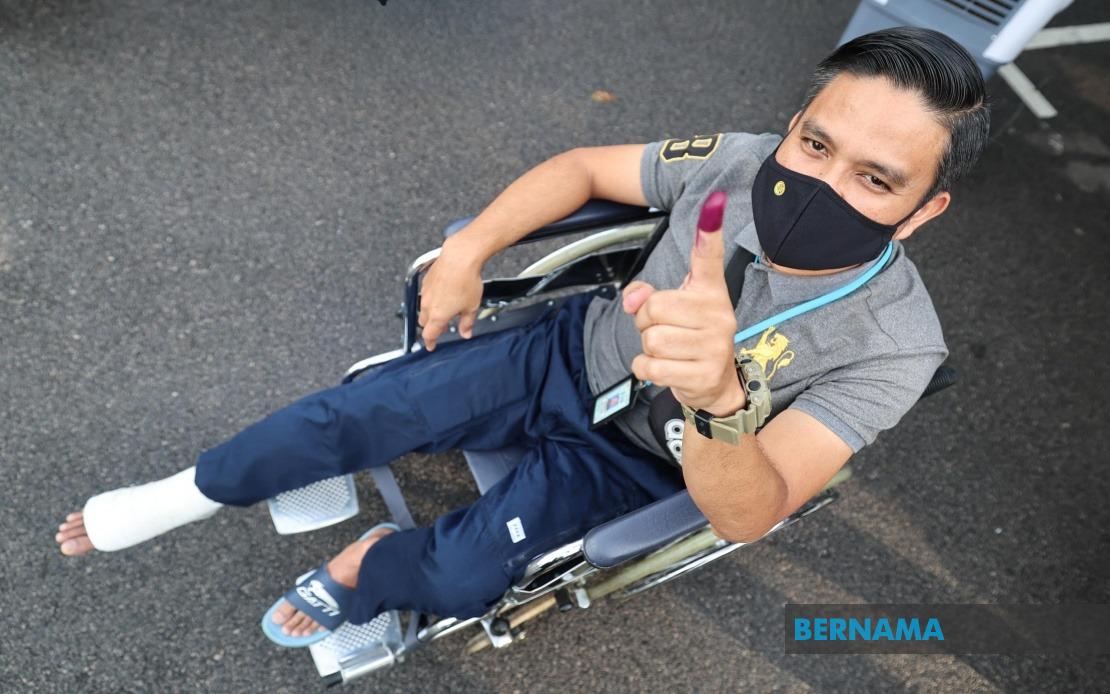
Sergeant Syahrizal Musa made an unscheduled journey to the Johor Police Contingent Headquarters on July 7 to cast his ballot in the 16th Johor state election—a decision that spoke volumes about his sense of duty. The 40-year-old officer, who had sustained a torn Achilles tendon while playing sepak takraw the previous week, arrived at the early voting centre in a wheelchair, his medical leave scheduled to extend until July 16. Yet the pain and mobility restrictions proved insufficient to keep him from fulfilling what he views as a fundamental obligation of citizenship.
Based at the Johor IPK's Internal Security and Public Order Department, Syahrizal represents a particular cohort of Malaysian public servants whose participation in elections carries symbolic weight. He travelled from the police quarters in Tampoi alongside a colleague, navigating his wheelchair through the voting process with determination. His presence at the early polling station highlighted how institutional commitment to democratic participation extends throughout the civil service hierarchy, from frontline officers to those in supporting roles.
The sergeant's injury occurred during recreation—a reminder that police personnel maintain active lifestyles outside their official duties. Syahrizal had been an accomplished sepak takraw player throughout his life and has represented the Johor police contingent in multiple tournaments, embedding himself in the sporting culture of his department. Medical assessment confirmed a minor tear to the Achilles tendon, an injury typically requiring weeks of restricted mobility and rehabilitation. Yet for Syahrizal, the inconvenience of healing did not override the importance of participating in the electoral process.
When questioned by reporters, Syahrizal articulated a perspective that transcends the immediate circumstances. His 22-year career with the Royal Malaysia Police has been marked by consistent electoral participation—he emphasized never having missed a voting opportunity throughout his service. This consistency suggests a philosophical commitment to democracy that operates independently of circumstance or convenience. For a public servant, such dedication to voting holds particular resonance, as it models civic engagement for the communities they serve and reinforces institutional respect for democratic processes.
Syahrizal's journey to the polling centre reflects broader trends in Malaysian electoral administration. The 16th Johor state election incorporated provisions for early voting specifically designed to accommodate security personnel and military staff whose operational demands might otherwise prevent their participation. A total of 64 early polling centres operated on the designated day, collectively processing 24,751 voters from the Malaysian Armed Forces and their spouses, alongside Royal Malaysia Police and General Operations Force personnel and their dependents. The infrastructure represented an acknowledgment that democratic participation requires institutional accommodation for those whose professional obligations demand flexibility.
The numerical scope of the electoral exercise underscored its significance within the state political calendar. Across 56 constituencies, 172 candidates competed for representation, with the wider electorate of approximately 2.7 million ordinary voters scheduled to participate in the main polling day that Saturday. Early voting mechanisms like those that enabled Syahrizal's participation thus operated at the margins of a substantially larger democratic exercise, yet their existence validated the principle that no eligible citizen should be systematically excluded from electoral processes.
Syahrizal's remarks to reporters extended beyond his personal decision to encompass broader exhortations toward civic participation. He articulated a hope that more Malaysians would embrace their voting rights and recognize the power of electoral choice in shaping state and national futures. This framing positioned his individual act not as exceptional heroism but as a normative standard—that Malaysian citizens should view voting as an expectation rather than an optional activity. The message carried implicit critique of electoral apathy while celebrating those who prioritize democratic participation despite obstacles.
The sergeant's background adds texture to his profile as an engaged citizen. Born in Seri Iskandar, Perak, he had served in the Muar IPD for nine years before transferring to Johor IPK in 2014, accumulating substantial experience within police administration and community-facing roles. This tenure within the institution suggests familiarity with how government operates at ground level, potentially informing his conviction that individual votes aggregate into meaningful political outcomes. His rootedness within the police hierarchy, combined with his demonstrated commitment to electoral participation, positions him as an exemplar of institutional citizenship.
The timing of the Johor state election reflected broader electoral momentum within Malaysian politics, representing the second major state-level exercise following earlier contests. Such statewide elections serve as barometers of public sentiment and provide opportunities for voters to assess state government performance and articulate preferences for alternative leadership. Johor's significance within Malaysian federalism—encompassing substantial economic output and demographic diversity—amplified the stakes for all participants, institutional and individual alike.
Syahrizal's wheelchair-bound presence at the polling centre carried unspoken commentary on accessibility and inclusion within electoral systems. While the specifics of his injury were temporary, the logistics he navigated—physical access to the voting space, accommodation within the polling process, dignity in participation despite disability—resonated with ongoing discussions about universal design in Malaysian governance. His successful participation demonstrated that with basic institutional planning, mobility challenges need not prevent electoral engagement.
The broader context of early voting for security personnel reflected recognition that institutional loyalty and democratic participation need not conflict. By enabling military and police staff to vote prior to main polling day, administrators acknowledged that operational readiness does not require forfeiture of political voice. Syahrizal's decision to participate despite injury suggests he viewed voting not as negotiable but as integral to his identity as a citizen, a perspective that transcended his professional role.
As Johor voters proceeded toward the main election, Syahrizal's quiet insistence on participating despite physical constraint offered an implicit rebuke to those who cite inconvenience as justification for electoral abstention. His narrative—injury sustained through recreation, professional obligation maintained through disability, civic duty exercised despite pain—encapsulated values that extend beyond party politics into the realm of citizen responsibility. Whether viewed as exemplary individual choice or normalized expectation, his presence at the early voting centre underscored the continuing centrality of electoral participation within Malaysian democratic practice, and the willingness of public servants to model that commitment for broader society.

