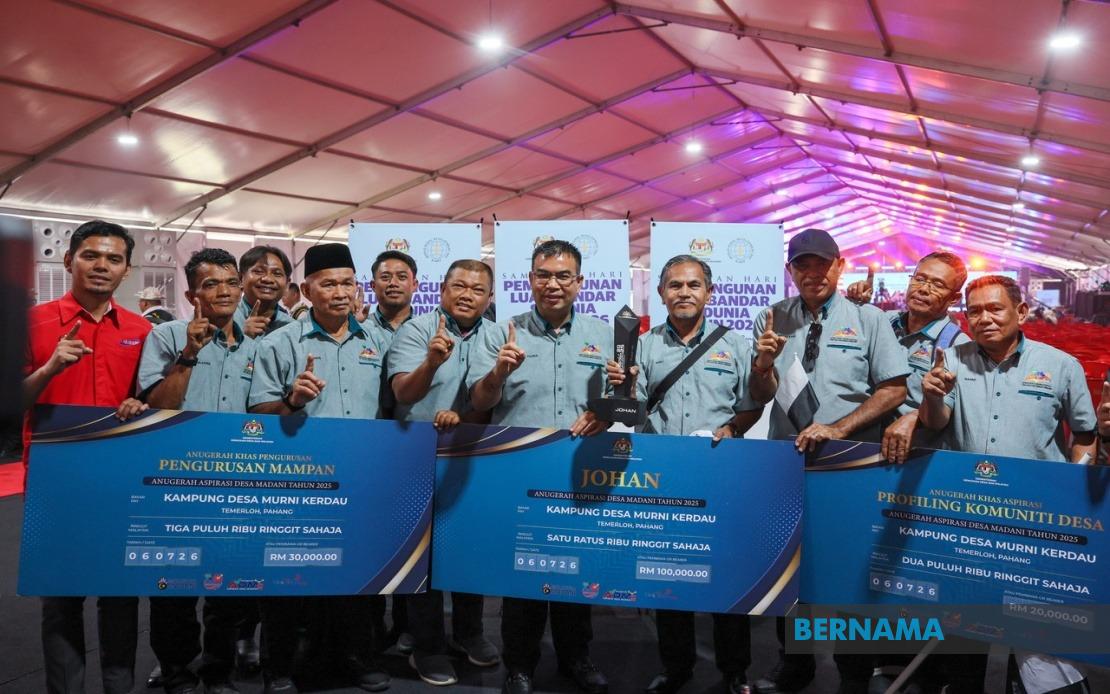
Desa Murni Kerdau, a village in Temerloh, Pahang, has secured three major awards at the World Rural Development Day 2026 celebration, held at Tun Abdul Razak Stadium in Jengka Sentral. The accolades underscore the growing momentum of rural revitalization efforts across Malaysia and highlight how grassroots communities are positioning themselves as models of sustainable development within the country's broader economic landscape.
The village clinched the 2025 MADANI Rural Aspiration Award Champion title, along with the Rural Community Profiling Aspiration Special Award and the Sustainable Management Special Award. Deputy Prime Minister Datuk Seri Dr Ahmad Zahid Hamidi presented the principal award, while Deputy Minister of Rural and Regional Development Datuk Rubiah Wang handed over the two additional recognitions. The involvement of senior government officials signals the importance placed on rural regeneration as a policy priority and suggests that Desa Murni Kerdau has become a case study for effective village management.
According to Mohamad Fazrul Ahmad, Chairman of the Village Development and Security Committee for Desa Murni Kerdau, the awards validate the community's track record in institutional governance, strategic leadership, and social cohesion. Speaking to reporters at the ceremony, he emphasized that the recognition reflected years of collective effort by local residents and administrators working toward tangible improvement. The chairman's remarks point to a governance model that blends traditional village structures with contemporary management principles, a combination that appears increasingly relevant as Malaysia seeks to narrow development gaps between urban and rural areas.
What distinguishes Desa Murni Kerdau within the broader narrative of Malaysian rural development is its entrepreneurial ecosystem. The village has incubated approximately 20 business owners operating across diverse sectors, ranging from small and medium enterprises to agricultural ventures and automotive services. This economic diversification reduces dependency on single industries and creates employment opportunities for residents, thereby tackling rural outmigration—a persistent challenge in many Southeast Asian farming communities.
Beyond agriculture, Desa Murni Kerdau has developed a rural tourism offering through its "Kampung Stay" initiative, which has gained recognition as a noteworthy agritourism destination nationally. This venture represents a strategic pivot toward service-based income generation while preserving cultural heritage and community identity. The convergence of traditional agriculture, small manufacturing, and hospitality creates a resilient economic base less vulnerable to commodity price fluctuations or seasonal variations.
The physical infrastructure of the village provides context for understanding its development achievements. Desa Murni Kerdau comprises approximately 200 households accommodating over 600 residents, making it a medium-sized settlement where governance mechanisms remain direct and accountability structures transparent. This scale allows for personalized community engagement while remaining large enough to justify investment in shared facilities and services, a balance that larger cities and smaller hamlets frequently struggle to achieve.
The award ceremony itself represents a symbolic moment in Malaysia's rural development trajectory. By celebrating villages that demonstrate excellence across governance, economic activity, and sustainability, the government reinforces the narrative that rural transformation is achievable through local initiative supported by institutional frameworks. This emphasis gains particular significance in a region where rural-to-urban migration has accelerated over the past decade, draining villages of younger populations and reducing tax bases for local services.
Monetary prizes accompanying the awards will flow directly to residents through distribution programs and fund village-level infrastructure projects. This approach ensures that recognition translates into tangible community benefits rather than remaining symbolic. Investment in local infrastructure—whether roads, water systems, or public facilities—attracts further economic activity and signals to younger residents that rural living offers viable futures, potentially slowing demographic decline.
Desa Murni Kerdau's success also carries implications for policy replication across Pahang and neighboring states. The model of integrating traditional governance structures with entrepreneurial development and tourism initiatives offers a template that other villages might adapt to local contexts. As Malaysia aims to develop inclusive growth patterns and distribute prosperity beyond metropolitan centers, examining how communities like Desa Murni Kerdau achieve institutional cohesion and economic diversity becomes strategically valuable.
The recognition further underscores the role of the Ministry of Rural and Regional Development in curating development narratives and establishing performance benchmarks. By identifying and celebrating excellence, the ministry signals its commitment to measurable outcomes beyond infrastructure provision, emphasizing governance quality and community agency. This shift toward recognizing institutional capacity and local leadership represents a maturing approach to rural policy, acknowledging that sustainable development depends on community ownership rather than top-down provision of services alone.
Looking forward, the awards position Desa Murni Kerdau as a site of potential knowledge exchange and policy learning. Researchers, administrators, and development professionals may increasingly look to the village for insights into effective rural governance, sustainable entrepreneurship, and community-based tourism development. Such attention, if managed thoughtfully, can reinforce local confidence while avoiding the pitfalls of disruption that intensive external scrutiny sometimes brings to small communities.

