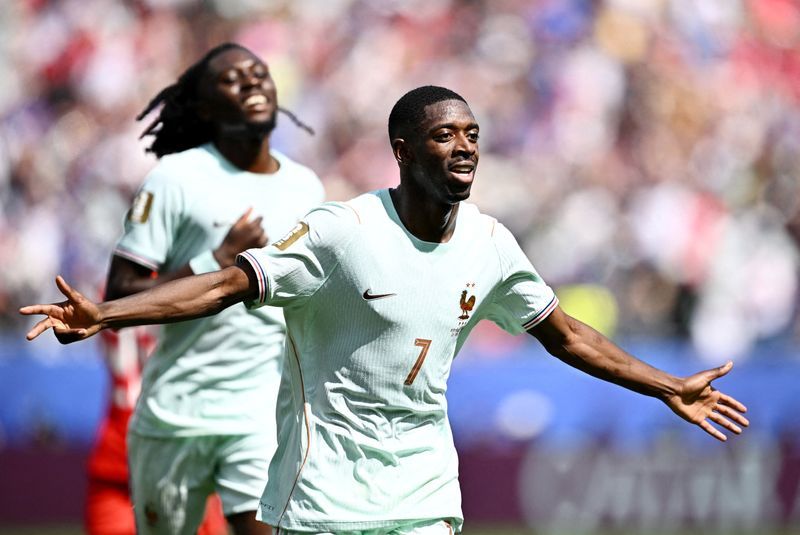
France delivered a ruthless demonstration of their World Cup pedigree on Friday, dismantling a heavily rotated Norway team 4-1 in Foxborough, Massachusetts to claim top position in Group I. The victory proved especially convincing given that winger Ousmane Dembele required just 25 minutes of the first half to complete a spectacular hat-trick, establishing himself among an exclusive fraternity of French goal-scorers at the tournament's highest stage. The performance reinforced why France remain among the tournament favourites despite the absence of head coach Didier Deschamps, who had returned to his home country to pay respects at his mother's funeral. The squad had collectively pledged to capture victory as a symbolic tribute to their absent leader, and they executed that promise with clinical efficiency against a depleted Norwegian opposition.
Although both nations had mathematically secured passage to the Round of 32 prior to their meeting, the stakes remained meaningful in terms of group positioning. Finishing atop their bracket carries tangible advantages within the tournament's logistical structure, particularly regarding the gruelling North American travel schedule that teams must navigate. France recognised this reality and approached the encounter with full intent, aiming to avoid the complications of a secondary-round seeding that could pit them against stronger European adversaries. Their eagerness to control Group I outcomes contrasted sharply with Norway's approach, where coach Stale Solbakken implemented a wholesale rotation strategy that removed most of the starting eleven from their midweek fixture against Senegal.
Norway's personnel decisions proved catastrophic to their competitive capacity. Solbakken benched all but a single player from the side that faced Senegal, conspicuously resting prolific striker Erling Haaland and captain Martin Odegaard. This tactical choice essentially handed France an open corridor through which to operate, stripping Norway of the attacking intensity and midfield control that define their football identity. The absence of these key figures transformed a competitive international encounter into a mismatch where France could freely express their superior technical capabilities without meaningful resistance. For Malaysian and Southeast Asian observers accustomed to more balanced continental competitions, the stark contrast in team preparation highlighted how World Cup logistics and group-stage mathematics create perverse incentives for established nations to rest players while denying weakened opponents any realistic path to competitive engagement.
France's attacking intent became apparent within seconds of kickoff. Kylian Mbappe, the Paris St-Germain sensation competing for the Golden Boot award, struck a promising angled shot that rattled the crossbar after merely 20 seconds of play. This early warning signal preceded Dembele's breakthrough in the sixth minute, when Mbappe executed a sweeping cross-field pass that found the winger in space. Dembele's movement proved exquisite—cutting inside past his marker before shifting outside again, creating sufficient angles to fire an angled shot beyond goalkeeper Egil Selvik with clinical precision. The combination exemplified the devastating interplay that France could orchestrate against a disorganised backline, establishing a rhythm that would carry through the opening period.
Dembele's second goal arrived fourteen minutes later when Mbappe again provided the service, this time setting up a simpler finish. The PSG forward gained crucial space against his assigned defender and converted with a dipping shot that beat Selvik. Remarkably, Norway responded almost instantaneously through Thelo Aasgaard's strike, briefly suggesting the fixture might develop competitive complexity. That prospect dissolved entirely when Dembele completed his hat-trick in the 32nd minute by curling a low shot into the corner, achieving a feat matched only by Just Fontaine and Kylian Mbappe among French World Cup performers. The speed of Dembele's triple strike—accomplished in just 26 minutes—ranked as the second-fastest hat-trick in World Cup history, behind Erich Probst's achievement for Austria against Czechoslovakia in 1954, which required 24 minutes.
Norway's second-half efforts proved insufficient to close the chasm that had opened. Jorgen Strand Larsen squandered a promising penalty opportunity when his weak attempt was saved by France goalkeeper Mike Maignan. Subsequently, winger Oscar Bobb created momentary discomfort by forcing another save from Maignan, exposing temporary vulnerabilities within France's backline during passages of unstructured play. These instances aside, France controlled proceedings and sealed victory when substitute Bradley Barcola delivered a cross that Desire Doue converted via header in the closing moments. The 4-1 scoreline accurately reflected the gulf between two teams approaching the encounter from entirely different strategic positions.
The group-stage outcome carries significant implications for the tournament's knockout structure. France's first-place finish positions them to potentially face Sweden in the Round of 32, a matchup shaped by European football's familiar competitive narratives. Norway, by contrast, will encounter Ivory Coast—a pairing that reflects their secondary finishing position. For Malaysian football constituencies observing this World Cup, France's methodical dismantling of their opponents underscores a fundamental reality: established football powers maintain significant advantages in tournament football, particularly when opponents approach matches with diminished squads. The psychological and tactical benefits of controlling group outcomes cannot be underestimated, and France clearly understood that investing full effort against weakened opposition represented prudent tournament management rather than unnecessary risk.
Dembele's performance will likely feature prominently in tournament retrospectives, particularly as discussions surrounding standout individual performances develop. His rapid completion of a hat-trick demonstrated the clinical finishing and movement intelligence that France's coaching staff have cultivated, even in the absence of their primary architect. The performance validated selector decision-making while simultaneously raising questions about the tournament format's capacity to produce genuinely competitive group-stage encounters when established nations face depleted opponents. For regional viewers, the match highlighted how World Cup football—despite its global appeal—continues to privilege the most prepared, resourced, and experienced footballing nations, with logistical advantages accruing to those capable of managing extensive squad rotation without sacrificing competitive standards.

