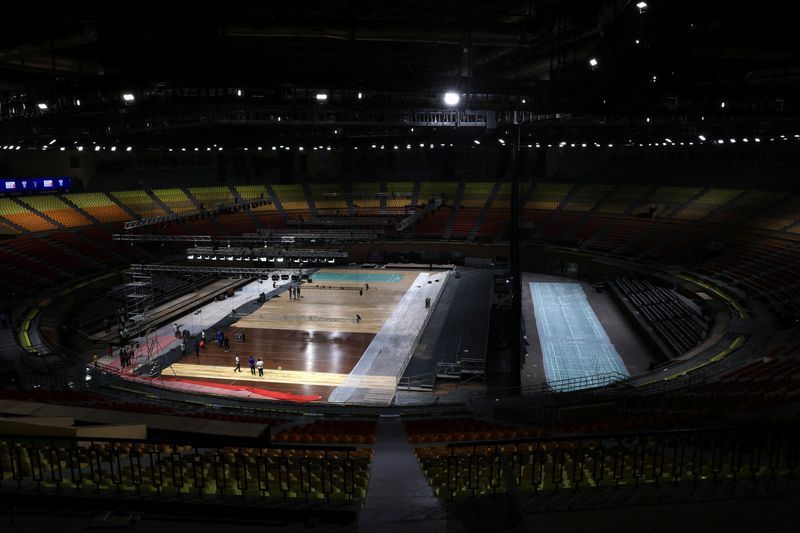
The Badminton World Championships coming to New Delhi next week will feature an unconventional addition to its organising crew: a cadre of skilled practitioners trained in the art of imitating langur monkey calls. Their mission is straightforward but unusual—to keep the capital's troublesome rhesus monkey population at bay and prevent a repeat of the wildlife disruptions that marred an earlier tournament at the same venue. This creative solution underscores both India's determination to demonstrate its capacity as a global events host and the very real practical challenges that come with staging world-class competition in a megacity where wildlife and urban infrastructure regularly collide.
The presence of rhesus monkeys throughout India's national capital presents an ongoing headache for public authorities and private organisations alike. These primates routinely infiltrate buildings, attack pedestrians without warning, and create security concerns that disrupt normal operations. While the monkeys have become almost a fixture of Delhi's urban landscape, their unpredictability and aggression make them particularly problematic in high-profile settings where international visitors and media attention converge. The situation became embarrassingly evident during this year's Indian Open, when a monkey was spotted wandering through the spectator gallery at the Indira Gandhi Indoor Stadium, forcing the Badminton Association of India to confront the institutional failure to maintain a controlled environment befitting world-class competition.
The solution adopted by tournament organisers draws on a traditional understanding of primate behaviour and ecology. Langurs, larger primates with distinctive black faces, naturally occupy a higher position in the local monkey hierarchy, and their presence—or even the mimicry of their alarm calls—proves remarkably effective at deterring rhesus monkeys from entering particular spaces. This predator-prey dynamic has been systematised in India's government offices for years, where langur deployment has become a standard, if unorthodox, pest management strategy. The Badminton World Federation event organisers have taken this principle further by hiring specialist mimics whose ability to reproduce langur vocalisations with authentic precision can maintain an invisible but effective perimeter around the stadium.
Zafar, one of the contracted mimics, represents a dying lineage of specialists. As a third-generation monkey whisperer, he embodies knowledge passed down through family and experience rather than formal training programmes. During a media demonstration at the stadium, Zafar showcased his hooting abilities, explaining that the approach prioritises displacement rather than harm. His philosophy reflects a broader ethical framework that recognises the monkeys as inhabitants of Delhi deserving coexistence rather than elimination. By making spaces unwelcoming through acoustic mimicry, organisers achieve their security objectives without resorting to cruel or violent measures. For Zafar and his peers, this balance between human event management needs and animal welfare forms the ethical foundation of their work across various government offices and now, prominently, at an international sporting showcase.
However, the monkey challenge represents only part of a larger wildlife management puzzle that Indian organisers must solve. An equally vexing problem stems from Delhi's burgeoning pigeon population, which has created distinct public health and operational concerns at the stadium. During the Indian Open tournament held earlier this year, the birds caused multiple match interruptions, with players reporting contamination of the playing court and raising legitimate hygiene worries. The situation became serious enough to warrant intervention, forcing tournament officials to acknowledge that the venue could not meet international standards without addressing the avian problem comprehensively.
To combat the pigeon infestation, organisers have applied a non-toxic gel across the stadium's roof and ducting systems. This substance, routinely deployed on railway infrastructure throughout India, discourages roosting without poisoning or killing the birds. The approach mirrors the langur-call strategy: it prioritises deterrence and coexistence over culling. Nevertheless, the sheer scale of Delhi's pigeon population means that multiple interventions and sustained effort remain necessary to maintain hygiene standards and ensure matches proceed without environmental disruptions. The combination of monkey whisperers and anti-roosting gels represents a distinctly Indian approach to reconciling world-class sporting infrastructure with an urban ecosystem that refuses to be neatly controlled.
The Badminton Association of India, stung by the earlier Indian Open difficulties, has publicly committed to resolving these issues before the world championships commence. BAI secretary general Sanjay Mishra stated that lessons learned from the previous tournament have been systematically addressed, with India's sports ministry investing substantially in facility improvements. According to Mishra, the Badminton World Federation has validated these efforts, expressing satisfaction with current arrangements and demonstrating confidence in the venue's readiness to host the prestigious event. This endorsement carries significant weight, as international sports federations jealously guard their reputational interests and would not certify a venue they deemed compromised by organisational or environmental failings.
India's attention to these details reflects a broader strategic calculation. The nation currently holds the hosting rights for the 2030 Commonwealth Games and is actively bidding for the 2036 Olympic Games. Each major international sporting event represents an opportunity to demonstrate organisational competence, infrastructure quality, and the ability to manage complex logistics at a world standard. A successful Badminton World Championships, free from animal disruptions or hygiene scandals, sends powerful signals to the International Olympic Committee and Commonwealth Games Federation about India's capacity to deliver on far more demanding undertakings. Conversely, repeated failures would invite questions about whether India's sporting infrastructure and operational systems can genuinely support the Olympics, which would constitute a far greater reputational and financial investment.
The monkey-whisperer solution also reflects deeper truths about hosting major events in densely populated developing-world cities. New Delhi, like many Asian megacities, exists in perpetual negotiation between human ambitions and natural systems that refuse simple boundaries. Unlike purpose-built Olympic venues in controlled environments, the Indira Gandhi Indoor Stadium operates within an urban ecology that includes multiple competing claims on space and resources. Rhesus monkeys, pigeons, and countless other species form part of Delhi's actual operating environment, not peripheral concerns that can be solved through infrastructure alone. Organisers cannot simply fence out nature; they must manage it through creative, culturally-grounded, and often improvised techniques.
The deployment of monkey whisperers at the Badminton World Championships thus transcends the specific logistics of one tournament. It exemplifies how India approaches the challenges of integrating into global sporting infrastructure networks while working within distinctly local constraints and ecological realities. The success or failure of these efforts will reverberate across the wider conversation about whether India can realistically host the Olympics, and what accommodations and innovations will be necessary if it does. For the badminton players arriving in New Delhi next week, the monkey whisperers working invisibly beyond the stadium will represent just one of many unconventional solutions that make this tournament possible—a peculiarly Indian approach to ensuring that world-class sport can unfold despite, and perhaps because of, the messy realities of hosting in one of the world's largest and most complex cities.

