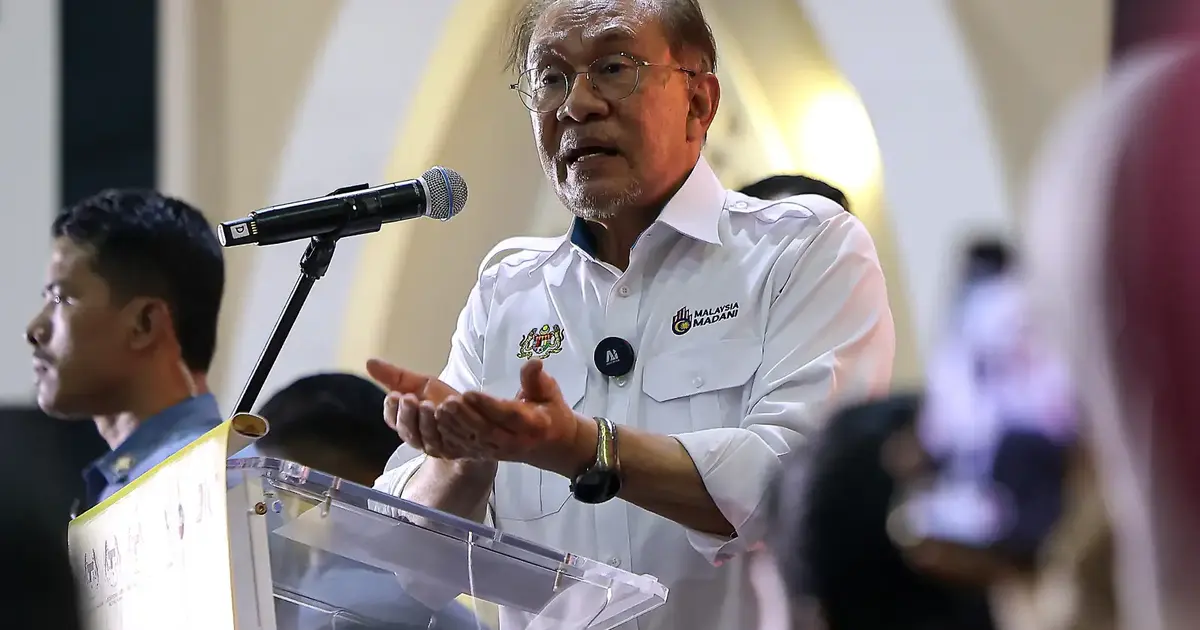
Prime Minister Anwar Ibrahim has moved to allay concerns among Malay and Muslim communities, asserting that the government's commitment to safeguarding the rights of Chinese and Indian citizens poses no threat to Islam's constitutional standing or the special position of Malays enshrined in the country's founding document. His remarks tackle a recurring source of friction in Malaysian politics, where debates over minority protections often provoke anxiety about whether such measures erode historical social contracts.
Anwar's intervention reflects a delicate balancing act that successive Malaysian governments have attempted to navigate, particularly as the nation's political landscape has grown more polarised. The Prime Minister sought to frame minority rights protection not as a zero-sum competition with Malay-Muslim interests, but rather as complementary objectives that can coexist within Malaysia's constitutional architecture. This framing represents an attempt to convince sceptics that inclusive governance does not require dismantling the foundations laid out in Article 153 of the Federal Constitution, which grants special privileges to the Malay-Muslim majority.
The constitutional position that Anwar referenced carries significant weight in Malaysian politics and law. Article 153 guarantees the sovereignty of the Malay rulers, Islam's position as the federation's religion in nine states, and Malay and Bumiputera privileges in education, employment, and business licensing. These provisions have remained largely sacrosanct across decades of political change, defended by courts and invoked frequently in public discourse. Any perception that these safeguards are being eroded tends to trigger fierce resistance from Malay-Muslim constituencies, making Anwar's reassurance particularly important given his coalition government's diverse composition.
The timing and context of Anwar's statement carry significance for Malaysia's evolving social compact. His administration has sought to position itself as a reformist government capable of addressing grievances across all communities while maintaining institutional continuity. This requires navigating treacherous political terrain where even symbolic gestures towards minority communities can be weaponised by opposition figures claiming that Malay-Muslim interests are being sacrificed. By explicitly stating that protecting Chinese and Indian Malaysians does not necessitate abandoning constitutional provisions for Malays, Anwar attempts to pre-empt such accusations.
The relationship between majority protections and minority rights in Malaysia remains among the nation's most sensitive governance questions. The 1957 social contract, expressed through the Constitution, represented a bargain whereby Chinese and Indian communities accepted Malay-Muslim constitutional privileges in exchange for citizenship rights and freedom of religion and language. Successive governments have invoked this arrangement to justify asymmetrical treatment, though interpretations have varied considerably. What constitutes genuine protection of minority rights versus what represents erosion of the social contract remains contested terrain, with different political actors offering sharply divergent readings.
Anwar's statement also reflects practical political pressures facing his government. The Pakatan Harapan coalition includes the Democratic Action Party, which draws heavily from non-Malay communities and has historically advocated for secular governance and equal citizenship principles. Simultaneously, the coalition includes the Amanah party and independent lawmakers who command support from Malay constituencies. Balancing these constituencies requires messaging that neither alienates urban, plural-minded voters nor triggers backlash from communities perceiving threats to Malay-Muslim interests.
The economic dimensions of this debate deserve consideration alongside its constitutional aspects. Persistent disparities in wealth distribution, educational access, and economic opportunity across ethnic lines create genuine grievances within Chinese and Indian communities. Addressing these inequities through targeted policies or reformed meritocratic systems becomes politically fraught when framed against the backdrop of constitutional privileges. Anwar's approach suggests that expanding opportunities for all Malaysians need not require dismantling existing protections, though critics across both sides question whether such expansion is practically achievable within the current framework.
International dimensions also influence this discourse. As Malaysia positions itself within ASEAN and on the global stage, perceptions of how effectively the nation protects minority rights affect its international standing and diplomatic relationships. Various international human rights mechanisms have scrutinised Malaysian practices regarding freedom of religion, freedom of expression, and equal citizenship. These external pressures, while sometimes resented domestically, create incentives for Malaysian leaders to demonstrate commitment to minority protections.
The broader challenge facing Anwar and his government involves reconceptualising how Malaysia understands its foundational bargain. Rather than treating Malay-Muslim constitutional positions and minority rights protections as inherently zero-sum, this perspective attempts to argue they can reinforce each other. A state that genuinely protects all communities' fundamental freedoms and rights could be understood as actually strengthening rather than weakening the framework that guarantees Malay-Muslim constitutional standing. This intellectual reframing, if it gains traction, could reshape Malaysian political discourse, though entrenched positions on both sides suggest significant obstacles to acceptance.
Moving forward, the practical test of Anwar's rhetoric will come through concrete policy implementation. Whether his government can deliver improved protections and expanded opportunities for minority communities while maintaining institutional features that secure Malay-Muslim constitutional positions will determine whether this framework proves viable. The coming months and years will reveal whether such balance is achievable or whether Malaysia remains locked in cyclical debates where gains for one community are perceived as losses for another.

