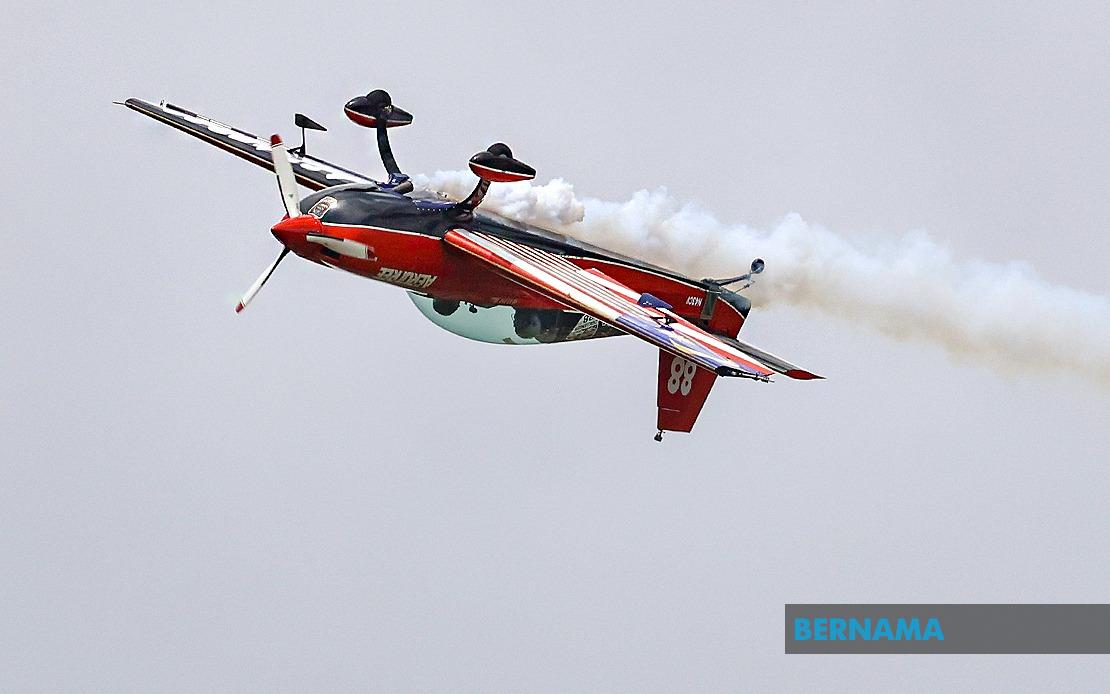
Putrajaya witnessed the debut of a spectacular new National Day tradition on August 30 as retired Royal Malaysian Air Force fighter pilot Major Datuk Halim Othman, 60, commanded centre stage with a solo twilight aerobatic performance that combined high-precision flying with pyrotechnics and smoke displays against the tropical sunset. The inaugural 'Merdeka Sunset Show: Melukis Senja' marked a significant moment in Malaysia's 69th National Day celebrations, bringing international-standard aerial choreography to the nation's premiere civic venue.
Halim's presence at the helm of this historic display underscores the calibre of aviation talent Malaysia has cultivated over recent decades. With four decades of professional flying experience, including a distinguished military career spanning fighter operations and advanced aerobatic disciplines, he has established himself as one of Southeast Asia's most accomplished aviators. His credentials extend beyond local boundaries—he remains the sole Malaysian pilot to have qualified for the prestigious Red Bull Air Race World Championship, an achievement that positions him among an elite global cadre of extreme aviation performers.
The seven o'clock performance represented more than mere entertainment value. Aerobatic flying, as Halim emphasises, demands a synthesis of technical mastery, physical courage, and profound comprehension of aircraft dynamics operating at the absolute margins of capability. The precision required to execute complex manoeuvres while coordinating smoke effects and pyrotechnics with sunset timing speaks to years of disciplined preparation and iterative refinement. The performance concept itself draws lineage from last year's maiden 'Melukis Senja' display held at Chenang during the Langkawi International Maritime and Aerospace Exhibition, suggesting the growth of these spectacles into established fixtures within Malaysia's aerospace calendar.
Halim's competitive racing history carries particular significance for Malaysian aviation. His campaigns in the Red Bull Air Race World Championship positioned him against predominantly European and North American pilots operating at the absolute pinnacle of aerobatic competition. Rather than viewing this as daunting, he channelled the experience into demonstrating that Malaysian pilots possess equivalent technical capabilities and competitive edge. This perspective proves crucial for understanding his contemporary advocacy roles—he consciously frames his performances as testaments to Malaysian potential rather than merely individual achievement.
Beginning his aviation journey in 1985 as an RMAF fighter pilot, Halim progressed through successive tiers of specialisation and responsibility. His 'Top Gun' designation reflects exceptional performance metrics within military training hierarchies, while his subsequent diversification into aerobatic flying and international racing demonstrates adaptability across aviation disciplines. The aircraft types he has commanded present a chronology of technological progression: the sophisticated MiG-29N and F/A-18D Hornet represent modern high-performance platforms, whilst the A-4 Skyhawk and F-5E Tiger reflect earlier generation combat systems with their own demanding flight characteristics. His civilian portfolio including Learjet and King Air operations shows competency across the broader aviation spectrum.
Beyond individual achievement, Halim's institutional contributions have shaped Malaysia's aerobatic landscape materially. As founder and president of Aerotree Defence and Services, he established Krisakti, Malaysia's inaugural official aerobatic display team, which debuted at LIMA 2011. This represented a watershed moment for Malaysian aviation—the formalisation of aerobatic excellence into an organised, recurring capability. The team brought Malaysian aerial proficiency before international audiences at one of Asia's premier aerospace forums, creating visibility for domestic aviation talent.
Looking forward, Halim has unveiled plans to expand Malaysia's aerobatic footprint significantly. A new aerobatic team featuring six aircraft equipped with coloured smoke systems represents scaling from the solo performances that have characterised recent displays. This expansion carries logistical, financial, and training implications: maintaining six advanced aerobatic aircraft to competition standards, training pilots to synchronised formation aerobatic levels, and executing coordinated smoke sequences demand sustained institutional commitment and resource allocation. The stated integration of these teams into future National Day celebrations and LIMA events indicates governmental and aerospace industry backing for this expansion.
The positioning of these initiatives under Aerotree's corporate social responsibility framework reflects evolving attitudes toward aerospace careers and youth engagement in Malaysia. By linking high-profile aerobatic performances to explicit mentoring and inspiration objectives, Halim positions aviation not as remote elite activity but as accessible career path for motivated younger Malaysians. This messaging proves particularly resonant in Southeast Asian context where aerospace sectors remain underdeveloped relative to economic sophistication. Visible demonstrations of Malaysian excellence at international standards can meaningfully shift perceptions among potential aviation professionals.
The Merdeka Sunset Show itself crystallises several contemporary themes within Malaysian national identity and civil society. National Day celebrations have historically emphasised military pageantry and cultural displays; the introduction of sophisticated aerial performances brings technological and modern dimensions into this traditional framework. The deliberate choice of sunset timing and artistic nomenclature—'Melukis Senja' translates loosely to 'painting twilight'—suggests sophisticated curatorial intent beyond straightforward military spectacle. This represents cultural evolution within national celebrations toward greater artistic ambition.
For Malaysia's broader aerospace aspirations, Halim's leadership of these initiatives carries strategic weight. The nation harbours ambitions within aerospace manufacturing, maintenance, and professional services, yet often struggles with human capital limitations and limited visibility for domestic aviation excellence. Performances that capture international-standard technical proficiency create soft power benefits whilst demonstrating to younger generations that aerospace careers can lead toward authentic competitive distinction rather than merely technical employment.
The forty-year timeline spanning Halim's career encompasses fundamental transformations within global aviation. He has adapted across generational aircraft, competitive formats, and operational environments—a flexibility that itself constitutes remarkable achievement. His evolution from military fighter pilot to international racing competitor to institutional leader and mentor reflects career trajectory possibilities that extend beyond traditional military progression, potentially inspiring alternative pathways for younger Malaysian aviators.
As Malaysia progresses toward its centennial and beyond, the quality of national representation in technical and athletic domains increasingly reflects overall developmental status. Halim Othman's performances, whether solo or coordinating team formations, contribute tangibly to this representation whilst simultaneously building institutional capacity for sustained excellence. The Merdeka Sunset Show succeeds not merely as spectacle but as symbol of Malaysian aviation capability matured to internationally competitive standards.

