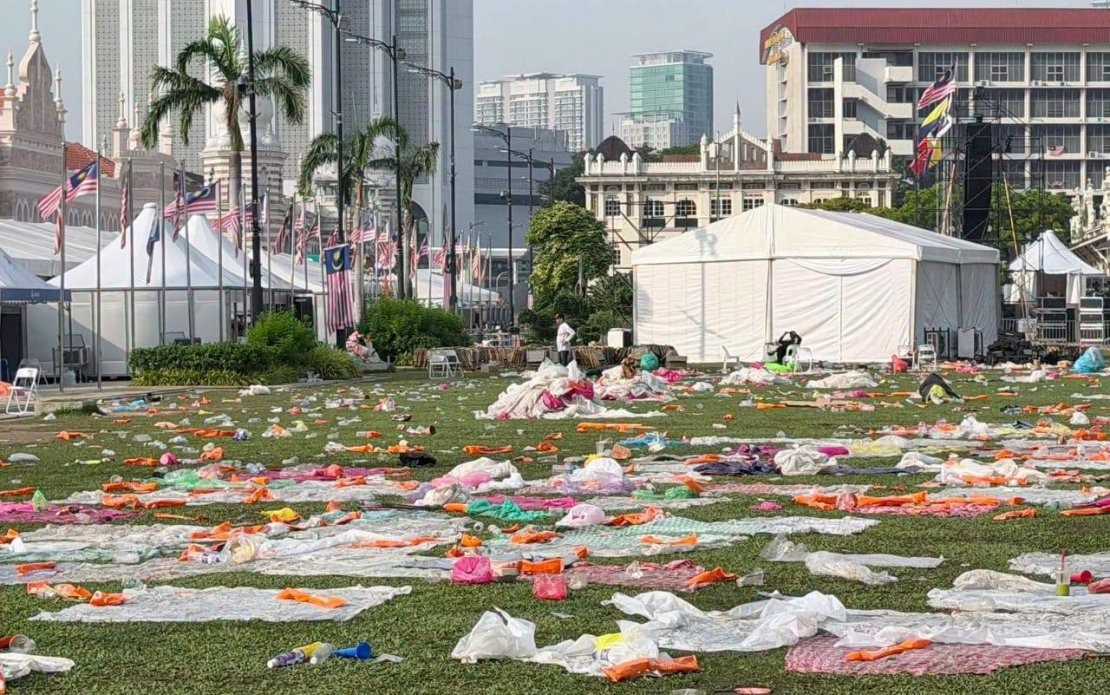
Kuala Lumpur City Hall (DBKL) has mobilised its cleaning teams to address the extensive littering at Dataran Merdeka, one of Malaysia's most significant national landmarks, following an outdoor screening of the 2026 FIFA World Cup final between Spain and Argentina in the early hours of July 20. The event drew more than 25,000 football enthusiasts to the open-air venue, creating an impromptu mass gathering that concluded with the ground strewn with discarded materials and waste left by departing crowds.
The situation at Dataran Merdeka has prompted a broader conversation about public responsibility and civic behaviour in Malaysia's capital city. DBKL's response has extended beyond merely announcing a remedial cleaning operation; the municipal authority issued a public statement that carries an unmistakable message of disappointment regarding how citizens have treated a space of profound historical and cultural importance. The authority's messaging reflects frustration with what officials view as a disconnect between the freedom to celebrate and the corresponding obligation to maintain shared public spaces.
In its Facebook announcement, DBKL articulated a position that distinguishes between the legitimate joy of large public gatherings and the inappropriate aftermath of irresponsible disposal of waste. The authority emphasised that while thousands of people had gathered to experience collective excitement around the World Cup final—an understandable exercise in shared sporting enthusiasm—the manner in which attendees departed revealed troubling attitudes toward communal stewardship. This framing positions the cleanup as symptomatic of deeper issues relating to how Malaysians value and maintain their public infrastructure.
The symbolic dimension of the incident cannot be overlooked. Dataran Merdeka holds profound significance as the birthplace of Malaysia's independence and remains a repository of national memory and identity. DBKL's statement explicitly references this heritage, arguing that the physical condition of the space reflects broader respect for the nation's values and history. By extension, the casual littering by World Cup viewers became more than a sanitation problem; it represented, in DBKL's analysis, a failure to honour the historical dignity embedded in the location itself.
The scale of the event—attracting over 25,000 spectators—presents both operational and governance challenges that extend beyond simple cleanup protocols. Managing such large spontaneous gatherings at heritage sites requires coordination between municipal services, traffic management, and waste collection infrastructure. The fact that inadequate provision appears to have been made for rubbish disposal during and after the event raises questions about advance planning and resource allocation for major public events in Kuala Lumpur.
DBKL's public messaging strategy appears designed to cultivate a shift in civic consciousness among Kuala Lumpur residents. Rather than positioning the authority merely as a service provider that will rectify problems created by the public, DBKL has cast itself as guardian of the capital's dignity and as an institution that cannot function effectively without corresponding responsibility from residents themselves. This rhetorical approach suggests that municipal authorities recognise the limitations of reactive cleanup efforts without corresponding behavioural change among the population.
The incident also underscores broader patterns of public behaviour at mass events in Malaysia and Southeast Asia more generally. Major sporting broadcasts, concerts, and cultural gatherings frequently generate substantial waste management challenges, yet systematic efforts to embed waste consciousness at such events remain inconsistent. The successful management of large public assemblies requires coordinated action: provision of adequate waste receptacles, clear signage regarding disposal expectations, and perhaps most importantly, cultural norms that stigmatise littering in shared spaces.
For Malaysia's urban governance, the Dataran Merdeka incident provides a lens through which to examine the relationship between city authorities and residents. While DBKL has committed to conducting the cleanup—thereby fulfilling its municipal obligations—the authority's pointed commentary suggests frustration with what it perceives as one-directional responsibility. This tension reflects broader global challenges in urban management, where the success of public spaces depends on reciprocal commitments from both government institutions and citizens.
The 2026 FIFA World Cup final broadcast also served as an inadvertent stress test for Kuala Lumpur's capacity to accommodate large spontaneous public gatherings. The fact that 25,000 people converged on Dataran Merdeka without apparent advance coordination demonstrates the appeal of centralised public venues for major events. Yet the aftermath reveals that infrastructure and cultural practices have not evolved in parallel with the appetite for such mass assemblies. If Kuala Lumpur is to position itself as a global city capable of hosting major events, both in official capacities and through spontaneous public engagement, the management of waste and the cultivation of civic responsibility must be treated as integral to the experience.
Looking forward, the incident suggests opportunities for DBKL and broader city authorities to develop more sophisticated approaches to public event management. This could include establishing temporary waste management systems tailored to expected crowds, implementing public education campaigns that frame waste disposal as an expression of national pride, and creating social incentives for responsible behaviour at public gatherings. Such measures would move beyond reactive cleaning protocols toward proactive systems that embed environmental responsibility into the experience of public celebration.
The World Cup final broadcast at Dataran Merdeka ultimately reveals the gap between Malaysia's aspirations as a modern, organised city-state and the reality of implementing consistent civic practices across a diverse urban population. While DBKL's cleanup response is necessary and appropriate, the underlying message from the authority—that public cleanliness and the preservation of heritage sites cannot rest solely on municipal workers—represents a call for collective reassessment of how Malaysians inhabit and value their shared spaces. The condition in which citizens leave public venues, particularly those of historical significance, becomes an expression of broader commitments to national stewardship and collective wellbeing.

