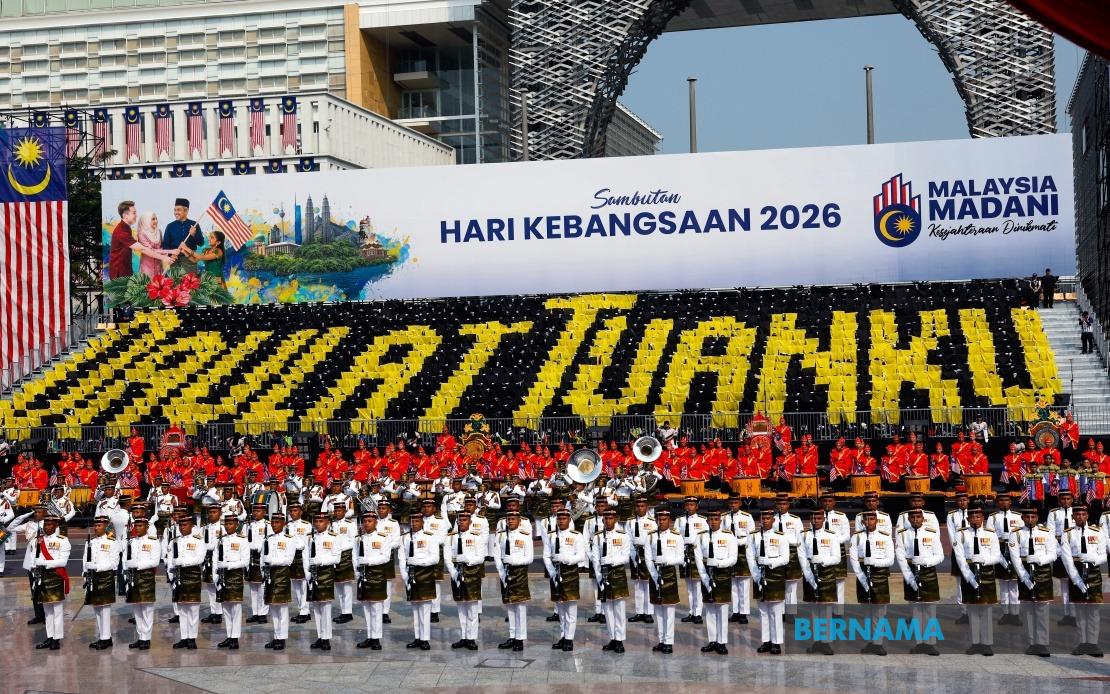
Tomorrow's 69th National Day celebration at Dataran Putrajaya promises to be a spectacular display of national pride and unity, with organisers preparing an ambitious programme that will draw thousands of participants and showcase Malaysia's cultural diversity, economic progress, and defence capabilities. The event, beginning at 8:00 am, carries the thematic underpinning of "Malaysia MADANI: Kesejahteraan Dinikmati" and will feature His Majesty Sultan Ibrahim, King of Malaysia, and Her Majesty Raja Zarith Sofiah, Queen of Malaysia, alongside Prime Minister Datuk Seri Anwar Ibrahim and Cabinet members in an atmosphere designed to reinvigorate patriotic sentiment across the nation.
The scale of tomorrow's gathering underscores the government's commitment to staging a comprehensive national ceremony that engages citizens from multiple sectors and backgrounds. The parade itself will deploy 10,819 participants distributed across 76 distinct contingents, supplemented by 22 marching bands and an array of specialised assets including 328 military and civilian vehicles spanning land, naval, and air operations. The inclusion of 112 working animals and 22 electric vehicles demonstrates an effort to balance traditional symbolism with contemporary environmental consciousness, reflecting broader national priorities around sustainability and technological advancement.
The opening performance, titled "Gema Inovasi MADANI" and coordinated by the National Department for Culture and Arts, will establish the thematic foundation through an innovative fusion of traditional instrumentation and modern artistic presentation. This segment will mobilise 150 musical instruments and 700 traditional kompang frame drums, each percussion element representing Malaysia's principal ethnic communities and embodying the values of harmony, well-being, and collective national identity. The deliberate weaving of cultural heritage with innovation through this performance illustrates how contemporary Malaysia seeks to honour its past whilst embracing forward-looking development narratives.
The substantive parade content has been structured into four thematic components that collectively narrate Malaysia's contemporary governance priorities and achievements. The statehood segment will feature prominent military and paramilitary organisations including contingents from the National Resilience Leadership Academy and the National Defence University of Malaysia, alongside graduates of the National Service Training Programme, visibly demonstrating the institutional frameworks through which national cohesion and sovereignty are maintained. This militaristic presentation, balanced with civilian participation, reflects the state's emphasis on security and institutional discipline as foundational to national well-being.
The sports and well-being component will provide a platform for national athletes and medal-winners from the upcoming Glasgow 2026 Commonwealth Games, positioning sporting excellence as a mechanism through which Malaysia projects national capability and pride internationally. This forward-looking inclusion acknowledges how contemporary nations leverage athletic achievement as soft power and inspiration for younger generations, whilst simultaneously grounding such aspirations in concrete, measurable accomplishment. The presence of these athletes transforms the parade from a purely ceremonial event into a performance that connects tangible national achievement to patriotic emotion.
Economic participation and public service capacity form equally substantive elements of tomorrow's procession, with the well-being and economy component drawing together diverse commercial enterprises including Munchy's Malaysia, ZUS Coffee, MR. D.I.Y Group, and financial institutions like Carsome Sdn Bhd. This private-sector integration reflects the Malaysia MADANI framework's emphasis on shared prosperity and public-private collaboration in advancing national welfare. Simultaneously, the public order component featuring the Malaysia Civil Defence Force, Road Transport Department, and Malaysian Fire and Rescue Department underscores the institutional machinery through which the state ensures citizen security and daily functionality.
A particularly distinctive element of tomorrow's celebration involves the presentation of Malaysia Airlines, AirAsia, Batik Air, and Air Borneo as strategic national partners whose participation visibly demonstrates the centrality of aviation and connectivity to Malaysia's economic identity and regional positioning. The prominence afforded to these carriers reflects the country's historical dependence on air transport infrastructure and its aspirations for Malaysia to function as a regional aviation hub. Additionally, the floats dedicated to the Visit Malaysia Year 2026-2027 campaign will present regional tourism assets, traditional materials, and ethnic cultural expression, deliberately commodifying national heritage as an economic proposition whilst reaffirming cultural distinctiveness.
Younger citizens will encounter representation through the participation of animation studio Les' Copaque and their characters Upin and Ipin, a strategic decision recognising how contemporary national celebrations must engage multiple demographic cohorts through culturally resonant imagery. The human graphics performance, coordinated by 1,500 students from 36 Selangor schools, similarly positions youth as active agents in national ceremonial expression rather than passive observers, fostering participatory investment in national identity formation. This pedagogical dimension transforms the parade into a vehicle for civic education and emotional attachment to national symbolism.
The airshow constituting the celebration's climax will feature Royal Malaysian Air Force fighter jets conducting aerial manoeuvres above Putrajaya's administrative precincts, a deliberate projection of national military capability and state power that resonates with regional defence competitions and demonstrates technical sophistication to domestic and international audiences. The decision to position military display as the ceremonial conclusion rather than an opening flourish emphasises how national defence capacity represents the ultimate guarantor of the prosperity and cultural flourishing celebrated throughout the preceding programme. This sequencing carries particular significance given Malaysia's maritime strategic location and ongoing regional security considerations.
The thematic musical anchor for tomorrow's celebration, the National and Malaysia Day 2026 song "Aku Berjanji" composed and performed by renowned singer Faizal Tahir, will inject emotional resonance and facilitate collective emotional engagement with abstract national concepts. The choice of an established popular musician rather than a ceremonial or institutional performer reflects contemporary approaches to patriotic expression through mainstream cultural figures rather than state-authorised artistic institutions, making national sentiment commercially and culturally accessible to broader audiences.
Practical considerations surrounding air quality have necessitated precautionary health measures, with the Communications Ministry advising visitors to wear N95 face masks in response to current regional haze conditions. The distribution of masks to over 10,000 parade participants represents a pragmatic recognition of how environmental factors intersect with public health and the logistical requirements of staging mass gatherings. This adaptation demonstrates how even ceremonial national events must accommodate contemporary environmental realities affecting Southeast Asia's urban centres.
Operational logistics have prompted comprehensive road closures across Putrajaya's core administrative zone, affecting five major bridge systems including Seri Wawasan, Seri Saujana, Seri Gemilang, Putra, and Seri Ehsan bridges, alongside surrounding arterial routes. The Ministry of Home Affairs advisory recommending public transport utilisation reflects urban planning challenges inherent in staging large-scale national ceremonies within densely built administrative environments. Closure periods extending from August 30 at 5:00 am through August 31 at 6:00 pm will necessitate substantial route adjustments for workers and residents ordinarily traversing these zones, illustrating how national ceremonial events impose significant coordination demands on urban infrastructure and daily operational rhythms.

