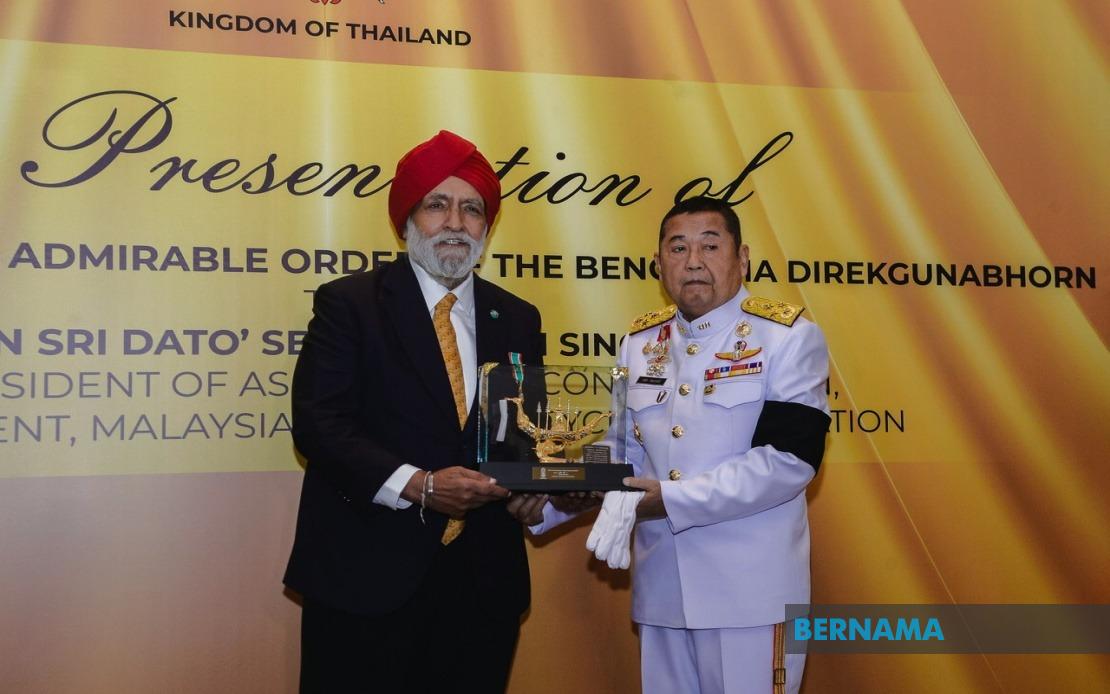
Tan Sri Darshan Singh Gill, a towering figure in Malaysian and Asian cycling administration, has been bestowed one of Thailand's most prestigious royal honours in recognition of his transformative contributions to the sport. The decorated administrator received The Most Admirable Order of the Direkgunabhorn (Fifth Class - Benjama Direkgunabhorn), a distinction originally conferred by the late King Bhumibol Adulyadej The Great, Rama IX. The presentation took place here on August 6, with the honour being formally delivered by ACC senior vice-president General Decha Hemkasri, acting under royal patronage.
The significance of this Thai royal recognition extends beyond personal accolade, serving as testimony to the influence wielded by Malaysian cycling administrators within regional and international sporting circles. During his tenure as Malaysian National Cycling Federation president from 1988 to 1990, and subsequently as Asian Cycling Confederation president from 1996 to 2005, Darshan Singh spearheaded initiatives that elevated the sport's profile across the continent. His nine-year leadership of the ACC placed him at the forefront of decisions shaping competitive cycling throughout Asia, a period marked by institutional strengthening and expanded participation across member nations.
Darshan Singh articulated the broader implications of the honour during media remarks following the ceremony, framing it as validation not merely of his personal journey but of Malaysia's trajectory as a serious cycling nation. He emphasised that the recognition reflects a continuum of achievement spanning decades, from the pioneering performances of earlier cyclists to contemporary international successes. This historical perspective grounds the award within a narrative of sustained institutional development rather than isolated accomplishment, demonstrating how individual contributions build upon predecessors' legacies.
The administrator drew particular attention to Malaysia's current cycling representatives at the highest echelons of international sport. Datuk Mohd Azizulhasni Awang's recent triumph at the Glasgow Commonwealth Games, where he secured gold in the men's keirin event at the Sir Chris Hoy Velodrome, exemplifies the calibre of athlete that Malaysian cycling now produces. This victory marked Awang's ascension to Commonwealth Games champion status after a 16-year competitive journey, underscoring both individual perseverance and the quality of development programmes that cultivated his talent. Such achievements demonstrate that Malaysia's cycling infrastructure has matured substantially since the earlier era dominated by competitors such as M. Kumaresan and Rosman Alwi.
Equally significant is the elevation of Malaysian administrative capacity within global sporting governance. Datuk Amarjit Singh Gill, the current Malaysian National Cycling Federation president, made history by becoming the first Malaysian elected as International Cycling Union vice-president. His election to this position for the 2025-2029 term, secured during the 194th UCI Congress in Kigali, Rwanda, represents a watershed moment for the nation's representation in world-level sports administration. This breakthrough signals recognition by the global cycling community that Malaysian administrators possess the expertise, vision, and diplomatic acumen required to influence policy at the international level.
Darshan Singh's observation that Malaysia's cycling sector has achieved parity with advanced cycling nations at the administrative level carries substantial implications for the sport's future development domestically and regionally. The progression from primarily producing athletes to now contributing administrators at the UCI level indicates maturation of institutional knowledge and governance capacity. This evolution allows Malaysian voices to influence rulemaking, competitive standards, and developmental initiatives affecting cycling across the globe, positioning the nation as a stakeholder in sport's global architecture rather than a passive participant.
The Thai royal recognition thus contextualises a critical juncture in Malaysian cycling history, where foundational work by administrators of Darshan Singh's generation has yielded compound returns through contemporary athlete success and institutional advancement. The deliberate construction of professional cycling administration during his tenure created pathways and protocols that subsequent generations of Malaysian sports leaders have leveraged and expanded. This long-view perspective on institutional legacy differentiates sporting administration from athlete-centred narratives, highlighting how governance decisions taken decades earlier continue shaping competitive outcomes today.
For Southeast Asian readers, the award resonates beyond Malaysia's borders, illustrating how regional sporting institutions function as platforms for national advancement and diplomatic soft power. Thailand's conferral of royal honours on accomplished administrators from neighbouring countries reflects interconnected sporting cultures and mutual recognition of contribution to regional development. The Asian Cycling Confederation, operating under Darshan Singh's leadership, functioned as a multilateral institution mediating sporting standards and competitive opportunities across dozens of nations and hundreds of millions of potential athletes.
The ceremony itself, conducted in Kuala Lumpur with high-level international representation through General Decha Hemkasri's presence, underscores the formal diplomatic dimensions of sporting recognition. Royal honours, particularly those originating from Thailand's monarchy, carry ceremonial weight that transcends sporting contexts, entering into broader narratives of regional cooperation and mutual esteem. For Malaysian policymakers and sports administrators observing the proceedings, the event communicates that excellence in sports administration commands recognition and respect comparable to achievement in traditional diplomatic or governmental domains.
Looking forward, Darshan Singh's recognition contextualises expectations for continued Malaysian advancement within cycling's international hierarchy. The combination of emerging athletic talent like Mohd Azizulhasni Awang's Commonwealth Games success and administrative representation through Amarjit Singh Gill's UCI vice-presidency creates synergies whereby governance decisions increasingly reflect Malaysian perspectives and priorities. This dual advancement—in athlete development and administrative influence—positions Malaysia to shape cycling's future direction across Asia and potentially globally.
The award also affirms that institutional memory and historical perspective matter in sports administration. Darshan Singh's visible connection to current successes through his foundational work demonstrates that cycling's development results from sustained commitment across generations rather than episodic achievements. Future administrators inheriting frameworks he helped establish can build upon tested structures, avoiding redundant institution-building and instead concentrating on strategic enhancement. This continuity represents a form of administrative capital accumulation that benefits Malaysia's sporting sector broadly.
Ultimately, the bestowal of Thailand's Most Admirable Order of the Direkgunabhorn represents recognition that Malaysian cycling has transcended narrow sporting boundaries to become an instrument of national achievement, regional cooperation, and international representation. Darshan Singh's decoration honours not only past service but implicitly validates current trajectories and encourages future Malaysian leaders to pursue comparable excellence in sporting administration. For a nation of Malaysia's size and resources, influence within global sporting governance represents a form of international standing that complements traditional diplomatic channels.

