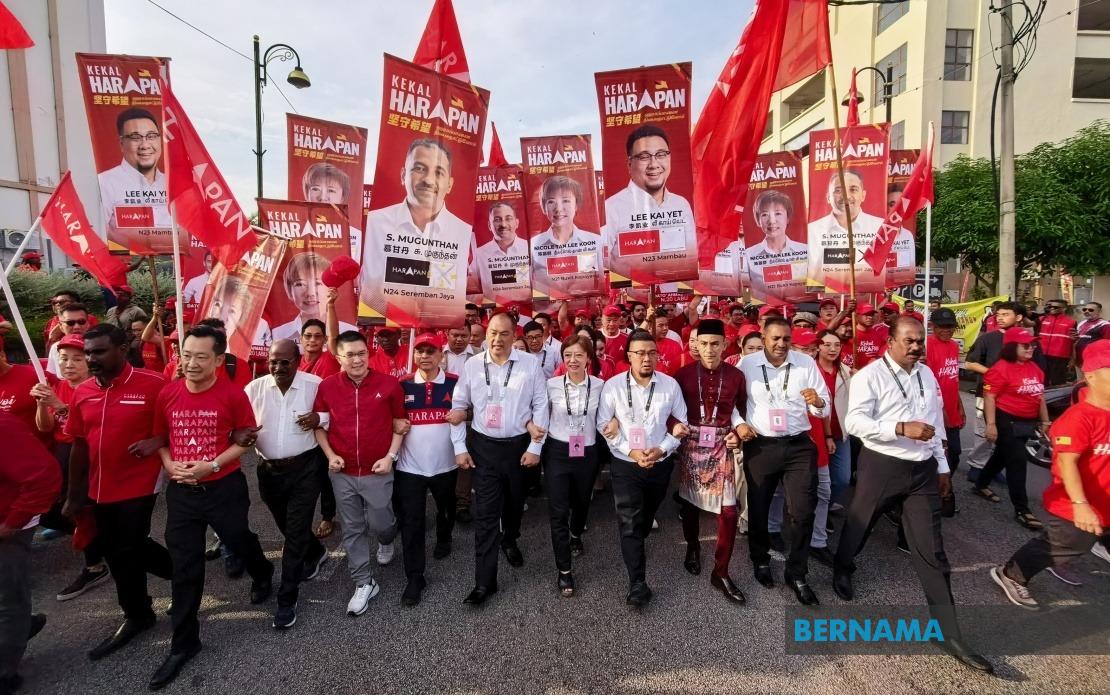
Negeri Sembilan's political landscape is set for a competitive showdown as the 16th state election takes shape, with the Rahang constituency emerging as a particularly contested battleground. Siaw Meow Keong, the DAP treasurer for the state, will seek to retain his seat following his 2023 victory, but he faces a formidable four-cornered challenge that reflects the fractured state of Malaysian politics. The returning officer, Mohamad Najib Mustafa, confirmed the nomination details at the Seremban City Council Hall following the completion of the nomination process, setting the stage for what promises to be a closely-watched constituency race.
The composition of candidates vying for Rahang reveals the diversity of political forces competing for voter support in the state. Siaw carries the banner of Pakatan Harapan, the ruling federal coalition that has adopted him as their defensive candidate for the seat. Challenging him from the establishment is Yap Siok Moy, the Rasah MCA Wanita chief representing Barisan Nasional, Malaysia's veteran opposition alliance. The field expands further with S. Thinagaran contesting under the banner of Parti Sosialis Malaysia, while Tang Jay San represents Bersatu, the Malay-majority party that has navigated a complex political journey over recent years. This constellation of candidates underscores the multi-dimensional competition that now characterises state-level politics in Negeri Sembilan, where traditional coalitions face pressure from newer political formations.
The nomination process itself unfolded in a manner typical of Malaysian electoral contests, with candidates filing their papers in rapid succession. Thinagaran was first to submit his nomination documents at 9.06 am, followed closely by Tang at 9.10 am and Siaw at 9.12 am. Yap completed the set by submitting her papers at 9.13 am, with all four candidates meeting the deadline before the one-hour nomination window closed at 10 am. The tight temporal clustering of submissions reflects the organized nature of Malaysia's electoral machinery, where nomination deadlines concentrate candidate registrations into a narrow timeframe.
Elsewhere in Negeri Sembilan, the electoral picture presents varying degrees of competition. The Bukit Kepayang constituency will witness a straight contest between two candidates, reducing the complexity that characterizes races like Rahang. Nicole Tan Lee Koon, the DAP Wanita chief who currently represents the seat, will defend her position against Lee Boon Shian fielded by Perikatan Nasional. This binary contest contrasts sharply with the multi-cornered fights occurring in other parts of the state, suggesting that some constituencies have managed to consolidate support around fewer political alternatives.
Three-cornered contests feature prominently across several constituencies, indicating a pattern of political consolidation that has narrowed but not eliminated competition in many areas. The Labu constituency will see Datuk Ahmad Faez Abdul Razak of Pakatan Harapan face Mohamad Hanifah Abu Baker representing Bersatu and Siti Nur Umaira Hasim contesting for Barisan Nasional. In Mambau, the competition pits PH's Lee Kai Yet against Bersatu's N. Sarawanan and PN's Eric Michael. Seremban Jaya presents a three-way contest between S. Mugunthan of Pakatan Harapan, T. R. Thinalan of Barisan Nasional, and Bersatu's R. Mahendran. These multi-cornered contests suggest that while some coalitions have achieved unity, others have fractured or remain unable to present unified fronts, complicating voter choice across multiple constituencies.
The Negeri Sembilan state election represents the latest instalment in Malaysia's complex electoral calendar, with the Election Commission establishing a structured timeline for the democratic process. Early voting has been scheduled for July 28, allowing eligible voters including government employees and those unable to vote on polling day to cast their ballots in advance. The main polling day is set for August 1, providing a concentrated electoral moment for the state's voters to determine their representation at the state assembly level. This scheduling reflects the EC's ongoing efforts to balance accessibility with logistical efficiency in conducting elections across multiple constituencies.
For the DAP specifically, the Rahang seat represents an important defensive position within the state, with Siaw's tenure since 2023 demonstrating the party's competitive capacity in this constituency. The party's decision to field him again signals confidence in his local standing and the viability of maintaining this parliamentary foothold. However, the presence of a competitive MCA candidate, combined with the fragmentation introduced by PSM and Bersatu's participation, suggests that retaining the seat will require substantial voter consolidation around the Pakatan Harapan banner. This dynamic mirrors broader challenges facing the federal ruling coalition as it navigates state-level competitions where local factors and emerging political formations challenge traditional partisan alignments.
The broader Negeri Sembilan election context reflects national political trends that have reshaped the Malaysian electoral landscape over recent years. The emergence of Bersatu as a significant competitor, the continued role of Perikatan Nasional as an alternative coalition, and the persistent participation of smaller parties like PSM all indicate that Malaysian voters now operate within a more fragmented and complex political environment than existed in previous decades. For Negeri Sembilan specifically, this means that constituency-level outcomes will depend heavily on local ground dynamics and the ability of coalitions to mobilize their respective support bases. The state, with its mixed urban-rural demographic profile, offers insights into how various political forces compete for voter allegiance across different community types.
The implications of this electoral activity extend beyond Negeri Sembilan's state assembly, potentially influencing federal political calculations and the health of the ruling Pakatan Harapan coalition. Strong performances by component parties such as DAP in defensive seats strengthen their negotiating position within the coalition framework, while any losses could amplify internal coalition tensions. For Bersatu and the Perikatan Nasional alliance, state elections provide platforms to demonstrate viability and build momentum toward national-level ambitions. The results in constituencies like Rahang will therefore resonate across Malaysia's political establishment, making this state election more significant than its local nomenclature might suggest. Malaysian political observers will be monitoring whether established patterns hold or whether new configurations emerge from the August 1 polling.

