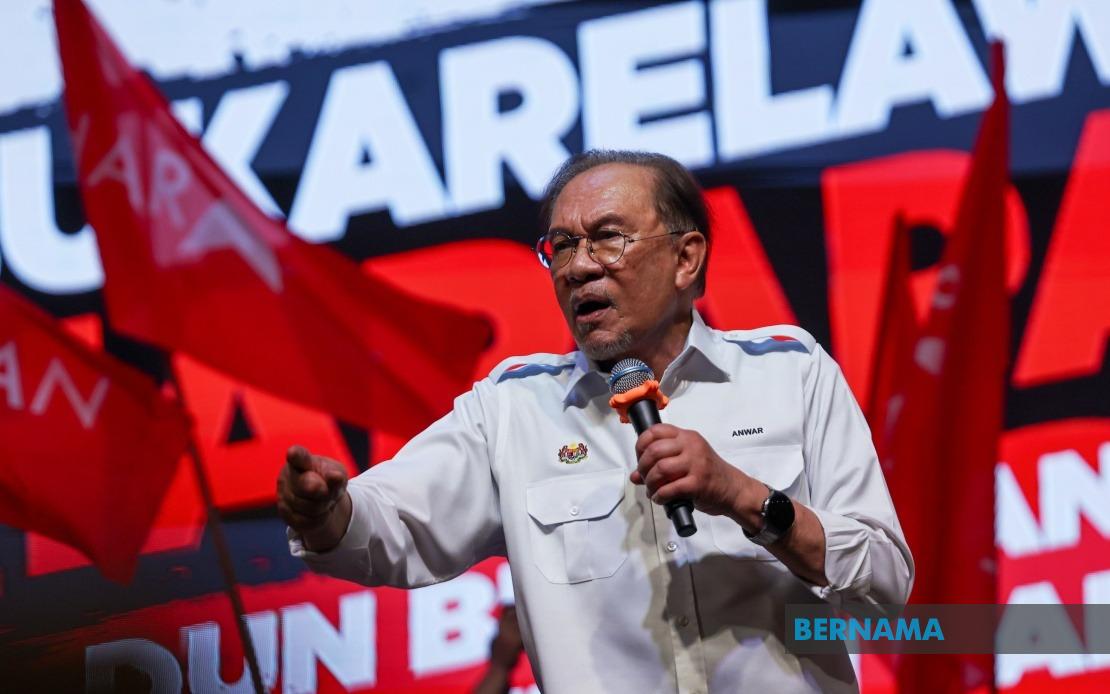
Prime Minister Datuk Seri Anwar Ibrahim has moved to counter perceptions that the Democratic Action Party harbours anti-Malay sentiment, asserting instead that the multi-ethnic coalition partner has consistently respected constitutional provisions protecting Malay and Bumiputera rights. Speaking at a public gathering in Muar, Anwar—who helms both the federal government and the Pakatan Harapan coalition—sought to dismantle what he characterized as a deliberate misrepresentation of DAP's positions by political opponents seeking to weaponize communal anxieties.
The Prime Minister offered concrete evidence to support his defence of the party's record on sensitive racial and religious matters. He highlighted DAP's acquiescence to government plans to designate 20.23 hectares in Bandar Malaysia as Malay Reserve Land, demonstrating that the predominantly Chinese-majority party does not obstruct measures enhancing Malay-Muslim interests. This example, he argued, undermines narrative framing DAP as fundamentally opposed to constitutional arrangements benefiting Indigenous communities, a charge that has surfaced repeatedly in Malaysian political discourse since the coalition's formation.
Anwar's intervention reflects the ongoing vulnerability of the Unity Government to communal polarization tactics. The Pakatan Harapan coalition, which governs in partnership with Barisan Nasional, has faced sustained criticism from opposition factions claiming that inclusive governance represents a threat to Malay-Muslim privileges. Such allegations carry particular potency in Malaysian politics, where constitutional recognition of Malay-Muslim special position remains a foundational pillar of the social contract. By explicitly defending DAP's acceptance of Malay Reserve designations, Anwar attempted to inoculate his coalition against charges of diluting constitutional protections.
Beyond addressing communal concerns, the Prime Minister articulated a broader vision of inclusive development anchored in equitable resource distribution. He outlined government commitment to expanding support for Bumiputera enterprises through increased allocations to the National Entrepreneurs Corporation, while simultaneously ensuring that assistance reaches poor communities across ethnic lines. This articulation—emphasizing simultaneous investment in Malay advancement and Chinese and Indian poverty alleviation—sought to reframe governance as fundamentally about fairness rather than zero-sum ethnic competition.
Anwar stressed that economic expansion must translate into tangible improvements in living standards rather than enriching a privileged elite. The government's development agenda, he explained, prioritizes providing affordable housing, basic infrastructure, and enhanced educational quality for all Malaysians. This emphasis on material welfare grounds his defence of multi-racial governance in the pragmatic language of economic outcomes rather than abstract principles of equality, potentially resonating with populations experiencing cost-of-living pressures regardless of ethnic background.
The Prime Minister's remarks carried an ethical dimension addressing governance integrity. He cautioned political operatives that public office constitutes a trust demanding service to the population rather than personal enrichment, suggesting that critics attacking his coalition do so to mask self-interested motives. This framing—positioning DAP and the Unity Government as motivated by genuine developmentalism while opposition figures propagate communal division for electoral advantage—attempts to reorient political discourse away from zero-sum ethnic calculations.
Anwar's intervention occurs against the backdrop of the sixteenth Johor state election, where voters will choose representatives across 56 seats on July 11, with early voting scheduled for July 7. The contest encompasses 172 candidates and represents an important electoral test for the Unity Government's viability in the southern industrial state, traditionally a Barisan Nasional stronghold. Opposition efforts to capitalize on communal anxieties surrounding DAP participation in government underscore the centrality of ethnic-religious messaging in contemporary Malaysian electoral competition.
The intensity of attacks on DAP's participation in the coalition reflects deeper structural tensions within Malaysian democracy. The party's presence in government symbolizes the possibility of power-sharing arrangements transcending ethnic boundaries—a development that challenges political actors whose constituencies depend upon zero-sum ethnic mobilization for electoral advantage. By defending DAP against discrimination allegations, Anwar attempts to normalize multi-ethnic governance as compatible with constitutional protections for Malays and Bumiputeras, though success depends upon sustained delivery of material improvements across all communities.
For Malaysian voters assessing the Unity Government, Anwar's arguments hinge on demonstrable outcomes. Claims that DAP accepts Malay Reserve designations and that the coalition pursues inclusive development require validation through tangible policy implementation. The government's capacity to simultaneously advance Bumiputera enterprise, provide safety-net assistance to poor households across ethnic backgrounds, and enhance public services will determine whether his defence of multi-racial governance gains credibility beyond coalition supporters. Opposition forces will undoubtedly continue exploiting communal anxieties, making sustained emphasis on equitable distribution essential to coalition durability.

