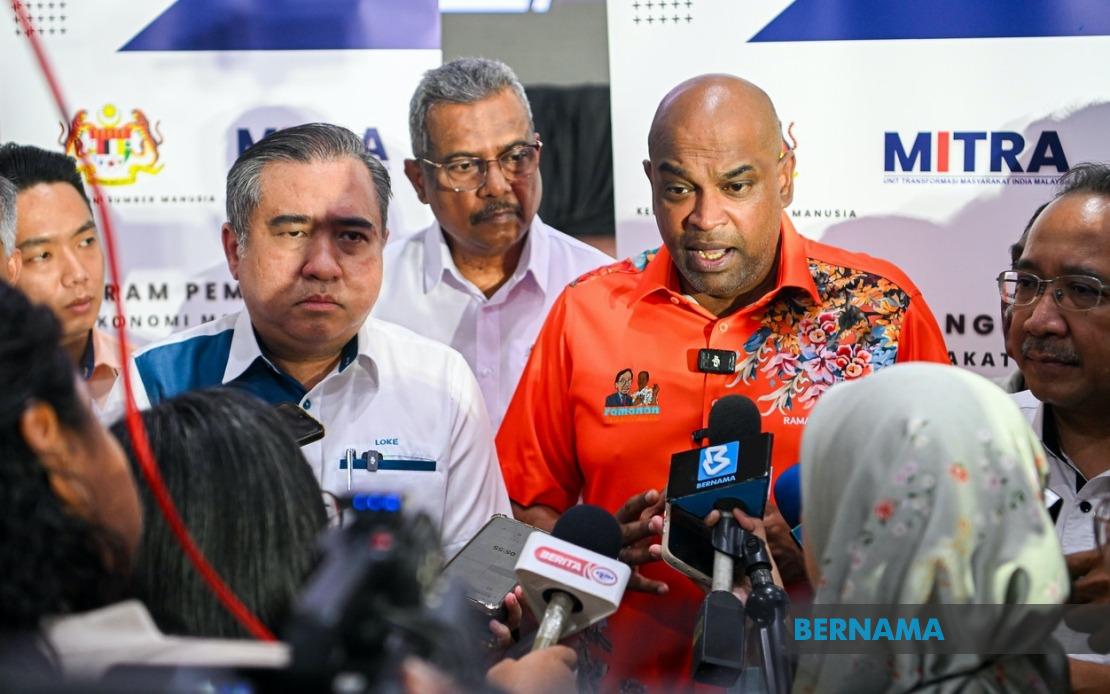
Transport Minister Anthony Loke has pushed back firmly against what he characterizes as a recurring political attack, dismissing suggestions that the Democratic Action Party exercises undue influence over the Pakatan Harapan administration. Speaking in Seremban on July 7, the DAP secretary-general argued that the narrative blaming a single coalition party for government direction has become a tired and predictable criticism levelled against the ruling alliance, used primarily as a vehicle to undermine public confidence in PH's legitimacy.
Loke outlined the decision-making structure of both the federal administration and the Negeri Sembilan state government, explaining that policy formulation occurs through a deliberative process involving all component parties. At the federal level, representatives from DAP, UMNO, and PKR—the major pillars of Pakatan Harapan—are afforded equal opportunity to voice their perspectives before Prime Minister Datuk Seri Anwar Ibrahim renders final decisions. This framework, according to Loke, ensures that no single party can unilaterally steer the government's direction, and that divergent viewpoints are incorporated into the policy-making exercise.
The distinction between consultation and control lies at the heart of Loke's rebuttal. He acknowledged that coalition members naturally contribute their positions on matters under consideration, asserting that silence from component parties would be both inappropriate and contrary to their responsibility as government partners. UMNO articulates its interests, PKR advances its agenda, and DAP presents its perspective—yet ultimate authority rests with the Prime Minister, whose role as chief executive grants him the prerogative to settle disputes and chart the final course. This separation between input and executive decision-making, Loke contended, fundamentally contradicts claims of party dictatorship.
The same collaborative approach extends to Negeri Sembilan, where Menteri Besar Datuk Seri Aminuddin Harun operates within an analogous framework. Before committing to significant policy decisions affecting the state, the Menteri Besar consults all coalition parties, seeking consensus where feasible and balancing competing interests where consensus proves elusive. This institutional practice at both levels of government, Loke suggested, demonstrates that Pakatan Harapan functions as a genuine coalition rather than as a vehicle for any single party's agenda.
The accusation that DAP dictates government policy has substantial political currency in Malaysia, particularly among opposition parties and segments of the Malay-Muslim electorate who view the predominantly Chinese party with suspicion. These criticisms often intersect with broader concerns about representation and communal interest, creating a potent political narrative that resonates beyond rational policy discussion. By framing such attacks as exhausted rhetoric, Loke sought to reposition them as evidence of political desperation rather than legitimate substantive concerns.
Loke also addressed a companion criticism—assertions that the Malay community faces threats under PH administration in Negeri Sembilan. He dismissed these claims as employing identical tactics, arguing that the factual circumstances of the state contradict such alararmist characterizations. The Menteri Besar himself is Malay, occupying the state's highest executive office, which Loke presented as irrefutable proof against allegations of Malay marginalization. Beyond personnel, he pointed to the continuity of government policies and programmes that he stated have consistently protected the interests of all communities, including the Malay majority, throughout PH's stewardship of the state since 2018.
This dual-pronged rebuttal addresses both the party-control question and the communal-threat dimension of opposition messaging. By anchoring his argument in the concrete presence of a Malay Menteri Besar and the preservation of community-oriented policies, Loke sought to disarm politically charged allegations with factual reference points. The implicit logic holds that if Malays were genuinely marginalized, it would be reflected in the composition of the state's political leadership and the substance of its governance.
The broader context for these exchanges involves the delicate balance required to maintain Pakatan Harapan's internal cohesion. The coalition brings together parties with substantially different constituencies, ideological foundations, and historical trajectories. UMNO represents traditional Malay-Muslim interests and brings substantial grassroots organization; PKR combines populist appeals with personality-centered politics around Anwar Ibrahim; and DAP draws support primarily from urban and predominantly non-Malay voters, advocating secular governance and meritocratic principles. Navigating these differences while presenting a unified governmental face requires constant management and periodic public assertions of equitable partnership.
Loke's remarks also reflect the particular vulnerability of DAP within the coalition structure. As the party most ideologically distant from UMNO and most frequently targeted by communal-based criticism, DAP faces recurring questions about its influence and intentions. Opposition narratives frequently cast the party as pursuing a hidden agenda to dilute Bumiputera protections, erode Islam's constitutional position, or otherwise alter the social contract enshrined in the Federal Constitution. These anxieties, whether empirically grounded or not, carry significant weight in Malaysian politics.
The Transport Minister's intervention represents an attempt to reframe the conversation around institutional process and evidence rather than allowing opposition critics to set the terms of debate through repetition of unsubstantiated claims. By characterizing such attacks as tired narratives, Loke implicitly appeals to voters' fatigue with predictable political theatre and their desire for substance over rhetoric. Whether this repositioning proves persuasive depends substantially on whether Pakatan Harapan can maintain governmental effectiveness and continue to demonstrate that coalition governance produces outcomes acceptable to diverse constituencies.
The question of who truly determines government direction ultimately resides with Malaysian voters, who must assess not the rhetorical claims made by political actors but rather the observable consequences of their policies. Loke's insistence on collective decision-making can be evaluated against the government's record, the consistency of policy implementation across different portfolio areas, and whether significant decisions appear to reflect partisan advantage or national interest. For coalition members and their supporters, such questions will likely determine whether confidence in Pakatan Harapan persists through the next electoral cycle.

