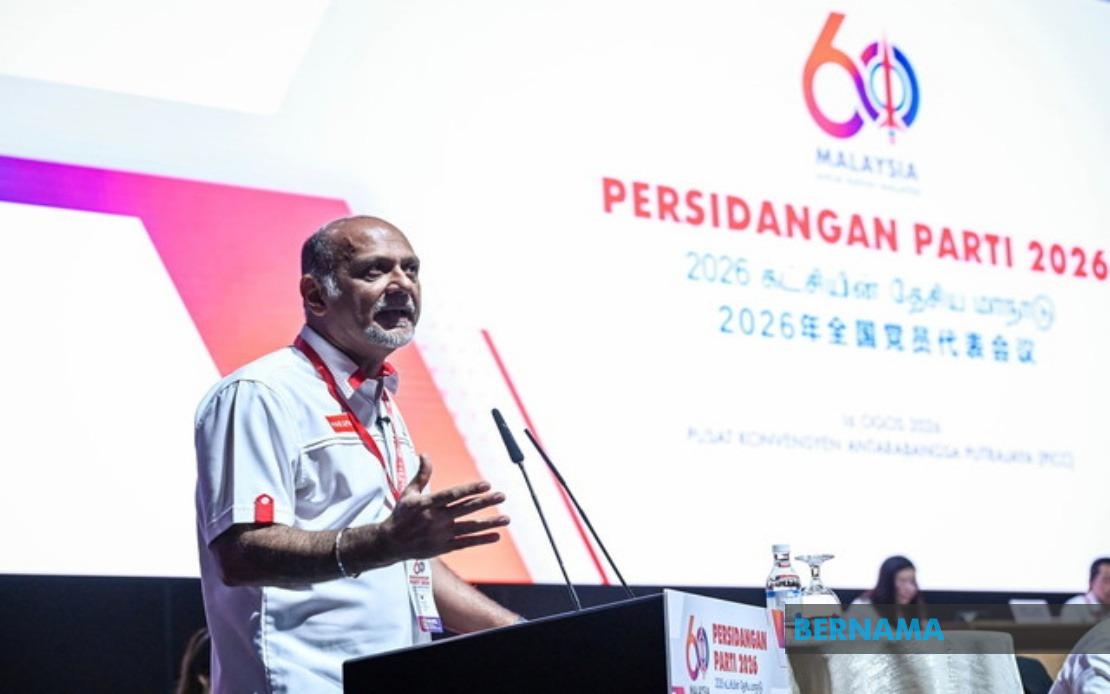
The Democratic Action Party has entered a period of critical self-examination following disappointing results in recent state elections, with national chairman Gobind Singh Deo acknowledging that the party must fundamentally reassess its political positioning and relevance within Malaysia's shifting democratic terrain. Speaking at the DAP Party Conference 2026 held at the Putrajaya International Convention Centre, Gobind framed the electoral outcomes not as a defeat but as a catalyst for honest reflection, giving the party an opportunity to evaluate what has been accomplished and where it has fallen short during its three-and-a-half years as part of the Unity Government coalition.
The timing of this introspection is significant, coming as Malaysia's major political coalitions recalibrate their influence and messaging ahead of crucial parliamentary and state decisions. Gobind's remarks underscore a maturation in DAP's approach to governance, moving away from the idealistic maximalism that characterised much of its opposition rhetoric toward a more measured, consensus-oriented strategy that acknowledges the constraints of multi-party coalition politics. This philosophical realignment has profound implications not only for DAP but for the broader architecture of Malaysian politics, where pragmatism increasingly trumps purist adherence to electoral manifestos.
Gobind explicitly advocated that the party prioritise only those reforms capable of securing agreement across all coalition members rather than attempting to impose DAP-backed initiatives unilaterally. This marks a significant departure from typical coalition dynamics in Malaysia, where partner parties have historically competed to claim credit for popular policies while deflecting blame for unpopular decisions. By openly acknowledging the need to identify common ground, Gobind signals that DAP recognises its position within the government has limitations and that sustainable reform requires genuine consensus rather than legislative arithmetic alone.
Central to DAP's proposed reform agenda is a special parliamentary sitting to debate and approve amendments to foundational legislation affecting civil liberties and institutional governance. The party has prioritised amendments to the Security Offences (Special Measures) Act 2012, commonly known as SOSMA, which has long drawn criticism from human rights advocates for enabling detention without trial and limiting judicial oversight. Alongside SOSMA reforms, DAP seeks to revise the Peaceful Assembly Act 2012, address the consolidated powers of the Attorney General and Public Prosecutor, and introduce constitutional limits restricting prime ministerial tenure to two terms. These proposals collectively represent an institutional reform framework designed to strengthen democratic safeguards and prevent power concentration, yet their realisation depends entirely on securing buy-in from coalition partners with differing ideological perspectives.
The separation of the Attorney General and Public Prosecutor portfolios emerges as a particularly contentious reform, as it directly affects the balance of power within Malaysia's legal and prosecutorial apparatus. Currently, these roles remain consolidated, giving the office-holder extraordinary influence over criminal proceedings and quasi-judicial decisions affecting millions of Malaysians. Disaggregating these functions would represent a watershed moment for institutional reform in Malaysia, though it requires constitutional amendment and broader coalition consensus—hurdles that have proven insurmountable in previous reform attempts.
Gobind's remarks on economic governance reveal a second layer to DAP's recalibration: the party acknowledges that Malaysian households face genuine material pressures requiring government intervention, yet recognises that addressing these concerns depends on macroeconomic stability and investor confidence. This recognition represents a pragmatic synthesis between social welfare concerns and market-oriented economic management—a balance that has historically proved elusive for left-leaning political parties in Southeast Asia. By emphasising that political stability serves as a prerequisite for foreign direct investment and employment creation, Gobind articulates a governance philosophy that subordinates ideological purity to material outcomes for ordinary Malaysians.
The present conference carries particular significance because it will require delegates to vote on a motion determining whether DAP should remain within the government coalition until the end of the 16th Parliament term or withdraw entirely. This decision represents far more than an internal party matter; it potentially affects the stability of the Unity Government itself and could reshape the entire competitive landscape for the anticipated next general election. With 4,264 delegates from 1,704 eligible branches participating in a secret ballot, the deliberative process offers an unusually democratic internal mechanism for resolving a strategic question that typically remains the preserve of elite party leadership in Malaysian politics.
DAP's position within the Pakatan Harapan coalition—the larger opposition-turned-governing alliance that includes PKR and Amanah—provides additional context for understanding these strategic shifts. As the most systematically organised and disciplined component of Pakatan Harapan, DAP carries outsized influence within coalition discussions, yet its ability to unilaterally drive the reform agenda remains constrained by the political interests and ideological commitments of its partners. The party's willingness to openly acknowledge these constraints signals maturation but also risks frustrating party activists who view the Unity Government as a betrayal of reform promises made during the 2018 electoral campaign that initially brought Pakatan Harapan to power.
The 60th anniversary of DAP's establishment, being commemorated at the current conference, provides historical perspective on this moment of recalibration. The party has evolved from a radical social democratic movement in the 1960s to an institutionalised force within mainstream Malaysian politics, a transformation that reflects broader patterns of political party lifecycle and adaptation across Southeast Asia. DAP's journey illustrates how ideological movements, when successful electorally, confront the sobering reality that governing requires compromise, coalition-building, and incremental progress rather than revolutionary transformation. Whether the party's delegates endorse continued participation in the Unity Government will significantly influence whether DAP can reshape this institutional constraint into an opportunity for meaningful, if limited, institutional reform.
For Malaysian voters and regional observers, DAP's strategic reorientation carries implications extending beyond factional party politics. The party's willingness to articulate realistic expectations about what coalition governance can achieve offers a counterweight to the zero-sum, winner-take-all political narratives that have increasingly dominated Malaysian discourse. Should DAP successfully translate its reform agenda into concrete legislative achievements—even if limited in scope—it would establish a precedent for cross-coalition collaboration on institutional matters affecting democratic quality and institutional integrity. Conversely, should the party prove unable to deliver even modest reforms despite occupying government seats, it risks validating a cynical view that Malaysian politics remains fundamentally dominated by narrow partisan and personal interests rather than genuine governance imperatives.

