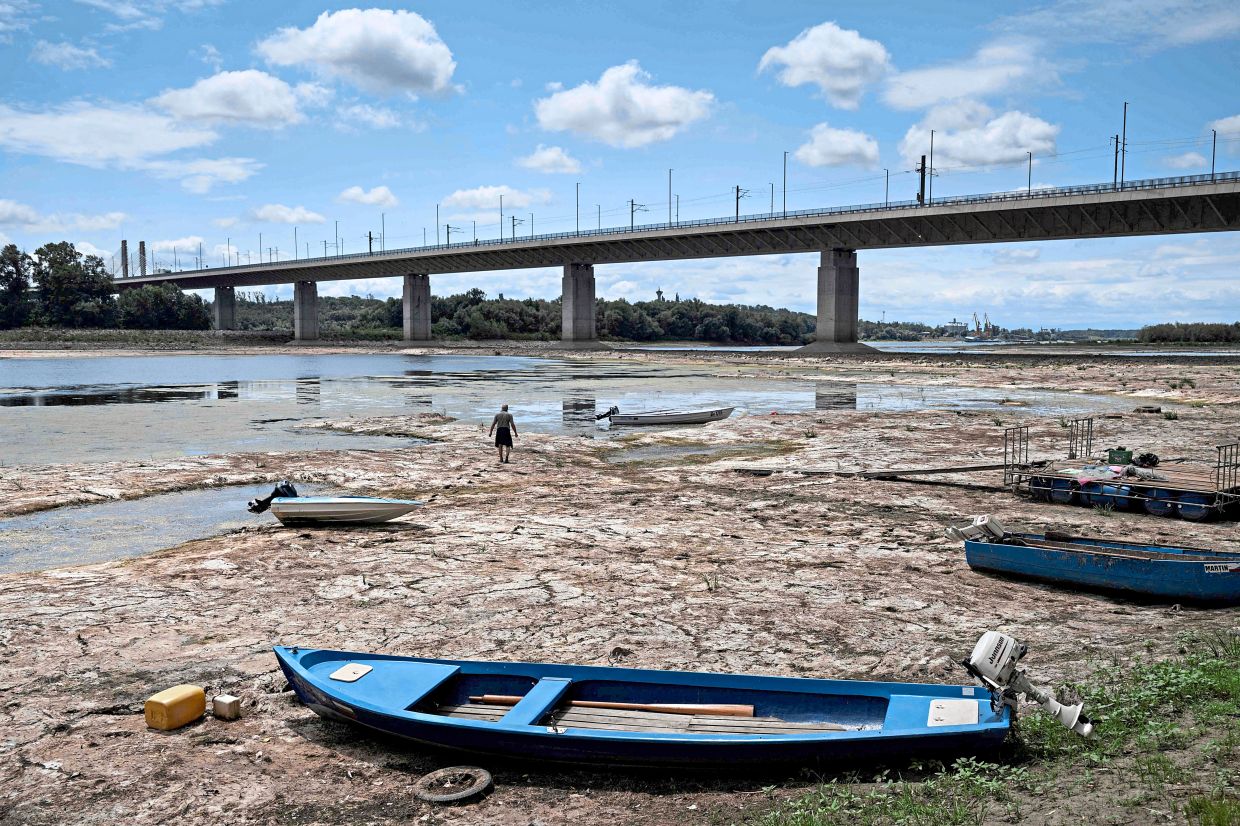
Europe's largest rivers are running dangerously dry, with the Danube hitting historically unprecedented water levels that have sent shockwaves across ten countries stretching from Germany to the Black Sea. A combination of prolonged drought and successive heat waves across Central Europe has created a crisis with far-reaching consequences for the region's tourism sector, industrial operations, and energy security. The scale of the environmental emergency became starkly apparent when Budapest's national water authority recorded the Danube's water level at just 23 centimetres on July 29, obliterating the previous record low of 33 centimetres set six years earlier in 2018. With temperatures expected to exceed 38 degrees Celsius and no meaningful rainfall forecasted, the situation threatens to worsen considerably in the coming weeks.
The visual transformation of the Danube has become a powerful symbol of climate change's tangible impact on European citizens. Where deep waters once flowed, exposed rocks, sandbars, and long-submerged relics now dot the riverbed, creating a landscape that has shocked residents and prompted widespread documentation of the phenomenon. Photographer Gabor Kertesz, who captured images beneath Budapest's Margaret Bridge—a location normally entirely underwater—articulated the visceral shock many have experienced witnessing such unprecedented changes. The contrast between historical and current conditions has become impossible to ignore, forcing ordinary people to confront uncomfortable questions about the future trajectory of their region's climate and what such environmental transformations might portend for everyday life.
Meteorological data underscores the exceptional nature of this drought. According to the Hungarian Meteorological Service, precipitation measured across 90-day periods has fallen between 80 and 130 millimetres below established long-term averages across nearly the entire country. This deficit represents more than a temporary weather anomaly; it reflects a sustained climatic pattern that has persisted throughout most of the year. The combination of below-average rainfall and accelerated evaporation caused by successive heat waves has created a compounding effect, systematically depleting water reserves that typically sustain the region's major waterways throughout summer months.
The tourism sector, which relies heavily on the Danube's appeal as a primary European attraction, has suffered immediate and substantial damage. Cruise operators have been forced to fundamentally alter operations, requiring vessels to dock at locations far upstream from their intended destinations, significantly degrading the passenger experience that customers pay premium prices to enjoy. The iconic journey through Budapest's cultural landmarks, normally a centrepiece of Central European river tourism, has become logistically problematic and economically unviable for many operators. The cascading effects extend throughout tourism-dependent communities, where hotels, restaurants, and cultural attractions have experienced reduced visitor numbers due to diminished cruise ship traffic and the general deterioration of conditions along the river.
Commercial shipping has been effectively paralysed across much of the Danube system. Hungary's Ministry of Transport and Investment has documented the near-total collapse of cargo operations, with shipping companies unable to move goods efficiently through channels that have become too shallow for economically viable transportation. In Serbia's Novi Sad region, the situation has reached crisis proportions, with hundreds of small vessels and dozens of cargo ships stranded on exposed banks. Radovan Segrt, a riverboat operator, reported that the Danube had withdrawn between fifteen and twenty metres from its normal shoreline—a distance that transforms the waterway from a navigable transport artery into a series of disconnected pools. The cessation of summer boat operations represents lost income for entire communities whose economies have developed around river-based commerce and tourism.
One particularly dramatic incident highlighted the severity of navigational hazards created by unprecedented water levels. In Bulgaria, authorities evacuated 186 tourists from the Viking Ullur cruise ship after the vessel ran aground near Vidin on July 28. The ship's passengers faced depletion of onboard supplies after the vessel proved unable to reach port to resupply, stranding crew members in conditions that demanded extended improvisation depending on whether refloating operations could succeed. Such incidents underscore how water shortages transform rivers into unpredictable hazards rather than reliable transport corridors, creating situations where safety concerns supersede commercial considerations.
The Danube's diminished flow has triggered urgent actions at nuclear power facilities across multiple countries, exposing how interconnected Europe's energy infrastructure has become with hydrological systems. Romania's Cernavoda nuclear power station shut down a reactor unit for safety reasons after Danube water flow declined to approximately 1,630 cubic metres per second—roughly a third of typical July volumes—leaving insufficient water for adequate cooling systems. Hungary's Paks facility, which supplies nearly half the nation's electricity, initiated reactor power reductions on July 29 due to restricted cooling-water availability, following two consecutive power cuts in preceding days. These cascading shutdowns demonstrate that climate-driven water scarcity creates immediate threats to energy security across the region, forcing authorities to choose between maintaining power generation and adhering to safety protocols designed to prevent catastrophic failures.
The exposed riverbed has created unexpected archaeological discoveries and historical revelations, though these pale beside the broader crisis. Authorities in Budapest closed the Margaret Bridge after a World War II-era bomb emerged from the receding waters, a stark reminder of how extreme conditions expose forgotten hazards. Treasure hunters have seized the opportunity, using powerful magnets to extract decades-old metallic objects—radio amplifiers, ammunition casings, military hardware—from newly accessible banks. While such activities create unexpected opportunities for historical documentation and artifact recovery, even enthusiasts acknowledge that the conditions enabling these discoveries represent fundamentally negative developments, trading minor cultural gains for the environmental catastrophe they reflect.
For Southeast Asian observers, the Danube crisis offers sobering lessons about climate vulnerability and interconnected risk. The European experience demonstrates how drought cascades through multiple economic and infrastructure systems simultaneously—tourism, shipping, energy production, and food security all face pressure when water scarcity occurs. Malaysia and other Southeast Asian nations, while generally well-supplied with rainfall, face distinct but related climate threats, from altered monsoon patterns to increased flooding intensity. The Danube situation illustrates how critical water management and climate adaptation planning have become for every region, regardless of current water abundance. European countries with advanced economies and technological capabilities are finding themselves struggling to respond to unprecedented water conditions; less developed regions with more limited resources face even greater vulnerability to climate disruptions of similar magnitude.
The political and social dimensions of the Danube crisis are beginning to emerge as governments confront difficult choices about resource allocation and regional cooperation. Water scarcity across multiple nations demands coordinated responses, yet historical tensions and competing national interests often complicate such cooperation. The crisis has forced governments to make uncomfortable public admissions about the realities of climate change, moving environmental concerns from abstract policy discussions into immediate operational necessities affecting millions of citizens. As residents witness the transformation of their major river and experience economic disruptions, political pressure is mounting for substantive climate action and adaptation investments. The human cost of the drought extends beyond tourism employment and shipping disruptions; it encompasses the psychological and political impacts of confronting visible environmental degradation that contradicts previous assumptions about the permanence and reliability of natural systems.
The Danube's record-low levels represent a culmination of warnings about climate vulnerability that have circulated through scientific communities for decades, now manifesting in ways that demand immediate societal responses. As wildfires continue devastating France and Spain while intense heat waves spread across the continent, the interconnected nature of contemporary climate challenges becomes impossible to ignore. The river will likely recover partially with autumn rains, yet the historical record it has set suggests that similar crises may recur with increasing frequency. European policy makers are confronting the uncomfortable reality that infrastructure and economic systems designed around historical climatic patterns may require fundamental restructuring to accommodate a changing environment. The Danube's decline serves as a powerful reminder that climate change is not a future threat but an active crisis reshaping daily life across entire regions, demanding urgent responses from governments, industries, and communities simultaneously.
Moving forward, the Danube crisis illuminates the necessity of integrated water management, accelerated climate adaptation planning, and serious investment in drought-resistant infrastructure across Europe and globally. The immediate recovery depends partly on weather patterns beyond human control, yet longer-term resilience requires deliberate policy choices about energy systems, transportation infrastructure, and water conservation. The river that has shaped European civilization for millennia faces an uncertain future, and the choices European societies make in response will determine whether they can adapt successfully to an increasingly unpredictable climate. For regions worldwide, the Danube's record lows offer cautionary evidence that even ancient, seemingly immutable natural systems can deteriorate rapidly when climate disruption intensifies.

