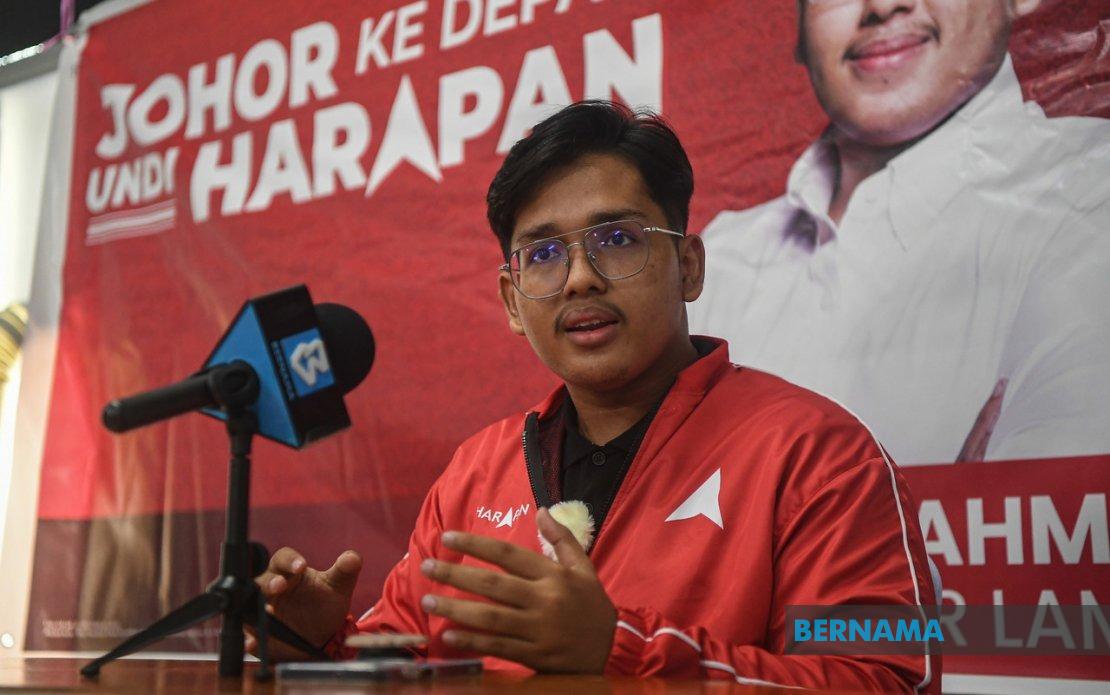
The 16th Johor state election is shaping up to be a test of how political parties can address the persistent economic disparities between developed urban centres and peripheral rural constituencies. Danish Hossman Abd Rahman, Pakatan Harapan's candidate for Johor Lama, is positioning himself as a bridge between traditional grassroots engagement and modern political communication, running under the banner "Wajah Baharu, Johor Lama" (A New Face, Johor Lama) with a manifesto centred on attracting capital and creating opportunities for residents who have historically depended on migration for economic advancement.
At 23 years old, Danish represents the youngest candidate contesting in the Johor state assembly elections, a demographic positioning that may resonate with younger voters frustrated by generational stagnation in peripheral constituencies. His central campaign premise directly confronts a longstanding challenge in Malaysian electoral politics: the drain of human capital from agricultural and rural communities towards urban economic hubs. The Felda settlements within the Johor Lama constituency, which have historically served as rice bowls for Malaysia's rural economy, have seen accelerating youth emigration patterns, with residents seeking employment in Johor Bahru, Kulai, Singapore and beyond. This demographic bleeding reflects broader structural inequalities in how development largesse is distributed across the state.
Danish's strategic focus on attracting high-impact investment to Johor Lama represents an attempt to reverse this tide through supply-side economics rather than welfare dependency. By proposing targeted development initiatives that create local employment, he is implicitly critiquing previous administrations for concentrating infrastructure and investment momentum in already-prosperous zones such as Johor Bahru and Tebrau. The candidate argues that without deliberate intervention to stimulate economic activity in peripheral constituencies, the migration pressure will intensify, exacerbating demographic imbalances and straining urban services in established commercial hubs.
A critical element of his campaign platform involves strengthening coordination between state and federal governments to ensure seamless policy implementation and project delivery. This emphasis on inter-governmental synchronisation acknowledges a persistent governance weakness in Malaysia's federal system, where jurisdictional silos between state and central authorities often create implementation bottlenecks. For voters in Johor Lama, such coordination failures translate directly into delayed infrastructure projects, stalled development initiatives, and uneven service delivery. By signalling commitment to bridging these institutional gaps, Danish is addressing a practical frustration that extends beyond mere electoral posturing.
Beyond macro-economic strategy, Danish has identified a specific administrative gap affecting daily life in the constituency: the absence of an Immigration Department branch office in Kota Tinggi. This seemingly technical issue has tangible implications for residents, who currently must undertake time-consuming journeys to Johor Bahru, Kulai, or Mersing to handle passport applications, visa matters, and other immigration services. In an age of digital governance, the continued absence of this basic facility suggests administrative neglect and raises questions about state-level commitment to service provision equity. Establishing such an office represents both practical relief for constituents and symbolic acknowledgment that peripheral areas deserve institutional responsiveness comparable to urban centres.
Danish's campaign methodology reveals contemporary Malaysian political evolution. He is deploying hybrid engagement strategies that combine traditional door-to-door canvassing with digital outreach, recognising that the 32,000-strong Johor Lama electorate likely spans generational and digital literacy divides. His emphasis on direct constituent listening—meeting people face-to-face and actively soliciting their concerns—echoes community-oriented politics, whilst simultaneous active social media presence signals adaptability to younger voter preferences and communication norms. The reported positive response from constituents suggests this bifurcated approach resonates with a constituency demographic spanning various age cohorts.
The electoral contest in Johor Lama represents a three-cornered competition featuring Danish as the PH standard-bearer, incumbent Norlizah Noh representing the Barisan Nasional establishment, and Aisah Esa fielded by Perikatan Nasional. This triangular contest reflects Malaysia's increasingly fragmented political landscape, where traditional two-coalition frameworks have given way to multi-way contests. For voters in Johor Lama, this plurality of choice creates opportunity but also raises stakes regarding which candidate can genuinely deliver on development promises.
The timing of the Johor state election, with polling scheduled for July 11 and early voting on July 7, occurs within a broader context of Malaysian political realignment and economic recovery discussions. At the state level, Johor's electoral contests have increasingly become battlegrounds for testing political messaging and organisational effectiveness ahead of potential federal elections. The emphasis on rural development, youth employment, and administrative equity in Danish's platform reflects broader nationwide conversations about inclusive growth and regional economic rebalancing.
For Southeast Asian observers, the Johor Lama contest illustrates persistent challenges in managing political integration between prosperous urban cores and peripheral agricultural zones—a dynamic replicated across the region. Denmark's candidacy and platform suggest that younger generation Malaysian politicians are directly confronting these asymmetries rather than accepting them as inevitable features of development. Whether his youth and commitment to constituent engagement can overcome incumbent advantages and established political machinery remains uncertain, but his campaign represents evolving voter expectations regarding responsiveness, equity in development resource allocation, and administrative efficiency in Malaysia's competitive electoral environment.

