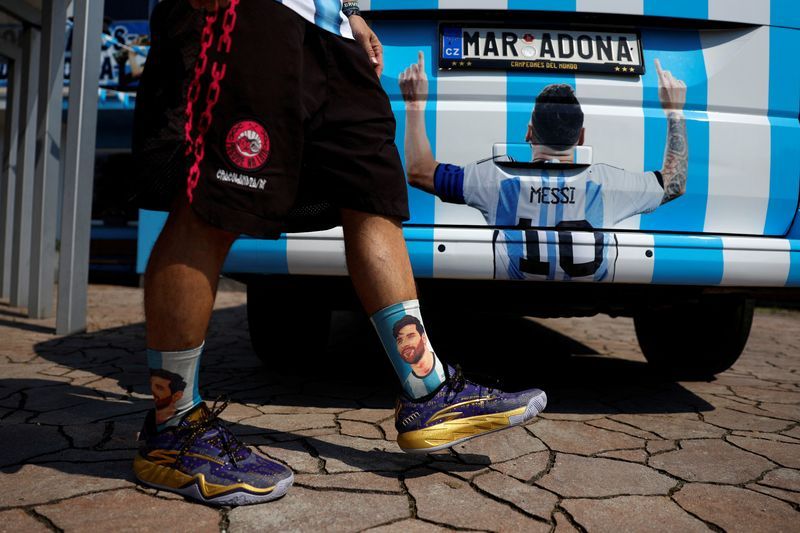
A modest three-storey house in Bukovka, a village ninety kilometres east of Prague, stands as perhaps Europe's most unusual tribute to Argentine football. Miloslav "Curby" Urbanec, a 51-year-old music promoter, has transformed his property into an elaborate shrine dedicated to the sky-blue and white colours of La Selección, complete with a life-sized statue of Diego Maradona, an imposing mural of Lionel Messi, and a massive sun emblem—the centrepiece of Argentina's flag—emblazoned across the exterior walls. The artistic declaration extends to his vehicle, a van painted in identical national colours and bearing the defiant slogan "In Messi we trust" alongside a custom registration plate reading "MARADONA".
Urbanec's devotion to Argentina transcends the typical enthusiasm of a football supporter. His commitment began decades ago, rooted in a formative childhood memory. When he was four years old, he watched the 1978 World Cup final alongside his father, captivated by the flowing hair and elegant play of Argentine striker Mario Kempes and his teammates. That tournament, which saw Argentina claim their first World Cup victory under coach César Luis Menotti, ignited a passion that would define the next five decades of Urbanec's life. He recalls the moment with crystalline clarity: the on-field triumph instantly transformed into a lifetime emotional investment in everything Argentine football represented.
For Malaysian and Southeast Asian readers accustomed to supporting European or Brazilian clubs, Urbanec's singular focus on Argentina merits consideration. Whilst the region's football allegiances typically fragment among multiple preferences, his monolithic dedication illustrates how geographical boundaries dissolve in the modern sporting landscape. A Czech villager and an Argentine nation separated by nearly thirteen thousand kilometres have become bound through the universal language of football excellence and aesthetic beauty.
The depth of Urbanec's commitment manifests in deeply personal ways. Seven years ago, when his second son was born, he made a deliberate choice to name the child Lionel—not after a family member, but in recognition of Messi's exceptional talent. At the time, Urbanec perceived something extraordinary in the Argentine maestro's abilities that justified naming his own child after him. This decision reflects how sports icons transcend mere entertainment, becoming cultural touchstones significant enough to shape family legacies. The gesture simultaneously honours Messi and binds his son to a heritage of Argentine football excellence before the boy could even understand language.
Beyond the household, Urbanec has constructed a football pitch behind his property, an all-weather facility surrounded by placards depicting Boca Juniors players. The choice of Boca holds particular resonance: this Buenos Aires powerhouse served as Maradona's club during some of his most transformative years, when the young genius announced himself to world football. By populating his pitch with images of Boca's greatest players, Urbanec creates a complete ecosystem celebrating Argentine football's history and contemporary brilliance in a rural Czech setting.
The construction of personal shrines to athletes reveals something profound about how modern football culture operates. Urbanec's home becomes more than property—it transforms into a public declaration of identity and values. His neighbours in Bukovka cannot ignore his allegiances when passing the Messi mural, the Maradona statue, or the colour-washed walls. In an era when identity increasingly fragments across digital platforms, Urbanec's physical environment represents a tangible, permanent assertion of belonging to the Argentine football community, however geographically displaced.
Urbanec's confidence in Argentina's prospects reflects a broader conviction about the team's quality. He describes La Selección as "absolutely amazing" and insists with unwavering certainty that they will secure another World Cup victory. His assessment privileges aesthetic considerations alongside trophy ambitions, arguing that Argentine players execute "the most beautiful football." This emphasis on style over mere results situates Urbanec within a particular football philosophy—one that values how teams win alongside the winning itself, a perspective increasingly common among committed supporters globally.
The challenge for Argentina lay ahead at the time of this report, with Cape Verde awaiting in the round of 32 on July 3rd. For Urbanec, such fixtures represent more than matches to be played; they constitute chapters in an unfolding narrative of vindication for his lifetime of faith. Every Argentine victory becomes personal triumph; each defeat threatens the worldview he has invested in through his home, his vehicle, his son's name, and his emotional commitment.
Urbanec's story illuminates how football transcends sport to become a vehicle for identity expression across cultural and geographical boundaries. His Czech village home, flying Argentine colours with the same intensity as Buenos Aires itself, demonstrates football's capacity to create genuine communities of passion that ignore national borders. For supporters in Malaysia and the wider Southeast Asian region, Urbanec's example suggests that football allegiances need not follow geographic proximity or ancestral heritage. Instead, they can emerge from childhood moments of wonder, sustained through decades of genuine belief, and crystallised through the act of building physical monuments to the teams and players who inspire devotion.

