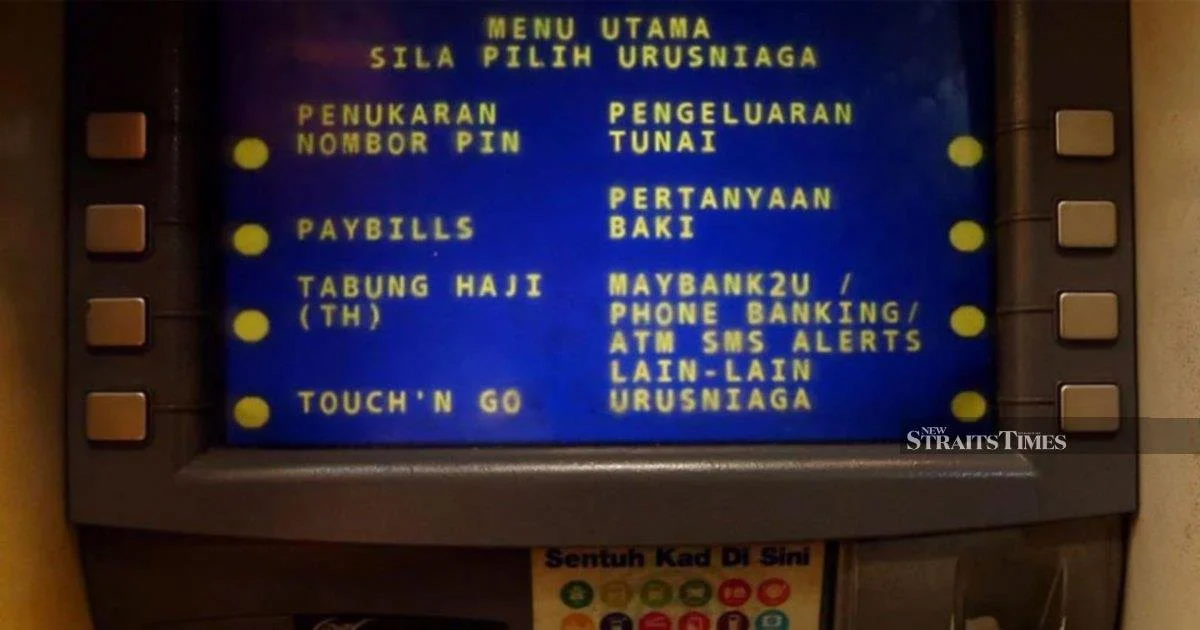
Bank Negara Malaysia has launched a push to crack down on improper charges being levied on customers who withdraw funds from automated teller machines belonging to their own financial institutions. Communications Minister Datuk Fahmi Fadzil revealed that the central bank is actively encouraging members of the public to come forward and lodge complaints whenever they encounter the RM1 interbank withdrawal fee at self-owned ATM terminals, a charge that should not technically apply under current banking regulations.
The directive represents an important escalation in the central bank's efforts to ensure that Malaysian banking customers are protected from hidden or unjustified charges. Withdrawals made at an ATM operated directly by a customer's own bank should be entirely free of charge, according to industry standards that Bank Negara Malaysia has implemented to safeguard consumers. When customers are instead billed the RM1 fee typically reserved for cross-bank transactions, this constitutes a breach of those protective guidelines and reflects either a system error or potentially deliberate overcharging.
The interbank ATM fee of RM1 per withdrawal was originally introduced to cover the operational and infrastructure costs incurred when customers use machines belonging to different financial institutions. This structure creates a straightforward incentive: customers who withdraw from their own bank's ATM network avoid the fee entirely, while those accessing competitor machines understand that a modest charge applies. The system theoretically encourages banks to maintain robust ATM networks for their own account holders, creating value through convenience.
However, reports of customers being charged this interbank fee when using their own bank's machines suggest that technical glitches, system misconfiguration, or inadequate verification processes may be preventing the charges from being applied correctly. Some banking observers suggest that the problem may stem from outdated or incompatible systems at certain institutions that fail to properly identify whether an ATM belongs to the customer's own bank. Others point to possible implementation issues where the correct charge classification rules have not been properly configured across all branches and terminal networks.
The central bank's call for public reporting serves a dual purpose in Malaysian's consumer protection framework. First, it creates a mechanism through which regulatory authorities can identify which financial institutions are experiencing problems and need to correct their systems urgently. Second, it empowers individual customers to understand that they have recourse and that their complaints matter to the regulator. By making it clear that such charges are improper, Bank Negara Malaysia is essentially reaffirming the consumer-friendly standards it has established.
Malaysian banking customers have become increasingly conscious of fees and charges over recent years, particularly as the sector has undergone significant digital transformation. The proliferation of online banking, mobile applications, and expanded ATM networks means that many individuals conduct dozens of transactions monthly. Even small recurring charges, when aggregated across millions of customers and thousands of transactions, can represent substantial sums, making fee transparency and accuracy critically important to consumer trust in the financial system.
The move also reflects broader concerns within Southeast Asia about financial inclusion and the cost of banking services for ordinary citizens. Malaysia has worked extensively to expand access to formal financial services, and maintaining reasonable fee structures remains essential to that mission. Overcharging customers at ATM terminals, whether intentional or accidental, undermines that accessibility by making basic financial transactions more expensive than they should be.
Customers who experience this improper charging can escalate their complaints through Bank Negara Malaysia's established channels, though the specific mechanisms have not been detailed in the statement. Previously, the central bank has accepted formal complaints through its official website and through coordinated complaints procedures with individual banks. Documentation of the transaction, including the date, time, ATM location, and amount charged, will likely be necessary for investigators to trace the problem back to the responsible institution.
The implications for Malaysia's banking sector are noteworthy. Financial institutions that have allowed such charging errors to persist risk regulatory scrutiny and potential enforcement action from Bank Negara Malaysia, which has demonstrated willingness to impose penalties and demand corrective measures from non-compliant banks. Refunding customers for improperly charged fees may also become necessary, adding to the financial and reputational costs of allowing system failures to persist. Banks that address any underlying technical or operational issues quickly will likely minimize their regulatory exposure.
Looking forward, this episode highlights the importance of robust testing and verification systems within banking technology infrastructure. As Malaysia's financial sector continues to digitalize and expand its service offerings, ensuring that core transaction systems operate with complete accuracy becomes increasingly critical. Mistakes that affect millions of transactions daily can erode customer confidence rapidly, even when they stem from technical problems rather than deliberate misconduct.
For Malaysian consumers, the key takeaway is straightforward: charges for withdrawals at your own bank's ATMs are not legitimate, and reporting such instances serves both individual and collective interests. The central bank's receptiveness to such complaints indicates that regulatory oversight is functioning and that customer concerns are being taken seriously by authorities responsible for maintaining the integrity of Malaysia's financial system.

