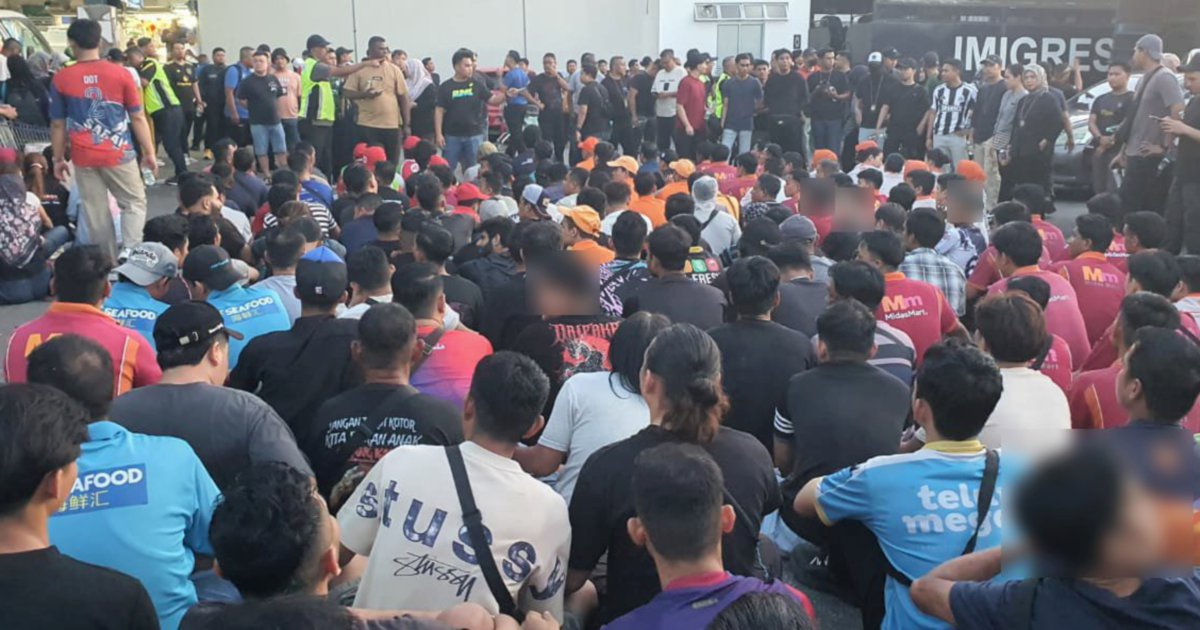
Immigration authorities in Johor Baru have arrested 226 undocumented migrants in a significant enforcement operation that has exposed a widespread scheme enabling foreign workers to maintain illegal employment in Malaysia while evading detection. The raids have revealed how systematic manipulation of immigration documents has allowed migrant workers to operate undetected in the country for extended periods, highlighting vulnerabilities in border control and document verification systems that authorities are now scrambling to address.
Among those detained was an Indonesian fishmonger whose case exemplifies the pattern discovered during the investigation. Over a four-year period, the man repeatedly crossed the Malaysian border on a monthly basis, presenting his passport for stamping before returning to engage in undocumented labour within the country. This cycle allowed him to maintain the appearance of legitimate border crossings while actually working illegally, a deception made possible by gaps in how authorities track continuous employment of foreign nationals.
The operational mechanics of the scheme relied on coordinated stamp placements that created false records of legal entry and departure. By obtaining regular passport stamps, migrant workers could theoretically satisfy inspectors who might question their immigration status, even though their actual residence and work patterns indicated clear violations of Malaysian immigration law. The sophistication of this approach suggests involvement from individuals with access to official stamps or knowledge of document verification procedures.
This case carries significant implications for Malaysia's broader labour market and security landscape. The country has long grappled with substantial irregular migration, with estimates suggesting hundreds of thousands of undocumented workers operate across various economic sectors. Manufacturing, construction, agriculture, and domestic service have all been identified as industries where illegal labour is particularly prevalent, often kept in place through cash-based employment relationships that generate no formal records.
The Johor operation demonstrates that enforcement priorities are shifting toward disrupting the systems and networks that enable persistent illegal employment, rather than merely apprehending individual workers. Authorities evidently coordinated across multiple locations and conducted surveillance to map out the patterns and connections within this particular network, suggesting a more intelligence-driven approach to immigration crime. The scale of the operation, with over 200 detentions, indicates this was not a routine checkpoint enforcement but rather a targeted investigation into organised irregular migration.
For Malaysian employers relying on undocumented labour, the raid represents an escalation in enforcement risk. Sectors dependent on low-cost migrant workers have historically faced sporadic penalties, creating an environment where violations were viewed as manageable operational costs. A more proactive approach focused on dismantling networks could fundamentally alter that calculation, potentially forcing employers to either formalise their workforce or accept higher labour costs. This transition would have ripple effects across supply chains and consumer prices in sectors like food production and construction.
The discovery also raises questions about the adequacy of Malaysia's document security systems. If passport stamps could be obtained repeatedly without triggering alerts, this suggests immigration databases may not be linked effectively to border control systems. A worker entering monthly should theoretically generate records prompting review, yet this individual apparently operated undetected for years. Modernising verification systems and ensuring real-time information sharing between agencies would be essential to preventing similar schemes in future.
From a Southeast Asian perspective, the case reflects broader challenges that plague the region. Countries throughout the Association of Southeast Asian Nations grapple with porous borders, limited resources for enforcement, and substantial economic incentives driving migration from less developed to more developed economies. Malaysia, as a relative high-income country within Southeast Asia, has become a natural destination for workers from Indonesia, Myanmar, Cambodia, and Bangladesh seeking better wages. This creates pressure on immigration systems regardless of enforcement capacity.
The fate of the 226 detained migrants remains unclear from available information, though standard procedure typically involves detention pending deportation proceedings. Many will likely return to their home countries, only to attempt re-entry through similar channels if underlying economic conditions remain unchanged. Without addressing the root causes driving migration, enforcement operations serve primarily as cyclical disruptions rather than permanent solutions, though they do impose costs that may deter some repeat attempts.
Authorities have indicated that further investigations into the network's organisational structure are ongoing. Identifying individuals who facilitated the document scheme, whether immigration officials, smugglers, or travel agents, will be crucial to preventing recurrence. Prosecutions of network operators rather than merely front-line workers represent a more effective deterrent, targeting the commercial incentive structures that enable systematic violations.
The Johor raid underscores persistent tension between Malaysia's labour market needs and its immigration enforcement capacity. While the country requires migrant workers in numerous sectors, managing their presence legally and securely remains challenging. Policymakers face pressure to either expand legal migration pathways for lower-skilled workers or accept that informal sectors will continue operating beyond official oversight. The current approach of periodic enforcement crackdowns occupies an uncomfortable middle ground where neither labour market reality nor security objectives are fully addressed.

