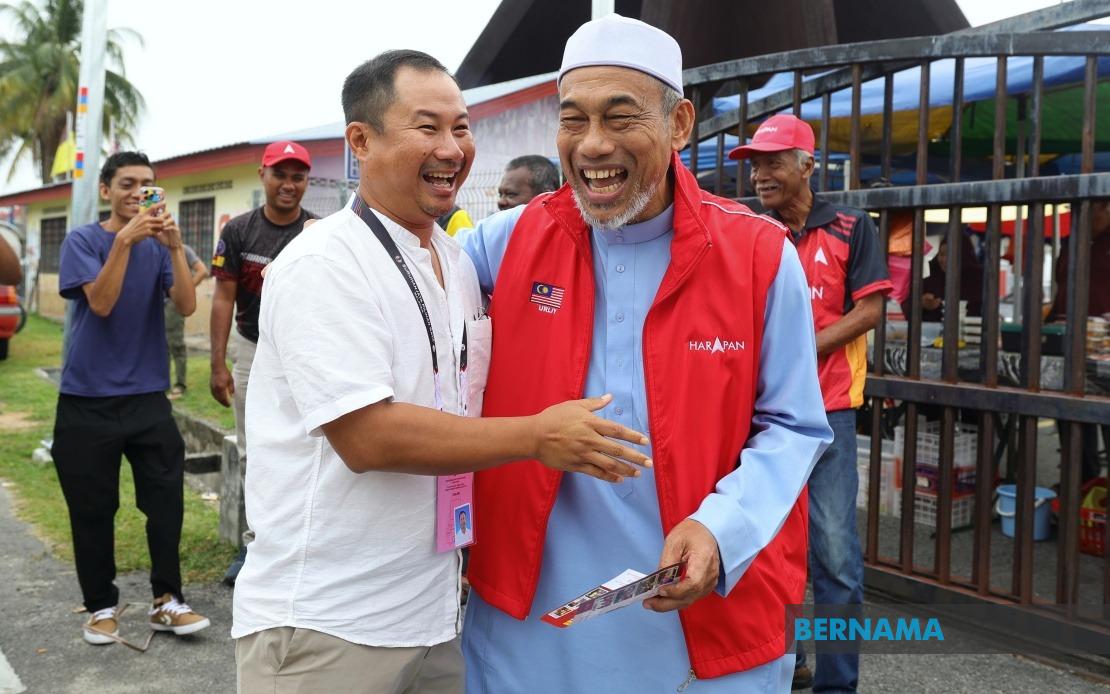
The Negeri Sembilan State Election campaign has taken on a more human dimension with an unusual political subplot unfolding at ground level. At the Kuala Klawang weekend market in Jelebu, two candidates from rival coalitions who happen to share family ties encountered one another whilst canvassing for votes on the second day of formal campaigning. The moment captured the attention of market-goers and drew onlookers eager to witness the spectacle of familial adversaries engaged in democratic competition. Both candidates moved through the bustling marketplace, engaging traders and visitors alike in separate campaign efforts, yet the proximity of their activities created a unique dynamic rarely seen in Malaysian electoral contests.
Datuk Bakri Sawir, representing Pakatan Harapan, holds the incumbent's advantage as he seeks to retain the Klawang state assembly seat. His competitor from Perikatan Nasional, Danni Rais, represents the challenge facing the ruling coalition in this particular constituency. The circumstances of their candidacy—being related by blood whilst standing on opposing political platforms—have added an intriguing dimension to what would otherwise be a straightforward three-way contest. Their relative youth in politics compared to entrenched party hierarchies suggests that this particular electoral battle may reflect broader generational shifts within Malaysian political parties and the electorate's receptiveness to fresh faces.
What distinguished this campaign encounter was its conspicuous civility. Rather than descending into confrontation or heated rhetoric, the two cousins maintained a respectful demeanour throughout their time in proximity at the market. Observers noted that they exchanged cordial greetings and even engaged in light-hearted banter, a departure from the sometimes acrimonious tone that characterises Malaysian political campaigns. This conduct suggests either genuine family affection transcending political affiliation or a calculated decision to demonstrate maturity and restraint to voters—though the distinction matters less than the precedent it sets for electoral discourse in the state.
Bakri articulated a principled stance regarding his electoral contest with his cousin, framing the competition not as personal rivalry but as an opportunity for both candidates to present their service platforms to constituents. His remarks reflected a philosophical approach to politics that emphasises institutional respect and adherence to regulatory frameworks. When the Jelebu District Council issued directives regarding campaign material placement on stadium fencing, Bakri's team promptly complied by removing their flags, demonstrating the ethos he advocates. This compliance serves a dual purpose: it legitimises his campaign message whilst tacitly criticising potential opponents who might disregard such instructions.
The incumbent's emphasis on campaign propriety carries particular resonance given the high stakes of Negeri Sembilan's electoral realignment. The state has become a competitive battleground where Pakatan Harapan's dominance faces sustained pressure from Perikatan Nasional's expanding support base. Any perception that PH candidates are flouting electoral guidelines could damage the coalition's appeal to voters concerned about institutional governance and rule of law. Conversely, demonstrating exemplary conduct establishes a counter-narrative to opposition allegations of PH's diminishing ethical standards since assuming federal power in 2018.
The Klawang constituency itself presents a microcosm of electoral dynamics across Negeri Sembilan. With 13,355 registered voters, the seat is neither a marginal by-election nor a guaranteed stronghold for any single coalition. The fact that the race involves three serious candidates—Bakri for Pakatan Harapan, Danni Rais for Perikatan Nasional, and Muhammad Adib Musa representing Bersatu—suggests that vote-splitting could determine the outcome. Malaysian electoral history demonstrates that three-cornered contests frequently produce results that surprise conventional analysis, particularly when a candidate belongs to a coalition experiencing internal tensions or when local issues override broader party narratives.
Bakri's broader call for harmonious campaigning throughout the election period indicates awareness that the tone set at constituency level influences perceptions of political maturity statewide. His remarks specifically directed at party machinery suggest concern that overzealous volunteers or lower-ranking officials might damage the coalition's carefully cultivated image through overly aggressive tactics. This institutional concern reflects lessons learned from previous electoral cycles where localised campaign misconduct generated negative headlines and provided opposition ammunition for broader criticisms.
The Election Commission's timeline—with early voting scheduled for July 28 and polling day on August 1—provides a compressed campaign window for both candidates to consolidate support and identify persuadable voters. In constituencies with this demographic size, ground-level organisation and community engagement prove decisive. The cordial relationship between Bakri and Danni, rather than polarising the electorate, might actually suppress turnout if voters perceive the choice as inconsequential. Conversely, their demonstrated respect for democratic processes could elevate the campaign's substantive focus on policy platforms rather than personal attacks.
The broader implications for Negeri Sembilan's political trajectory extend beyond the Klawang seat itself. The state election represents a crucial test of Pakatan Harapan's ability to retain its positions following the federal administration's mixed economic performance and social policy controversies. Any gains by Perikatan Nasional in previously secure PH constituencies would signal accelerating erosion of the ruling coalition's grassroots support. The conduct and outcome of contests like Klawang, where local factors intersect with statewide political calculations, will substantially influence narrative formation around the election's meaning for Malaysia's future political configuration.
For Southeast Asian observers monitoring Malaysia's democratic evolution, the Klawang campaign offers an encouraging illustration of competitive politics conducted within institutional boundaries. The willingness of political opponents bound by family connections to campaign against each other whilst maintaining mutual respect suggests that Malaysian democracy, despite periodic strains, retains capacity for civilised contestation. Whether this civility proves durable throughout the remainder of the Negeri Sembilan campaign period will bear watching, particularly as voting draws nearer and electoral stakes intensify in other constituencies across the state.

