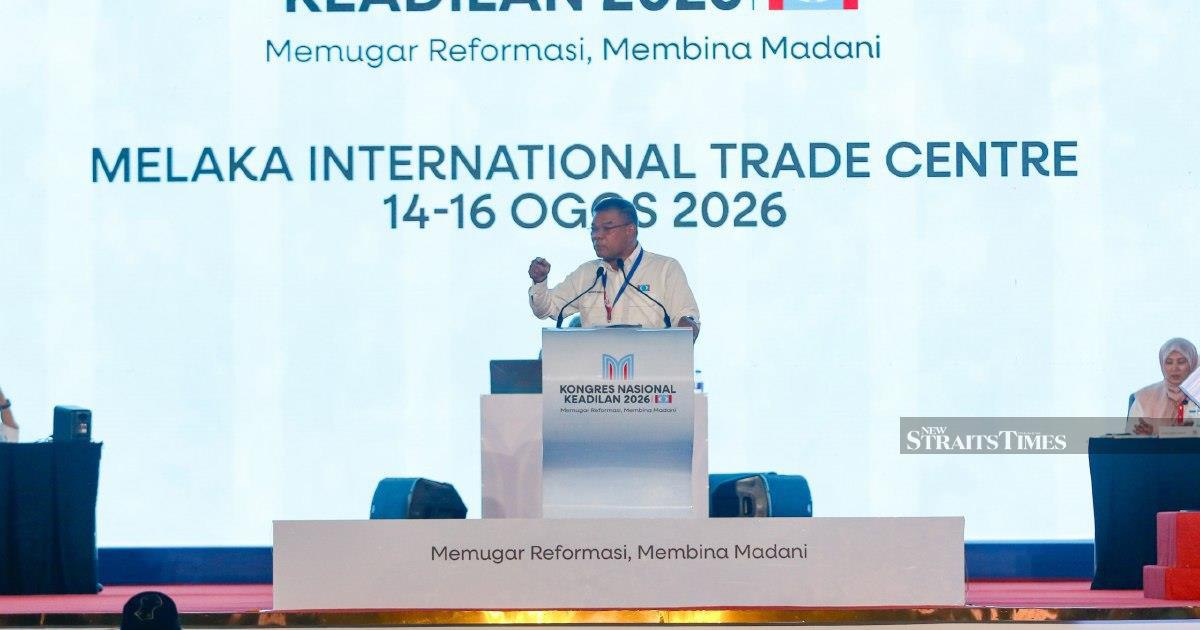
PKR vice-president Datuk Seri Saifuddin Nasution Ismail has called for Malaysia's anti-corruption agenda to be anchored in principles of governance and moral responsibility rather than weaponised as a tool for racial or religious division. Speaking at an event in Ayer Keroh, he emphasised that the battle against graft should remain rooted in universal values that transcend communal identities and sectarian boundaries.
The statement reflects growing concern among Malaysia's political establishment about how corruption allegations have increasingly become entangled with identity politics. Rather than focusing solely on misconduct, critics and rivals often frame graft cases through ethnic or religious lenses, risking the depoliticisation of what should remain a strictly institutional and moral matter. Saifuddin's remarks suggest that PKR, which has positioned itself as a multiethnic coalition partner in the Anwar Ibrahim-led government, views this framing as counterproductive to genuine reform.
Such pronouncements carry particular weight in Malaysia's complex political ecosystem, where race relations and religious sensitivities remain foundational to electoral calculations. When allegations of corrupt conduct become vehicles for advancing communal agendas—whether by painting certain groups as inherently prone to dishonesty or by suggesting that investigating particular individuals amounts to persecution—the integrity of the anti-corruption machinery itself risks being compromised. The message Saifuddin appears to be advancing is that Malaysia cannot afford such distortions at a moment when public trust in institutions already faces significant erosion.
The PKR figure's intervention also reflects tension within Malaysia's ruling coalition between competing narratives about what the government's primary mission should entail. While some quarters push for aggressive prosecutions of officials associated with previous administrations, others worry that an overly selective or politically-motivated approach to enforcement could undermine the legitimacy of anti-corruption institutions. Framing the struggle as fundamentally moral rather than partisan addresses this tension by suggesting that graft-fighting should apply equally regardless of a person's background.
For ordinary Malaysians, the practical implications are substantial. Corruption remains a persistent constraint on economic competitiveness, public service delivery, and social cohesion. When citizens view anti-corruption efforts through a distorting lens of race or religion, support for institutional reforms and whistleblower protections inevitably weakens. Public cooperation with enforcement agencies depends partly on the perception that these bodies operate according to universal principles rather than communal favouritism. Saifuddin's call essentially asks Malaysians to recognise that their collective interest in stamping out graft transcends any individual group's parochial concerns.
The Malaysian Anti-Corruption Commission and related enforcement bodies have in recent years faced criticism from various quarters—some arguing they act too slowly or selectively, others suggesting they overreach. Against this backdrop, Saifuddin's insistence on moral and governance foundations for anti-corruption work implicitly defends institutional independence. It suggests that these agencies should be evaluated not by how their decisions align with any faction's political interests, but by whether they apply consistent standards and treat suspects fairly. Such objectivity is precisely what allows public confidence to accumulate over time.
Regionally, Malaysia's approach to governance matters beyond its borders. Southeast Asian economies have collectively struggled with investor confidence partly due to perceptions of institutional corruption and politicised enforcement. Should Malaysia succeed in positioning itself as a jurisdiction where anti-corruption efforts operate according to transparent, non-partisan criteria, the economic and reputational benefits would extend to the broader region's standing in global markets. Conversely, if graft-fighting becomes merely another arena for zero-sum political combat, both Malaysia and its neighbours risk further credibility damage.
The challenge, of course, lies in implementation. Saifuddin's articulation of principle is straightforward; translating it into consistent administrative practice across diverse institutions with varying cultures and pressures is far more complex. Political actors themselves must resist the temptation to selectively invoke anti-corruption rhetoric when convenient and shelve it when inconvenient. This requires not just rhetorical commitment from figures like Saifuddin, but sustained institutional reform and oversight.
PKR's own positioning as a multiethnic, ostensibly reform-oriented party gives added credibility to Saifuddin's intervention. A party that depends on support across multiple communities and emphasises inclusive governance has structural incentives to oppose corruption narratives that divide voters along communal lines. Yet such positions also invite scrutiny: critics often contend that any party benefits from framing graft-fighting in universalist terms when doing so happens to disadvantage opponents while shielding allies. Scepticism about such rhetoric is therefore healthy in Malaysia's polarised environment.
Ultimately, Saifuddin's message speaks to a deeper anxiety afflicting contemporary Malaysian democracy—the fear that institutional legitimacy and social cohesion depend on the political elite's willingness to elevate certain issues above factional interest. Whether Malaysia's political actors, individually and collectively, can sustain commitment to this principle will significantly shape the nation's trajectory over the coming years. For now, at least, his words represent a necessary if insufficient step toward reclaiming corruption-fighting as a shared national responsibility.

