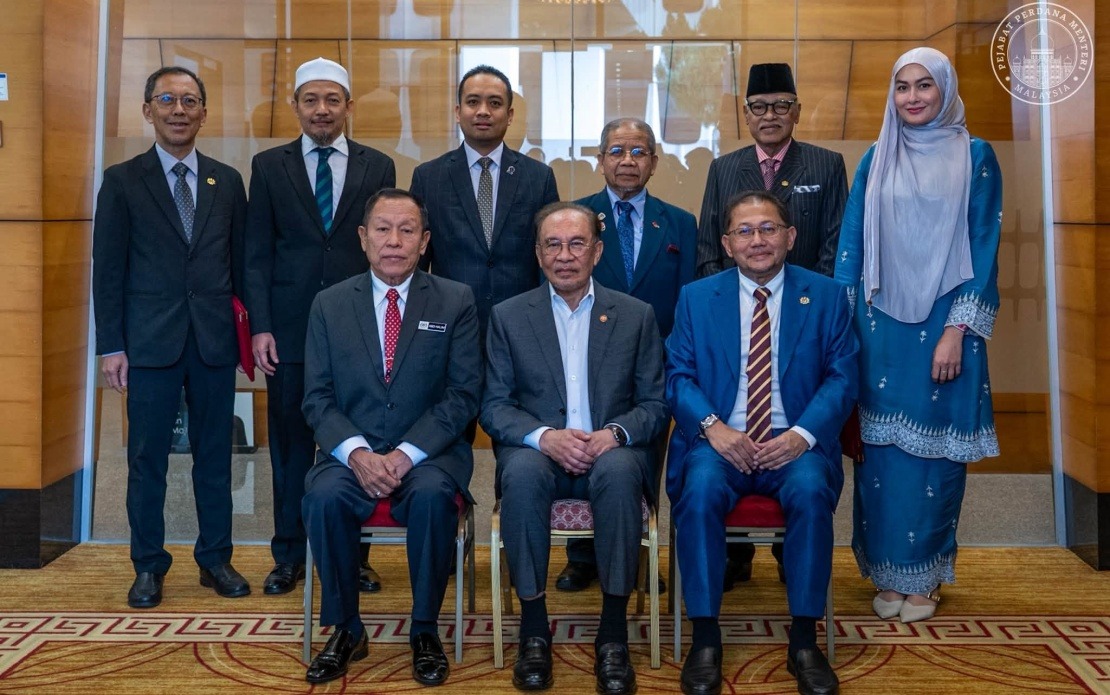
Prime Minister Datuk Seri Anwar Ibrahim has underscored the necessity of a comprehensive, multi-sectoral approach to combating corruption, asserting that no single body can address the challenge independently. Speaking on the appointment of fresh committee members, he emphasised the critical importance of seamless cooperation among enforcement agencies, oversight bodies, the legislative branch, public and private sector organisations, and the broader community to achieve meaningful progress against corrupt practices.
The Prime Minister's remarks came as he formally presented appointment instruments to newly selected members of the Special Committee on Corruption (JKMR) and the Anti-Corruption Advisory Board (LPPR) at Parliament, following approval from the Yang di-Pertuan Agong. This parliamentary ceremony underscored the constitutional significance of these appointments and the institutionalised role these committees play within Malaysia's governance framework. By conducting the appointment process transparently within the legislative chamber, the government signalled its commitment to accountability and institutional propriety in the selection of individuals tasked with overseeing anti-corruption mechanisms.
Anwar stressed to the newly appointed members the importance of strengthening their personal commitment to advancing Malaysia's anti-corruption agenda. Despite their diverse professional and personal backgrounds, he highlighted that all appointees share a unified obligation to reinforce the nation's capacity to detect, investigate, and prevent corruption across government and the wider economy. This emphasis on shared purpose, transcending sectoral or partisan boundaries, reflects a deliberate strategy to build consensus around integrity as a foundational national value rather than a politically divisive issue.
The JKMR operates as a legally constituted oversight mechanism established under Section 14 of the Malaysian Anti-Corruption Commission Act 2009. Its membership draws from both the Government and Opposition benches of the Dewan Rakyat and the Senate, a structural arrangement designed to ensure balanced representation and prevent any single political faction from dominating the body's direction. This cross-party composition theoretically enables the committee to function as a genuine check on executive power while maintaining legislative credibility. The inclusion of opposition members signals an institutional acknowledgment that anti-corruption efforts transcend party politics and must command support across the political spectrum.
Parallel to the JKMR's legislative focus, the LPPR operates under Section 13 of the same legislation, drawing its members from individuals of demonstrated integrity who have either provided exemplary public service or achieved professional distinction. This advisory board, by design, incorporates perspectives from sectors beyond government, including academics, business leaders, civil society figures, and other accomplished professionals. The dual-track structure—one politically representative, one meritocratic—reflects Malaysia's attempt to balance democratic legitimacy with specialised expertise in building institutional safeguards against corrupt behaviour.
The conceptual framework underpinning Malaysia's anti-corruption architecture recognises that enforcement alone proves insufficient without complementary engagement from multiple stakeholders. Enforcement agencies such as the Malaysian Anti-Corruption Commission provide investigative capacity and prosecutorial tools, but these tools operate more effectively when supported by whistleblower protection, corporate compliance standards, and public vigilance. Similarly, private sector cooperation becomes essential when large-scale corruption involves commercial entities, requiring companies to embed integrity into procurement, contracting, and financial reporting processes.
For Malaysian readers and regional observers, the Prime Minister's statement carries implications extending beyond institutional rearrangement. The appointment of fresh committee members represents an opportunity to reset expectations about the government's commitment to tackling corruption, particularly given Malaysia's historical struggles with graft and the political sensitivities surrounding previous anti-corruption efforts. The emphasis on collective responsibility places accountability not solely on investigating agencies but on all institutions and individuals operating within Malaysia's political economy.
The timing of these appointments also warrants consideration within Malaysia's broader political context. Following the appointment of newly constituted oversight bodies, public expectations will focus on whether these committees demonstrate genuine independence and whether their findings and recommendations translate into concrete policy changes or enforcement actions. The challenge facing both the JKMR and LPPR lies in maintaining credibility with the public while operating within institutional constraints and political realities that may sometimes conflict with the pursuit of accountability.
For the private sector and civil society, the Prime Minister's framing of anti-corruption as a collective endeavour suggests expectations for increased engagement in compliance and reporting. Malaysian businesses operating in competitive procurement environments, particularly those dealing with government contracts, may anticipate closer scrutiny and stronger requirements for transparency. Similarly, civil society organisations, media outlets, and academic institutions receive implicit invitations to contribute to anti-corruption efforts through investigative journalism, research, and public advocacy.
The success of Malaysia's anti-corruption framework ultimately depends on whether these institutional mechanisms translate into deterrence and behaviour change across the political and commercial landscape. Historical experience demonstrates that committees and advisory boards, however well-intentioned, cannot function effectively without sustained political will, adequate resourcing, and genuine protection for those individuals within institutions who champion reform efforts. The Prime Minister's emphasis on collective effort implicitly acknowledges that no structural innovation succeeds in isolation.
Regionally, Malaysia's multi-stakeholder approach to anti-corruption aligns with broader Southeast Asian trends toward institutional pluralism and checks-and-balances governance. Neighbouring countries including Indonesia and the Philippines have similarly experimented with independent commissions, parliamentary oversight committees, and advisory bodies designed to fragment corruption-enabling concentrations of power. The regional significance lies in whether Malaysia's approach proves more durable and effective than alternatives, potentially influencing governance reform trajectories across the Association of Southeast Asian Nations.

