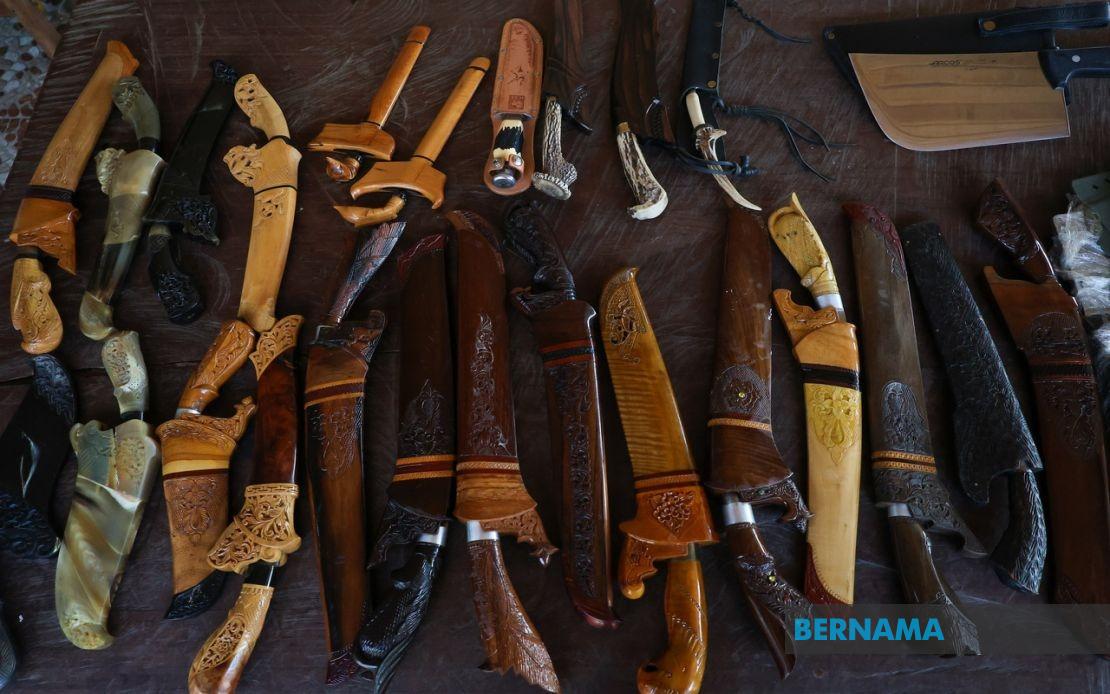
Ahmad, a 71-year-old enthusiast in Kelantan, stands at the front line of efforts to preserve one of Malaysia's most threatened cultural traditions: the art of traditional blacksmithing. Through his careful stewardship of a collection containing more than 100 weapons worth an estimated RM20,000, he embodies the struggle to maintain a craft that has increasingly slipped from public consciousness as elder master craftsmen have died without passing their knowledge to the next generation.
The iconic bird-headed golok, a traditional Kelantanese blade distinguished by its distinctive avian-shaped hilt, represents far more than a functional tool in Ahmad's eyes. It serves as a tangible symbol of a fading cultural legacy, each handcrafted piece carrying the individual artisan's signature technique and creative vision. In an era of mass production and industrial manufacturing, these blades have become exponentially more valuable precisely because they remain irreplaceable expressions of heritage and personal craftsmanship that cannot be reproduced once the maker has passed away.
Ahmad's perspective on the craft extends beyond mere collection. He views each death of a traditional blacksmith as an irreplaceable loss—not simply of a person, but of accumulated knowledge, refined technique, and cultural understanding that often vanishes entirely when no apprentice or family member stands ready to inherit the master's methods. This transmission of skills has historically formed the backbone of Malaysia's artisanal traditions, yet that chain has been fractured in recent decades as younger generations pursue formal education and urban employment rather than apprenticeships in traditional trades.
The bird motif adorning these goloks carries particular historical resonance within Kelantan's maritime heritage. Ahmad connects these ornamental elements to the Petalawali bird figures that once graced the ancient boats of the Kelantan Sultanate, vessels that served crucial administrative and ceremonial functions centuries ago. This historical continuity demonstrates how traditional weapons transcend their utilitarian purpose to become repositories of cultural memory and artistic expression spanning generations.
Beyond aesthetics, the bird-shaped hilt provides genuine ergonomic advantages that centuries of refinement have perfected. The curvature and balance point accommodate the natural grip of the human hand, a practical achievement born from countless hours of experimentation and adjustment by generations of craftsmen. Modern industrial designers might spend months developing similar functionality through computer modelling; traditional blacksmiths arrived at equivalent solutions through intuitive understanding of form and function refined over decades of hands-on work.
Maintaining such a collection demands rigorous discipline and technical knowledge. Ahmad treats preservation with the seriousness of a museum curator, storing each weapon in a dedicated cabinet and conducting systematic inspections every three months. This preventative maintenance regimen, involving careful application of protective oils to blade surfaces, reflects his understanding that these objects represent irreplaceable cultural assets vulnerable to oxidation, rust, and environmental degradation. Without such meticulous attention, the physical integrity of these weapons—and the craftsmanship they embody—would deteriorate beyond recovery.
Ahmad's journey into traditional weaponry began approximately two decades ago through informal apprenticeship, working alongside a blacksmith friend to learn the intricacies of hilt and scabbard construction. This personal connection to the craft provides him with informed appreciation that most casual collectors cannot access, allowing him to recognise not merely the monetary value but the technical excellence and historical significance embedded within each piece. His education through hands-on experience demonstrates how such traditional knowledge transmission, though increasingly rare, remains possible when dedicated individuals commit to learning.
His collection's geographic diversity reveals Malaysia's historical position within broader regional and international weapon-trading networks. Acquisitions from Germany, Sweden, Denmark, England, the United States, Japan, China, Spain and Portugal illustrate how Malaysian metalwork traditions engaged with global influences while maintaining distinctive local characteristics. Among his particularly treasured pieces are a knife featuring a Sarawakian deer-antler hilt and a keris constructed from black kemuning wood with a golden kemuning wood handle—examples showing how Malaysian artisans integrated local materials with sophisticated aesthetic principles.
Despite receiving approaches from collectors willing to pay substantial sums, Ahmad has consistently refused to part with his collection. This decision reflects his conviction that these weapons constitute cultural property that transcends personal ownership or monetary value. Many blades were crafted by blacksmiths now deceased, their techniques and personal innovations locked within the objects themselves and irretrievable once dispersed into private collections worldwide. Ahmad recognises that his role involves temporary custodianship of national heritage rather than proprietorship in the conventional sense.
The broader implications of Ahmad's preservation efforts extend throughout Southeast Asia, where similar traditional crafts face extinction as globalisation accelerates and younger populations gravitate toward different economic opportunities. Malaysia's blacksmithing heritage, once foundational to Kelantanese identity and economic life, now depends upon individuals like Ahmad to maintain continuity during a transitional period. Without such dedicated preservation efforts, knowledge systems refined over centuries could disappear within a single generation.
Ahmad's vision articulates a path forward that many heritage advocates across the region now advocate: innovation that honours rather than abandons tradition. He believes Malaysia's weapon-making heritage can remain vital through contemporary applications and artistic evolution, provided the foundational identity, technical mastery, and cultural values defining the craft remain intact. This approach differs fundamentally from museumification, which preserves objects while allowing the living tradition to atrophy. Instead, Ahmad envisions a future where traditional blacksmithing adapts to modern contexts whilst maintaining its essential character.
The challenges confronting Malaysia's traditional blacksmithing communities mirror those facing artisanal traditions across developing nations. Economic pressures, educational priorities favouring formal credentials over apprenticeship, and the dominance of industrial manufacturing create structural barriers to knowledge transmission that individual efforts, however dedicated, struggle to overcome. However, Ahmad's example demonstrates that preservation remains achievable through personal commitment, suggesting that institutional support and cultural recognition could amplify such grassroots conservation efforts substantially.

