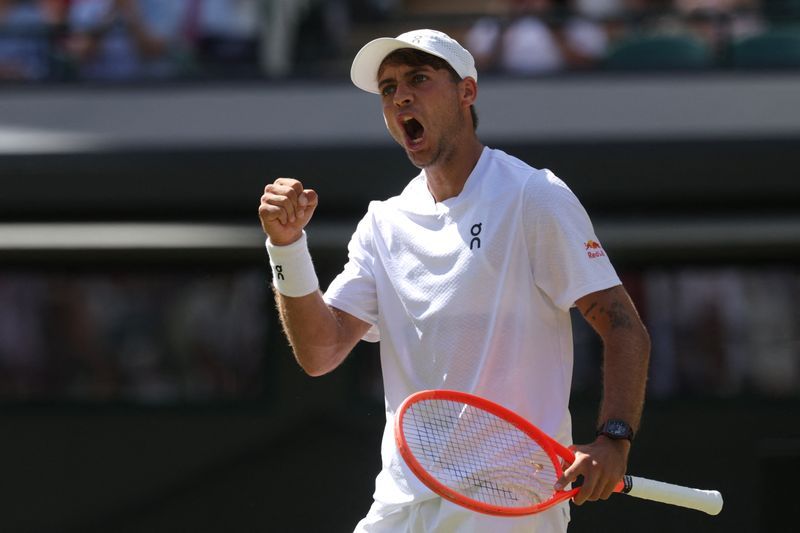
Flavio Cobolli's remarkable trajectory through this year's Grand Slam season reached another milestone on Monday when the Italian ninth seed dispatched Australian fifth seed Alex de Minaur 7-5, 7-6(4), 6-3 on Court One at the All England Club. The victory marks Cobolli's return to the Wimbledon quarter-finals for the second successive year, cementing what has become the most significant career achievement of the 24-year-old's professional journey. Coming merely weeks after his runner-up finish at the French Open, Cobolli's progression through the tournament's early rounds has demonstrated a growing ability to sustain his game across consecutive weeks of Grand Slam competition—a benchmark that separates rising talents from consolidated contenders.
Cobolli's measured approach to the encounter with De Minaur bore the hallmarks of a player learning to manage energy expenditure across extended tournaments. After securing the opening set in 50 minutes through a break of De Minaur's serve in the 11th game, Cobolli acknowledged the physical toll that the tour has exacted. His commentary following the victory revealed a strategic mindset focused on preserving resources for the matches ahead rather than celebrating the immediate achievement. This perspective, unusual for a player of his age in the midst of career-defining moments, suggests a maturity in understanding the demands of elite professional tennis that extends beyond stroke-making and tactical awareness.
The second set developed into a tense struggle punctuated by the extraordinary heat affecting the London tournament. A spectator collapsed during play, necessitating a halt to proceedings and prompting stoppages that fragmented the rhythm of the encounter. Rather than allowing such disruptions to disturb his concentration, Cobolli engaged in respectful exchanges with both the crowd and his opponent during the interruption. De Minaur, despite his seeding and established credentials as a top-five competitor, found himself unable to impose his typically aggressive baseline game. Cobolli's recovery from 2-5 down to force a tiebreak, which he won 7-4, shifted the psychological balance decisively in his favour and demonstrated the mental resilience required to navigate tournaments under increasingly challenging conditions.
The third set saw Cobolli assert his dominance more comprehensively. After surrendering the first two games, he reeled off an impressive sequence of consecutive victories that allowed him to overturn another break point deficit and finally subdue De Minaur's resistance. The Italian's aggressive stroke selection during crucial moments, particularly his powerful hitting to navigate the tension points that characterised the latter stages of the second set, proved instrumental in closing out the match efficiently. This capacity to elevate intensity precisely when the pressure mounted speaks to a player whose technical foundation has been supplemented by improved tactical awareness and emotional regulation.
Cobolli's respect for De Minaur, expressed in candid remarks following the victory, illustrated the camaraderie that exists among elite competitors despite the professional necessity of defeating one another. De Minaur's warning to expect further heat-related stoppages proved prescient, and both players demonstrated professionalism in managing the disruptions that threatened to derail the contest. The acknowledgment that the pairing finished with only two stoppages rather than more extensive delays highlighted the genuine concern surrounding player welfare in an era of increasingly hostile playing conditions at major tournaments. For Southeast Asian readers familiar with similar climatic challenges in regional tournaments, this dimension of the story resonates deeply, illustrating how global tennis must adapt its infrastructure and scheduling to protect player safety.
The draw for Cobolli's quarter-final encounter presents a genuine advantage in the form of a matchup against either British hopeful Arthur Fery or Bulgarian veteran Grigor Dimitrov. Both potential opponents have experienced success at Wimbledon during the current fortnight, yet neither represents the kind of seeding rank or proven major championship pedigree that would typically intimidate a player of Cobolli's current trajectory. Dimitrov, in particular, represents a player whose career arc—marked by extraordinary early promise that produced fewer Grand Slam titles than expected—offers a cautionary precedent for players attempting to consolidate breakthrough moments into sustained success.
When asked about his preparation plans and interest in observing Fery's and Dimitrov's fourth-round encounter, Cobolli's response provided insight into the mental and physical strategies that successful athletes employ during intense tournaments. Rather than immediately consuming tactical footage of his potential next opponent, he opted for ice cream and pasta prepared by his father—a choice that prioritised physiological recovery and family connection over obsessive strategic preparation. This balancing act between dedication and perspective represents a healthy approach to professional sport that acknowledges the importance of maintaining emotional reserves alongside physical ones. Many younger players, caught in the pressure cooker of professional sport, neglect such recuperative activities in favour of endless analysis.
Cobolli's reference to watching Spain and Portugal's World Cup encounter—a comment that may perplex tennis-focused observers unfamiliar with the cross-pollination of sporting interests among continental European athletes—reveals the broad cultural context in which European professional tennis operates. For Malaysian and Southeast Asian readers, this serves as a reminder that the professional athletes dominating global sports occupy complex cultural environments where national sporting identities extend across multiple disciplines. The ease with which Cobolli transitions between his own professional demands and the football calendar illustrates how major sporting events create a shared temporal landscape that frames an athlete's year.
Looking forward, Cobolli's progression to the quarter-finals of two consecutive Wimbledon tournaments, achieved while maintaining recent French Open momentum, suggests that his emergence as a genuine force in men's tennis represents more than a transient surge in form. The question that now preoccupies observers concerns whether this period of elevated performance can be sustained across the remainder of the season and into future years. The Italian must now confront either Fery or Dimitrov while managing accumulated fatigue and the psychological weight of escalating expectations—the precise juncture where promising careers either consolidate into sustained excellence or encounter the inevitable regression that separates fleeting breakthroughs from genuine ascendancy in professional sport.

