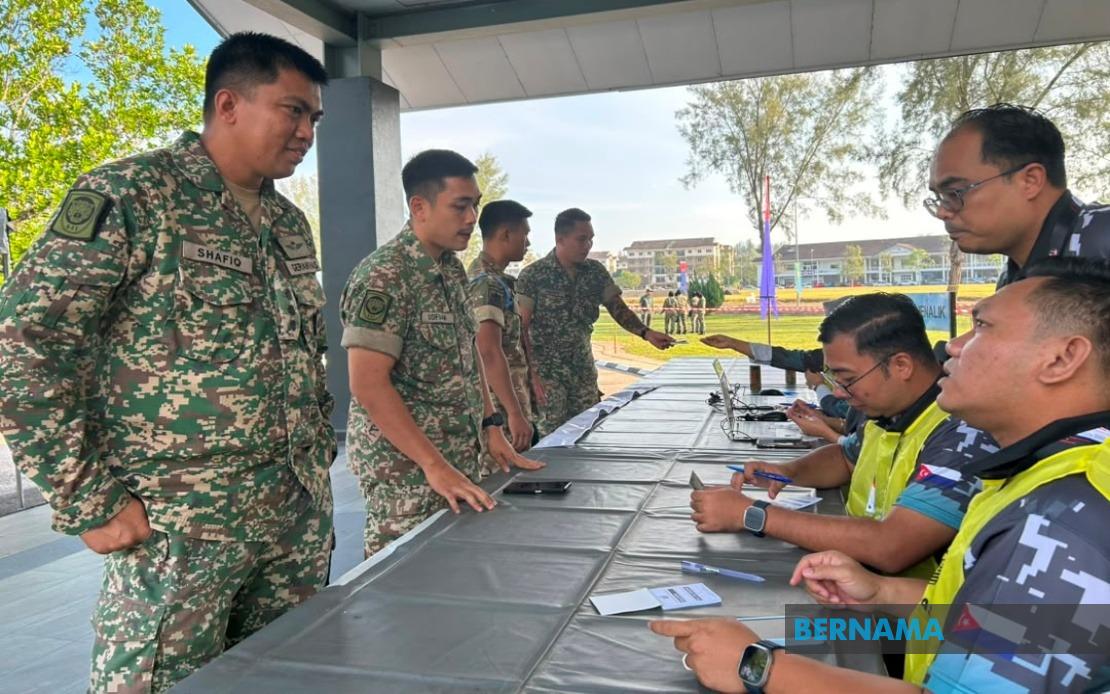
The 16th Johor state election got off to an auspicious start on July 7 as early voting commenced under clear skies, allowing security forces and their families to cast their ballots without weather-related disruptions. The opening of 64 dedicated polling centres from 8 am proved timely for the anticipated turnout, with security personnel arriving from as early as 7.30 am to participate in this preliminary voting phase. The benign weather conditions at polling locations streamlined the movement and processing of both election officials and voters, creating an orderly environment for what Electoral Commission officials described as a smooth electoral exercise.
The early voting mechanism, designed to accommodate 24,751 voters unable to participate on the main polling day, drew substantially from the uniformed services. Among those voting early were 12,041 personnel from the Malaysian Armed Forces and their spouses, alongside 12,710 members of the Royal Malaysia Police and General Operations Force, together with their partners. This arrangement reflects standard electoral practice in Malaysia, where security and law enforcement personnel are afforded the opportunity to vote in advance, given their potential deployment on the actual election day. The Election Commission's decision to stagger centre closures between noon and 6 pm based on locality and voter density demonstrated careful administrative planning to manage the movement of voters across the state.
The Malaysian Meteorological Department issued cautionary weather forecasts even as morning conditions remained favourable, warning that thunderstorms would likely develop across Johor during the afternoon hours. This advance notice allowed the Election Commission and security coordinators to complete early voting operations ahead of the anticipated inclement weather, minimising potential disruptions. While the morning's clement conditions enabled efficient processing, the threat of afternoon storms highlighted the precarious timing of electoral operations during Malaysia's monsoon season, a recurring challenge for administrators conducting elections during this period.
Field observations from Bernama correspondents at several major polling locations, including the 5th Battalion GOF Camp in Simpang Renggam, Johor Contingent Police Headquarters, and Mahkota Kluang Camp, confirmed that voting procedures proceeded without significant complications. Election Commission personnel had completed comprehensive final checks before centre openings, ensuring voter registration rolls were accurate, ballot papers properly distributed, and polling booths appropriately configured. This pre-election preparation reflected institutional commitment to maintaining electoral integrity and voter confidence in the democratic process.
The early voting phase represented merely the opening chapter of Johor's electoral exercise. Saturday's main polling day would see the broader electorate of 2,727,926 registered voters converge at 1,140 polling centres distributed throughout the state to determine representation across 56 state assembly constituencies. The magnitude of this electoral undertaking—involving nearly 2.73 million voters casting ballots to select 172 candidates contesting the 56 seats—underscores the complexity of managing democratic participation across a state of Johor's geographic and demographic scale.
The structure of Johor's state assembly and its 56 constituencies reflects the state's role as one of Malaysia's largest and most populous territories. The presence of 172 candidates indicates competitive contests across multiple seats, suggesting genuine competition between political formations vying for voter support. This diversity of candidature and the substantial voter base engaged in the selection process render this election significant not merely as a state-level exercise, but as a barometer of political sentiment that may carry implications for national political dynamics, given Johor's strategic position and electoral weight within Malaysia's broader political landscape.
The electoral process gains particular significance given Johor's historical importance in Malaysian politics. As a major state with substantial population and economic resources, electoral outcomes in Johor have frequently influenced broader national political calculations and coalition-building among political parties. The 2024 election therefore attracted attention from political observers seeking insights into voter preferences and regional political trends that might shape subsequent national developments.
The Election Commission's logistical execution on early voting day demonstrated the institutional capacity to manage large-scale voting operations while maintaining procedural standards. The coordination required to accommodate 64 simultaneous polling centres, process nearly 25,000 voters, and ensure security personnel could fulfil their electoral obligations while maintaining their professional responsibilities illustrated the sophisticated administrative infrastructure supporting Malaysia's electoral system. Such operational competence underpins public confidence in the democratic process and the reliability of electoral results.
Looking toward Saturday's main polling day, the early voting phase had proceeded without recorded incidents or controversies, establishing a positive trajectory for the election's continuation. The meteorological department's forecast of potential afternoon storms on that weekend date would present a different challenge, with weather potentially affecting voter turnout and polling centre logistics on a substantially larger scale. Election officials would likely draw upon the lessons and observations from early voting operations to refine preparations for managing the main polling day's more extensive operations.
The Johor election underscores Malaysia's ongoing commitment to regular democratic exercises and the integration of electoral participation into national governance processes. The constitutional framework permitting state-level elections independent of federal electoral timings enables localized democratic engagement and allows voters to express preferences on state-specific issues and candidates. This electoral exercise therefore represents not merely an administrative exercise, but an affirmation of democratic values and participatory governance principles embedded within Malaysia's constitutional arrangements and political culture.

