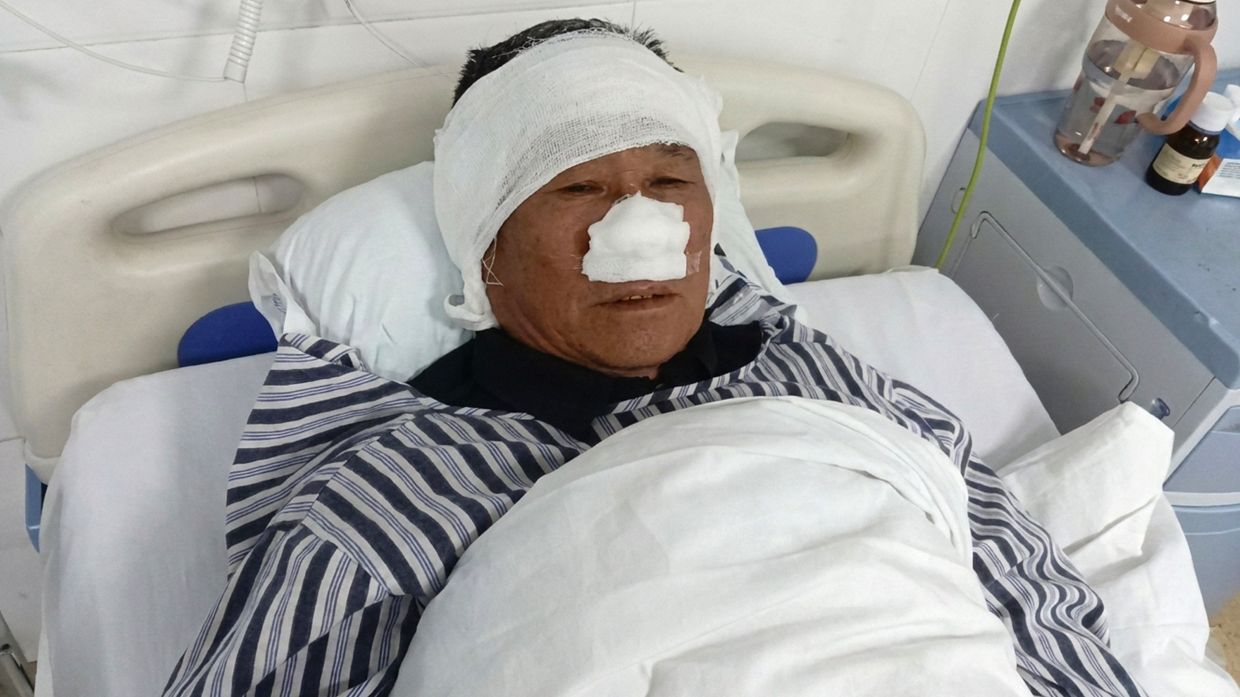
In one of China's most remarkable recent examples of everyday heroism, a 69-year-old man from Chenzhou in Hunan province has been formally honoured by his nation's government after suffering life-altering injuries while protecting a stranger from violent assault. Zeng Fanlin, whose selfless intervention in April resulted in the permanent disfigurement of his face, was among 86 individuals named to China's latest list of "national heroes for a just cause" on July 9, recognition that underscores both the severity of his sacrifice and the societal values that prompted his instinctive decision to act.
Zeng's background shaped a lifelong commitment to community service and civic responsibility. Orphaned during childhood, he was raised through the collective support of villagers and later benefited from government-funded education that allowed him to attend school without charge. This formative experience of receiving help during vulnerability appears to have instilled in him a deep sense of obligation to reciprocate that kindness. Over the decades, he transitioned from serving as an elected village official into volunteer mediation work, positioning himself as a trusted figure who helped resolve disputes and maintain social harmony within his community. Such roles typically attract conscientious individuals motivated by principles rather than financial reward.
The violent incident that would transform Zeng's life unfolded in April when an unknown man in his twenties entered the village and embarked on an erratic, destructive rampage. According to local media accounts, the attacker targeted both property and people indiscriminately, kicking down doors and assaulting passers-by without apparent provocation. The rampage escalated when he accosted a woman riding an e-bike, seizing her by the neck and subjecting her to what appeared to be a strangulation attempt. The situation represented an immediate, life-threatening emergency with few bystanders willing to intervene physically. Instead, witnesses called police and watched from a distance, paralysed by fear of the attacker's evident volatility and capacity for violence.
Zeng arrived on the scene as the assault was occurring and, confronted with a woman facing potential death, made an instantaneous decision to intervene directly. He rushed the attacker and managed to bring him to the ground, initiating a physical struggle to subdue the man. Two additional villagers quickly recognised what Zeng was attempting and joined the effort to restrain the assailant. During this chaotic melee, the attacker—perhaps as a last resort or reflexive act of desperation—bit into Zeng's face with sufficient force to sever a substantial portion of his nose. Yet despite experiencing what would undoubtedly be excruciating pain and the shock of such a traumatic injury, Zeng maintained his grip and held the attacker in place until police arrived at the scene. His persistence in those critical moments, even as he suffered severe facial injury, almost certainly prevented further violence and potentially saved the woman's life.
The attacker was taken into police custody, while Zeng underwent emergency medical transport to hospital for treatment of injuries that would prove far more consequential than typical assault wounds. Investigators determined that the suspect had acted violently after losing emotional control, though the precise triggers remained unclear as the case proceeded through investigation. The woman Zeng rescued has not made any public statements about the incident, choosing to maintain privacy regarding her traumatic experience. Under China's criminal law framework, intentionally inflicting serious bodily harm carries potential sentences ranging from three to ten years imprisonment, and the strangulation attempt would likely elevate charges even further.
The medical assessment of Zeng's injuries presented a sobering reality. Doctors reported that most of his nose had been lost in the attack, presenting reconstructive challenges that extended far beyond typical cosmetic surgery. The surgical team warned of potential long-term complications, including chronic pain and extensive scarring that would likely persist for the remainder of his life. The severity of tissue loss meant that simple closure was impossible; instead, surgeons would need to harvest healthy skin from other areas of his body—specifically his head—to attempt reconstruction of both the nasal structure and the nasal wings that are critical for normal breathing function.
The financial burden of this reconstruction proved substantial, with medical costs exceeding 70,000 yuan (approximately US$10,000), an amount that would represent a significant hardship for most rural villagers in central China. However, government support mechanisms stepped in to cover these expenses, ensuring that Zeng's act of heroism would not consign him to financial ruin. Additionally, the Alibaba Foundation and local media outlets subsequently presented Zeng with an additional 20,000 yuan as recognition of his bravery, providing some monetary acknowledgment of his sacrifice beyond the medical assistance.
Zeng has since undergone two surgical procedures with measured success. Surgeons successfully rebuilt his nose using the skin graft harvested from his head and restored the nasal wings, which allowed him to recover breathing capacity that had been compromised by his injuries. However, the long-term consequences of his heroism remain evident in his daily life. Zeng continues to experience significant pain on a consistent basis, a constant physical reminder of the cost of his intervention. The scarring and altered appearance that result from reconstructive surgery following such severe trauma are permanent, marking him visibly as someone who paid a price for his principles.
When asked to reflect on the magnitude of his sacrifice in interviews with local media, Zeng demonstrated the philosophical perspective that appears to have guided his actions throughout his life. "Compared with saving a life, everything I have given is worth it," he told journalists, a statement that captures both his hierarchy of values and his absence of regret despite the permanent consequences he now endures. His daughter has publicly described her father as a man possessed of a strong innate sense of justice—someone fundamentally incapable of standing passively by when witnessing wrongdoing. This characterisation aligns with his documented history of community service and with a 2016 incident in which he assisted police in apprehending a thief, suggesting that his April intervention was entirely consistent with his established character rather than an aberration.
Zeng's recognition as a national hero carries significance beyond his individual circumstances. In a societal context where concerns about bystander apathy and the reluctance of citizens to intervene in public emergencies have generated substantial discussion in China, Zeng's actions and subsequent official recognition serve as powerful symbolic affirmation that such intervention is valued and will be honoured. The government's decision to include him among 86 individuals named to the national heroes list signals that individual acts of moral courage—particularly those involving personal sacrifice—remain central to the nation's conception of exemplary citizenship. Online responses to his story have emphasised both admiration for his heroism and demands that the attacker face appropriately severe punishment, reflecting broader public sentiment that those who would harm others should face serious consequences while those who protect others deserve protection and recognition in return.

