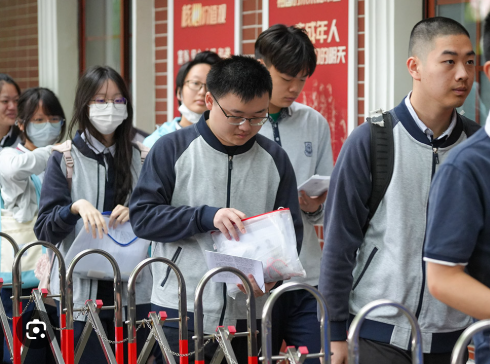
A tightening crackdown on examination integrity across Chinese universities has prompted sweeping prohibitions against smart devices, as institutions struggle to contain a sophisticated form of academic dishonesty involving wearable technology. Multiple universities have enacted strict bans on items including smart glasses, smartwatches, wireless earbuds, and fitness trackers, reflecting mounting evidence that students have discovered ways to leverage these gadgets to circumvent examination security. The measures signal a significant escalation in the cat-and-mouse game between academic institutions and those seeking unfair advantage through technological means.
South China Agricultural University in Guangdong province initiated formal warnings to its student body on July 1 after identifying numerous instances of attempted cheating using electronic devices smuggled into testing facilities. The university's notification made clear that any apparatus containing communication, storage, photography, or transmission capabilities—including mobile phones, smart eyewear, smartwatches, Bluetooth earbuds, and concealed earpieces—faces outright prohibition. Critically, the university's policy stipulates that mere possession of such devices within examination premises constitutes cheating, irrespective of whether the device was activated or actually utilised during the test.
The consequences outlined by South China Agricultural University are severe enough to deter all but the most determined offenders. Students found in violation face a zero score in the affected subject combined with a demerit notation that eliminates eligibility for awards, scholarships, or membership in the Communist Party of China. More serious infractions trigger additional disciplinary action that can have lasting implications for academic standing and career prospects. This graduated penalty structure reflects institutional determination to establish clear boundaries and enforce them with meaningful consequences.
Technological countermeasures have become integral to the enforcement strategy. South China Agricultural University has deployed artificial intelligence-powered surveillance systems capable of monitoring examination halls in real time, with algorithms designed to flag suspicious patterns including unidentified objects, inter-student item exchanges, excessive head movement, and hands concealed beneath desks. This technological response underscores how institutions are fighting technological cheating with more advanced technological solutions, creating an arms race of sorts within the academic examination ecosystem.
Other major universities have publicly documented specific incidents to underscore the seriousness of the problem. Xuchang University in Henan province reported on June 29 that five students had brought electronic devices into final examinations—three carrying apparatus pre-loaded with exam materials and two operating devices capable of bidirectional information transmission to facilitate answer retrieval. Hubei University of Technology disclosed on June 23 that a student received a ten-month demerit period for introducing an electronic device containing examination materials into a final English assessment. Zhongnan University of Economics and Law in Hubei province issued targeted warnings about smart glasses specifically, characterising such devices as sophisticated information-transmission equipment that can wirelessly convey answers, archive study materials, and photograph examination papers.
National oversight bodies have reinforced these institutional responses with formal regulatory guidance. China's Ministry of Education has explicitly classified the transmission of information via electronic devices during examinations as cheating, with prescribed consequences including complete invalidation of all examination results for affected candidates. The ministry issued a specific advisory on June 2 concerning the 2026 national college entrance examination, commonly referred to as gaokao, reminding all participants that introducing smart devices into examination venues constitutes cheating regardless of intent, usage, or device activation status. This unambiguous messaging aims to eliminate any perceived grey areas or loopholes in student understanding of permissible conduct.
Underlying these enforcement actions is the genuine technological capability that has emerged in wearable artificial intelligence. Research from Hong Kong University of Science and Technology, reported by China Newsweek in December 2025, demonstrated the practical feasibility of using modified commercial smart glasses integrated with the GPT-5.2 language model to complete examinations. In a controlled demonstration, a test participant wearing such glasses read answers displayed on the device's lenses and completed a Computer Network Principles examination in thirty minutes, achieving a score of 92.5 per cent. This evidence of technological viability provides sobering validation of institutional concerns about wearable-based cheating schemes.
Industry professionals acknowledge that detection and prevention remain challenging as wearable technology evolves. Lin Che, a product manager with extensive experience in smart eyewear manufacturing, told China Newsweek that smart glasses present particular vulnerability because university regulatory frameworks have not evolved at the pace of hardware innovation. Lin noted that as smart glasses continue to diminish in size and increasingly resemble ordinary spectacles, visual identification during examination oversight becomes progressively more difficult. The product manager suggested that manufacturers could facilitate identification by incorporating conspicuous design elements, such as visible indicators for camera functionality, thereby assisting proctoring staff in distinguishing prohibited devices from legitimate eyewear.
The escalating arms race between examination security and wearable technology carries implications for educational institutions throughout East and Southeast Asia, including Malaysia. As artificial intelligence capabilities become more accessible and hardware becomes more miniaturised, universities across the region should anticipate similar pressure to modernise examination protocols and supervision methodologies. Malaysia's higher education institutions may find themselves confronting comparable challenges as students gain access to sophisticated wearable devices, necessitating proactive policy development before widespread cheating incidents emerge. The experiences of Chinese universities offer instructive lessons regarding the importance of combining technological solutions with clear regulatory frameworks and credible enforcement mechanisms.
Beyond the immediate examination context, the Chinese university response illustrates broader tensions between technological advancement and institutional authority. The deployment of AI-powered surveillance systems capable of interpreting physical behaviour patterns raises questions about privacy, oversight scope, and the potential for false positives to affect innocent candidates. Institutions must balance legitimate security concerns with legitimate privacy expectations, a calculation that becomes more complex as monitoring technology becomes more sophisticated. The resolution of this tension will likely shape how educational institutions globally approach examination security in the artificial intelligence era.

