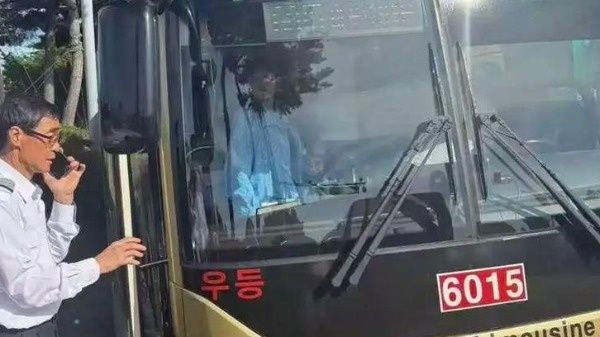
A routine airport transfer became an extraordinary test of human courage and quick thinking on Saturday afternoon when a group of Chinese tourists prevented what could have been a catastrophic incident aboard an airport bus travelling from central Seoul to Incheon International Airport. The No 6015 bus, carrying more than a dozen passengers predominantly from China, was travelling at speed when its driver suddenly lost consciousness, causing the vehicle to veer dangerously and scrape against a roadside guardrail. What unfolded in those chaotic moments would later be hailed across social media in both China and South Korea as a remarkable display of collective bravery and composure.
Sun Qian, a 35-year-old visitor from Nanjing in Jiangsu province, was seated in the second row directly behind the driver when she noticed something was catastrophically wrong. Working in the health sector back in China, she had travelled to Seoul to study a local health programme but instead found herself in a life-or-death situation. Describing the moment to China Daily, Sun recalled her immediate instinctive response: she rushed forward and grabbed the steering wheel to stabilise the vehicle as it threatened to career across multiple lanes. Her training and professional background in healthcare may have sharpened her ability to respond without panic, but those critical first seconds demanded nothing more than decisive action and physical strength.
Simultaneously, another female passenger scrambled to locate the emergency braking system, demonstrating the kind of spontaneous coordination that can only emerge when multiple people recognise an existential threat simultaneously. Within seconds of the initial collapse, the two women had managed to arrest the bus's dangerous trajectory. Sun pressed the emergency brake button while fellow passengers engaged the handbrake, gradually bringing the massive vehicle under control despite the enormous physical effort required. Speaking afterwards, Sun acknowledged her nervousness at handling such an unwieldy piece of machinery, yet the alternative—allowing the bus to continue uncontrolled along a busy Seoul highway—never seemed to enter her calculation.
Du He, 33, also from Nanjing and sitting beside Sun, sprang into action with equal immediacy. While Sun and others wrestled with the steering mechanisms, Du attempted a traditional first-aid technique, attempting to stimulate the driver by pinching his philtrum. Within moments, however, she realised the severity of the situation: the driver had stopped breathing entirely, and his face was turning purple—unmistakable signs of cardiac arrest. The realisation transformed the emergency from a traffic crisis into a medical catastrophe. Rather than succumbing to despair or shock, Du and the other passengers organised themselves to begin cardiopulmonary resuscitation, taking turns at chest compressions despite having no professional medical training.
Sun, whose fluency in Korean proved invaluable in those moments, seized the driver's mobile phone and placed an emergency call to local services in Korean, describing their location and the driver's condition while other passengers continued the gruelling physical labour of CPR. The efforts were sustained and determined, with multiple passengers participating in the resuscitation attempt. Yet despite their best efforts, the situation proved beyond what untrained civilians could reverse. Within one or two minutes, the driver had no detectable pulse and no respiratory function, suggesting a catastrophic cardiac event that had already progressed too far. After emergency services arrived and the patient was transported to hospital, he died following approximately two hours of professional emergency treatment, with police subsequently opening an investigation into the precise cause.
What made this incident particularly fortunate was its timing and location. Du reflected afterwards that the highway carried relatively light traffic at that particular moment, meaning the uncontrolled bus did not trigger a cascade of secondary collisions that might have transformed one tragedy into multiple deaths. The passengers, who had been heading to Incheon International Airport for flights back to China, ultimately flagged down another bus and continued their journey, allowing them to complete their travel plans despite the traumatic detour. Yet the emotional weight of the experience proved delayed; both women reported that in the immediate aftermath, adrenaline and the demands of the crisis suppressed their full emotional response. Only upon arrival at the airport, when the danger had passed and the urgency evaporated, did the magnitude of what they had experienced fully register, triggering the delayed fear response that such experiences typically provoke.
The incident generated substantial coverage across Chinese and South Korean social media platforms, with observers from both countries expressing admiration for the tourists' composure and decisive action. South Korean internet users particularly remarked on the remarkable nature of remaining calm and acting so swiftly while facing a language barrier in a foreign country, while Chinese social media users praised the women extensively after they shared their account on the platform Xiaohongshu. However, both Du and Sun deflected much of the praise, emphasising that their actions were simply what any responsible person would have done in similar circumstances. Du argued that nationality played no role in the response—that Chinese citizens, like people everywhere, are naturally inclined to cooperate and assist in moments of crisis, and that the international nature of their actions reflected fundamental human values rather than cultural exceptionalism.
Sun stressed that the successful intervention resulted entirely from collective effort rather than individual heroism. She highlighted that one passenger had assisted in locating the brake, multiple others had participated in the CPR attempts, and everyone had worked in concert toward the singular goal of preventing a worse outcome. From her perspective, the true lesson of the incident involved the power of coordinated human action in extremity—the way that strangers can function as a unified team when faced with circumstances that transcend individual capability. The support offered by fellow countrymen in a foreign crisis, she suggested, created an emotional dimension that transcended mere technical coordination.
Though the effort ultimately could not save the bus driver's life, the swift intervention undoubtedly prevented what might otherwise have become a mass casualty incident. The bus, travelling at speed with minimal traffic control once the driver lost consciousness, might easily have collided with other vehicles, barriers, or infrastructure. The actions of Sun, Du, and their fellow passengers arrested that terrible momentum in the crucial first seconds when physical control of the vehicle remained possible. Their actions stand as a stark reminder that ordinary citizens, when circumstances demand, can rise to extraordinary challenges—and that international crises, transcending language and cultural boundaries, can unite strangers in common purpose.

