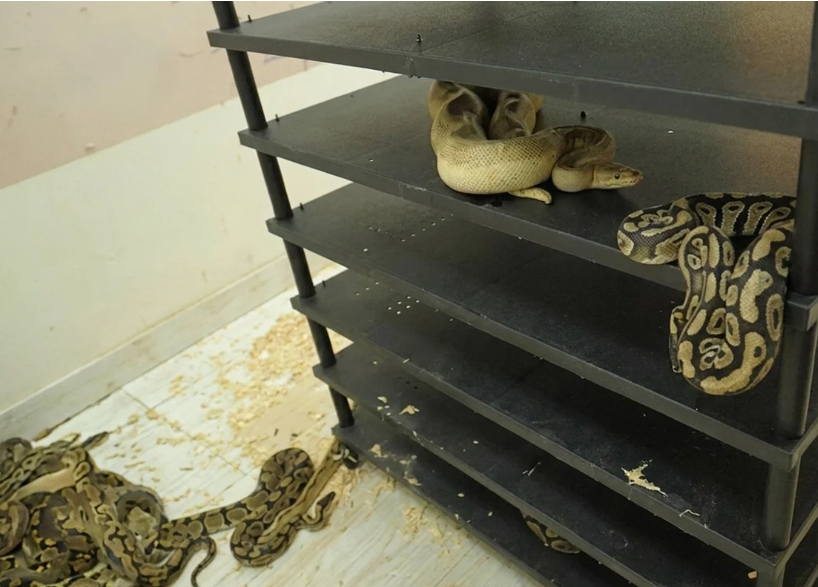
A resident of Taizhou in Zhejiang province has been sentenced to prison for operating an extensive illegal breeding operation involving more than 300 pythons inside his residential flat, a case that authorities revealed in late June as a serious breach of China's wildlife protection laws. The discovery came only after months of detective work that began with a simple report from a concerned elderly resident and evolved into one of the largest python seizures in the region, ultimately involving 436 reptiles valued at over 30 million yuan.
The investigation started innocuously in March 2024 when a senior citizen stumbled upon a large python near the base of a mountain in the Taizhou area. The tawny snake, as thick as an adult's arm, seemed wildly out of place in the region, prompting the elderly man to report his discovery to local police. Officers initially suspected the reptile had not wandered naturally into the area but rather had escaped from a captive breeding facility, reasoning that pythons remain largely inactive during March and are not native to the locality. This early hypothesis would prove crucial in redirecting the investigation toward a human source rather than treating the encounter as an isolated wildlife incident.
The breakthrough came when police consulted with a professional snake expert who provided critical insight into python husbandry. Pythons thrive only in carefully controlled environments where temperature and humidity remain consistently stable, typically maintained between 20 and 30 degrees Celsius. Any large-scale breeding operation would require substantial and continuous electricity consumption to power heating systems and maintain these precise conditions throughout the year. This observation led investigators to adopt an unconventional investigative strategy: cross-referencing residential electricity usage patterns across the surrounding area to identify households with abnormally high consumption that could not be explained by conventional domestic needs.
Using this utility-based approach, officers eventually identified a man surnamed Guo as their prime suspect. Guo lived alone in his flat, was unmarried, and listed as unemployed, which made his household's extraordinarily elevated electricity bills all the more suspicious. Further surveillance revealed that an associate named Di frequently visited Guo's residence and engaged in a suspicious pattern of behaviour. Di would regularly collect parcels from courier stations, and police traced these deliveries to multiple online purchases of small white mice. When officers contacted the online sellers, they discovered that bulk orders of small rodents are typically purchased by people maintaining reptile collections, as these animals serve as feeding stock for captive snakes and other predatory pets.
Digital investigations uncovered additional incriminating evidence. Guo had posted photographs of snakes across social media platforms and had made oblique references to selling pythons to interested buyers. Police also obtained transaction records showing that Di had sold two pythons to another individual for 1,000 yuan, establishing a clear commercial dimension to the operation. Armed with mounting evidence of illegal breeding and sales, authorities obtained warrants and arrested both Guo and Di, preparing for a raid on Guo's residence that would reveal the true scale of the operation.
When police officers entered Guo's flat, they encountered a sight that left them visibly unsettled. Plastic storage boxes were stacked throughout the rooms in towering columns, each container housing a living python. Guo had reorganised his entire living space to facilitate the breeding operation, confining all his personal furniture and bedroom necessities to a single room while converting the remaining two bedrooms and the living room into a vast python warehouse. The sheer density and scale of the collection shocked even experienced officers. In total, 309 pythons were seized from the flat and subsequently transferred to a local zoo for proper care and rehabilitation.
During questioning, Guo freely admitted to his long-standing obsession with snakes and expressed no fear whatsoever of the animals. He recounted beginning his collection in 2014 when he purchased four pythons, from which point forward he dedicated himself intensively to understanding and perfecting breeding techniques. Guo was quoted describing his endeavour in almost scientific terms, claiming he had developed the expertise to cultivate pythons in various colour variations and comparing himself to a "creature creator." This sense of pride and accomplishment appeared to motivate his activities far more than financial gain alone, suggesting the operation reflected both a commercial enterprise and a deeply personal passion project.
The investigation expanded further when authorities identified a shop owner named Deng who had sold four pythons to Guo back in 2014. Deng himself became a suspect, and police discovered an additional 47 pythons in his residence. Records showed that Guo and Di had successfully sold approximately 80 pythons to various buyers, demonstrating an active and ongoing black market in protected reptiles. The three defendants—Guo, Di, and Deng—all faced sentencing in a Taizhou court, though the specific prison terms imposed were not disclosed in the initial reporting. However, under China's Criminal Law, violations involving Grade Two protected animals such as pythons carry maximum penalties of five years imprisonment.
In China, pythons are classified as Grade Two protected animals under the nation's endangered species framework, making their unauthorised buying, selling, breeding, and transportation serious criminal offences. The case, with its total of 436 pythons valued at over 30 million yuan, represents one of the most significant wildlife protection violations prosecuted in the province. The operation's exposure also highlights evolving investigative techniques employed by Chinese authorities, who increasingly use unconventional data sources such as utility consumption records to identify illegal activities that might otherwise remain hidden. This approach proves particularly effective for activities like large-scale animal breeding that require sustained infrastructure investments that leave detectable traces in municipal records, offering lessons for law enforcement agencies throughout Southeast Asia grappling with wildlife trafficking and illegal breeding operations.

