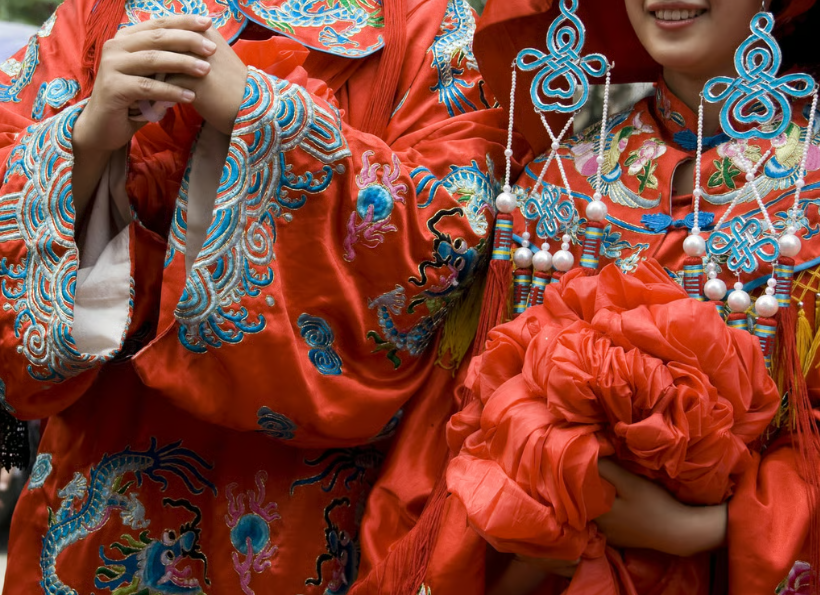
A court in Ruyang county, Henan province, has delivered a cautionary verdict against dangerous wedding customs, ordering a bride and groom along with nine groomsmen to pay 230,000 yuan (US$34,000) in compensation to a bridesmaid severely injured during a hazing ritual. The July ruling, made public by news portal gmw.cn, underscores mounting judicial concern over how traditional nuptial celebrations can spiral into acts causing serious bodily harm, a pattern increasingly visible across Chinese society.
The incident unfolded on October 4, 2023, when Zhang, a bridesmaid attending the wedding of her friend Li and the groom, found herself isolated in a wedding room with approximately ten men, most serving as groomsmen. After Zhang retreated into a cabinet—reportedly for an undisclosed reason—one groomsman identified as Wang Moubing forcibly extracted her and thrust her onto the bed. What followed exemplified how wedding revelry can transform into coordinated assault: Wang orchestrated the other men to grab the corners of a bedsheet and hoist Zhang skyward repeatedly. While the first toss succeeded, the second attempt ended in catastrophe when the men failed to maintain their grip, and Zhang plummeted to the floor, suffering a lumbar vertebral fracture that would demand eighteen days of hospitalization and long-term recovery.
The court's investigation revealed that even as the incident unfolded, the groom's aunt had passed through the room and explicitly cautioned the men against permitting the prank to escalate further. Her warning proved ineffective against the momentum of the gathering, demonstrating how group dynamics and the perceived acceptability of hazing can override even explicit safety concerns. Only one participant, a man surnamed Hu, declined to participate in the bedsheet tossing and instead carried the injured Zhang downstairs when an ambulance was summoned, providing crucial aid during a critical moment.
Zhang's injuries proved substantial enough to warrant serious classification. A forensic judicial assessment conducted in August 2024 determined she had sustained ninth-grade disability status—representing a severe level of permanent impairment. This medical determination transformed her case from a simple accident into a claim for comprehensive compensation reflective of lifelong consequences. Zhang pursued legal remedy against the newlywed couple and the nine individuals directly involved in the hazing, seeking 270,000 yuan (US$40,000) in damages, positioning herself against a broad network of defendants bound by their participation or organizational responsibility.
The court's liability apportionment revealed nuanced reasoning about responsibility distribution in group hazing scenarios. The bride and groom, as primary wedding organizers, bore significant liability because they possessed knowledge that wedding hazing would likely occur at their celebration yet failed to implement preventive measures or intervene when the activity commenced. This principle—that hosts bear responsibility for foreseeable harms arising from known activities on their premises—establishes an important precedent holding couples accountable for inadequate risk management at their own events.
Wang Moubing, the groomsman who initiated the dangerous prank, received the heaviest individual burden at approximately 50,000 yuan, reflecting the court's recognition that he bore primary responsibility for creating and directing the specific dangerous activity. His actions of forcibly removing Zhang from the cabinet and orchestrating the bedsheet toss positioned him as the architect of her injury rather than a passive participant in collective revelry. The remaining eight groomsmen faced joint and several liability for approximately 90,000 yuan collectively, as they could not provide satisfactory evidence demonstrating non-participation in the actual hazing despite their passive roles in execution.
The court's final apportionment mandated the couple to pay 40 percent of the total award, or 90,000 yuan, reflecting a balanced approach that recognized their organizational culpability without completely absolving the active participants of responsibility. This distribution methodology creates incentives for future couples to exercise greater vigilance over wedding festivities and for groomsmen to recognize that participation in dangerous pranks carries material financial consequences extending far beyond the immediate moment of injury.
Wedding hazing, known colloquially as hun nao in Mandarin, possesses deep historical roots in Chinese celebration customs, traditionally designed to generate joyous atmosphere and ward off malevolent spirits during nuptial ceremonies. The practice remains deeply embedded across numerous regions, particularly in central and western provinces where traditional customs maintain stronger cultural purchase. However, this historical pedigree has not protected the ritual from contemporary criticism as documented cases reveal increasingly severe injuries and occasional fatalities resulting from pranks that escalate beyond celebratory intent into genuine violence.
The Ruyang verdict arrives within a troubling pattern of wedding-related injuries making headlines throughout China. In 2018, a bridegroom in Guizhou province suffered multiple traumatic injuries after being struck by a vehicle on an expressway while fleeing his own wedding hazing. Earlier in the current year, another Guizhou bridegroom broke his leg attempting to escape similar revelry and subsequently sued the pranksters successfully, securing 50,000 yuan in compensation. These incidents collectively demonstrate that hazing dangers extend across multiple regions and affect both primary newlyweds and their wedding parties, suggesting systemic issues within how wedding celebrations are culturally understood and managed.
For Southeast Asian observers, particularly Malaysia where diverse wedding traditions coexist and where similar hazing customs exist within certain communities, the Ruyang verdict carries significant implications. The court's explicit acknowledgment that traditional customs cannot justify serious injury or disability establishes a legal principle that subordinates cultural practice to individual safety and bodily integrity. This approach suggests that as modernization proceeds and legal systems mature throughout the region, expectations regarding acceptable risk levels in celebratory activities may shift toward greater emphasis on personal welfare over tradition-driven revelry.
The ruling also illuminates practical questions about civil liability distribution in group harm scenarios, distinguishing between organizers, primary actors, and passive participants in ways that create differentiated accountability. For wedding planners, venues, and couples themselves, the verdict establishes that explicit knowledge of likely hazing combined with failure to prevent known dangers can generate substantial financial liability. This legal framework incentivizes preventive action and explicit safety communication in ways that cultural exhortations alone have apparently failed to achieve throughout China.
The case ultimately reflects broader societal reckoning with the consequences when celebratory traditions operate without meaningful constraints or consequences for participants. As Zhang's serious, permanent disability demonstrates, the human costs of uncontrolled wedding hazing extend far beyond momentary discomfort or minor embarrassment. The court's willingness to impose significant financial penalties across multiple parties suggests that Chinese jurisprudence is increasingly prepared to hold individuals and couples responsible for permitting or facilitating dangerous practices, potentially signaling a cultural inflection point where tradition-based celebration must accommodate contemporary safety consciousness and legal accountability.

