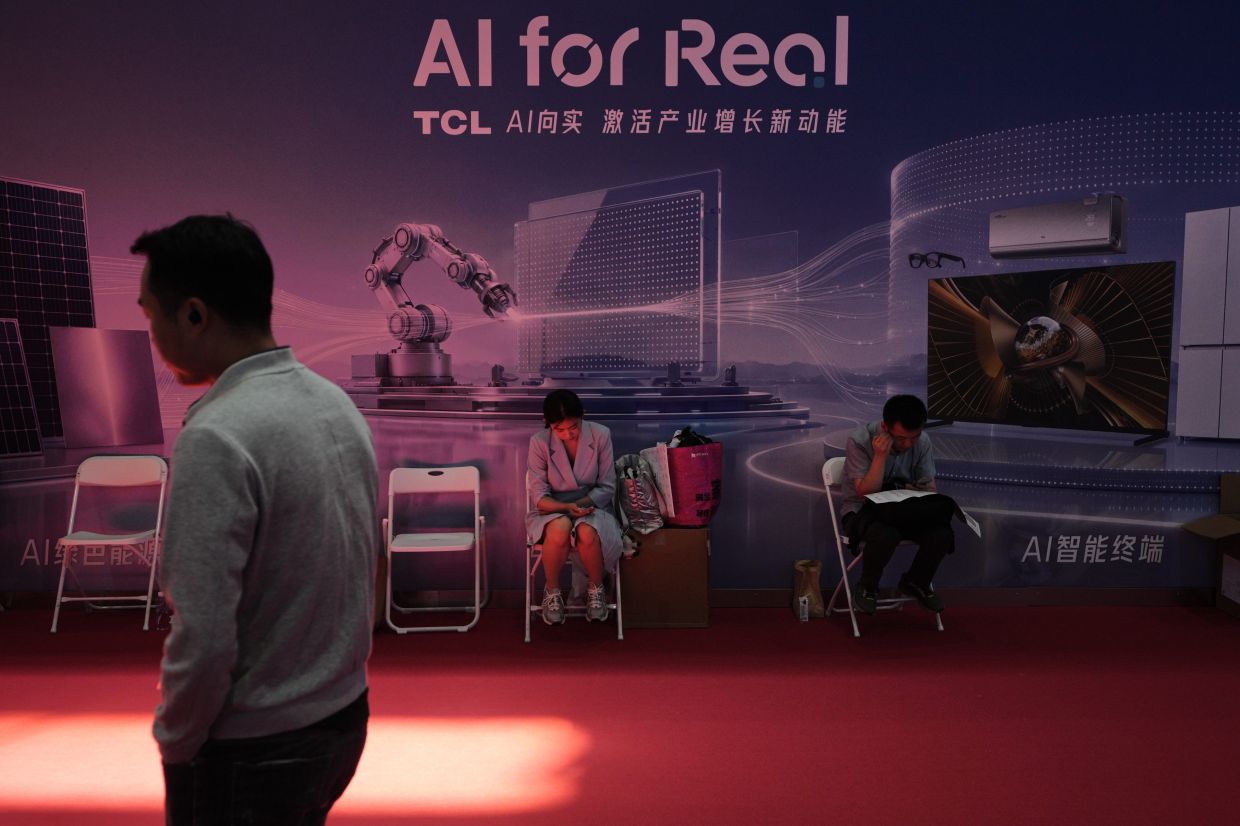
Workers across China are confronting an uncomfortable reality: the machines and algorithms powering their industries are becoming increasingly capable of performing their roles. This phenomenon, driven by government initiatives that champion AI integration, represents one of the most significant labour market transformations the world's second-largest economy has experienced in recent decades, with implications that extend far beyond national borders.
The scale of AI deployment in China has accelerated dramatically. Industrial enterprises using AI models and intelligent agents jumped to 47.5 per cent in the past year, compared to just 9.6 per cent in 2024, according to market intelligence firm IDC. This explosive growth reflects deliberate policy choices by Beijing, which has embedded AI advancement into its broader technology competition with the United States. The government's "AI Plus" initiative and its five-year plan through 2030 specifically target the infusion of AI capabilities across diverse economic sectors, from manufacturing to services, aiming to achieve technological dominance while simultaneously reshaping how millions of Chinese workers perform their daily tasks.
Unlike some Western nations where public discourse around AI adoption often turns anxious or confrontational, Chinese workers and society demonstrate a striking pragmatism about technological change. Shujing He, a senior analyst at advisory firm Plenum based in Beijing, observes that anti-AI sentiment in China remains far less pronounced than elsewhere. Rather than resisting automation, many displaced or threatened workers are actively experimenting with AI-enabled business ventures and independent projects, viewing technological disruption as an entrepreneurial opportunity rather than merely a threat. This cultural acceptance of rapid change may smooth adoption but also masks deeper economic vulnerabilities.
The personal stories emerging from China's transformation reveal the complexity of this transition. Fei, a 40-year-old programmer, initially doubted AI's capacity for sophisticated coding work, yet now acknowledges that mid-level programming positions are largely replaceable. Rather than resist this reality, he has pivoted toward creating video content during a career break, exemplifying how workers are attempting to reinvent themselves in response to technological displacement. Similarly, Du Qinchun, a part-time translator in Chengdu, has participated in training AI translation models, temporarily generating additional work even as industry compensation has collapsed, with translator pay declining by more than half compared to previous years.
The disruption is visible across multiple sectors simultaneously. China's short drama industry, a booming segment centred on vertical video content designed for mobile platforms, has contracted sharply as generative AI tools proliferate. Live-action short and vertical video series production plummeted approximately 75 per cent in the first quarter of this year compared to the previous year, according to Chinese media reports. Humanoid robots have begun sorting parcels in postal facilities and performing increasingly sophisticated physical tasks including traffic direction and food preparation. Food delivery robots are proliferating across major cities, creating existential pressure on millions of workers in that labour-intensive sector. These developments underscore how AI is not confined to knowledge work or digital domains but is encroaching on service and logistics positions that have traditionally employed large numbers of workers.
Educational trends signal how workers and families are responding to perceived threats. University programmes in foreign languages have fallen sharply out of favour as AI translation tools have improved substantially and become accessible to the broader population. Young people and their families are making calculations about which skills will retain value in an AI-augmented economy, and language translation appears increasingly vulnerable. This educational reorientation will shape the composition of China's workforce for years to come, potentially creating mismatches between skills young people develop and actual labour market demand.
Gender dynamics add another troubling dimension to China's AI displacement story. Research from the International Labour Organization indicates that women face disproportionate employment risk from automation, as they remain overrepresented in sectors particularly susceptible to AI substitution, including electronics assembly and other routine manufacturing tasks. Simultaneously, women remain underrepresented in science and technology fields where new opportunities may emerge. This gender imbalance in both vulnerability and access to emerging opportunities could exacerbate existing income inequality across the Chinese economy.
Beyond the immediate labour market impacts, economists express concern about broader macroeconomic consequences. China's economic growth has already decelerated in recent years, and consumer spending has weakened partly because workers increasingly harbour anxieties about employment stability. These labour market concerns compound challenges already created by the prolonged downturn in China's housing sector, which has severely damaged household wealth accumulation. When workers fear job loss, they consume less, which dampens aggregate demand and undermines the consumption-led growth trajectory that Chinese policymakers have been attempting to cultivate as manufacturing productivity plateaus.
The employment picture remains particularly dire for younger age cohorts. While China's overall urban unemployment rate hovers around five per cent, unemployment among workers aged 16 to 24, excluding students, reaches approximately 15 per cent. This youth employment crisis predates the current wave of AI acceleration but will likely worsen as automation eliminates entry-level positions that traditionally served as gateways into the workforce. Younger workers face the dual challenge of entering a labour market already weakened by cyclical economic underperformance while simultaneously confronting technological displacement affecting their generation's earning potential.
Chinese technology giants have mirrored their Western counterparts by conducting substantial workforce reductions, partially attributed to AI capabilities reducing labour requirements. Yet Eswar Prasad, a professor of economics and trade policy at Cornell University, cautions that while AI will undoubtedly boost productivity across the economy, it threatens severe employment disruption that could deepen existing joblessness and jeopardise social stability. The prospect of artificial intelligence delivering productivity gains without corresponding employment growth represents a particular challenge for Chinese policymakers already contending with multiple economic headwinds.
However, some analysts offer a longer-term counterargument grounded in China's demographic trajectory. Zilan Qian, a research associate at Oxford China Policy Lab, notes that government promotion of AI diffusion across the economy is specifically Chinese in character, with implications for how rapidly automation spreads compared to other nations. More fundamentally, China's population of 1.4 billion is aging rapidly and contracting. By 2050, China is projected to have fewer than two working-age adults supporting each retiree, compared with more than 2.5 in the United States. Xuenan Cao, a professor at San Francisco Bay University focused on technology and society, suggests that automation could partially offset China's shrinking workforce rather than functioning purely as a source of unemployment. From this perspective, AI adoption becomes not merely disruptive but potentially essential for maintaining economic capacity as the population ages.
Workers navigating this transformation demonstrate adaptive creativity. Wang Zhicheng, a 32-year-old former scriptwriter for an educational content company, used AI tools for brainstorming and fact-checking before his employer laid off roughly half its writing staff. He subsequently resigned and established an independent studio producing illustrated children's books. While acknowledging that AI sometimes accelerated production, Wang observed that AI-generated scripts often felt formulaic and repetitive, with inconsistent treatment of detailed content. His experience reflects a broader reality: AI functions as a powerful tool for certain tasks, yet human judgment and creative sensibility remain necessary for producing work with genuine quality and distinctive character. Wang's philosophy—treating AI as one would treat any productivity software while maintaining human decision-making authority—suggests a pragmatic path forward that neither exaggerates AI's capabilities nor dismisses its utility.
The Chinese experience offers crucial lessons for Malaysia and the broader Southeast Asian region. As governments across ASEAN consider their own AI adoption policies and technology strategies, they will observe whether China's aggressive approach generates the dual benefits of productivity gains and employment opportunity, or whether it produces the productivity gains accompanied by destabilising job losses. Malaysia's own labour market, comprising large numbers of workers in manufacturing, services, and logistics sectors vulnerable to automation, faces similar pressures. The willingness of Chinese policymakers to prioritise technological advancement over short-term employment concerns suggests a strategic calculation that long-term competitiveness justifies immediate workforce disruption—a choice that carries significant social and political risks that Malaysian policymakers must carefully weigh as they chart their own technology futures.

