The back-to-back memorials for two architects of China's modern economic transformation—former president Jiang Zemin and ex-premier Zhu Rongji—have exposed a peculiar fault line in contemporary Chinese politics. Jiang's centenary celebration on August 17 in Beijing and Zhu's state funeral on August 18, following his death at 97, created an unusual convergence of mourning and commemoration that invited the nation to reflect on a quarter-century of governance that fundamentally reshaped the world's second-largest economy. Yet beneath the official ceremonies and public tributes lies a more complicated picture: one where the Communist Party leadership carefully manages how a more prosperous past is remembered, even as current challenges demand attention.
President Xi Jinping's presence at both events underscored Beijing's determination to frame these tributes within a narrative of continuity rather than contrast. At the Great Hall of the People, Xi delivered a 40-minute address celebrating Jiang's "indelible contributions," deliberately positioning the late president as a pioneer within the Party's broader historical mission rather than as a counterpoint to contemporary governance. Similarly, Xi attended Zhu's funeral at Babaoshan Revolutionary Cemetery, where he and other senior Politburo Standing Committee members bowed three times before the casket and offered formal condolences. These choreographed displays of respect served dual purposes: honouring respected predecessors while simultaneously demonstrating that their legacies remain subordinate to Xi's vision for China's future.
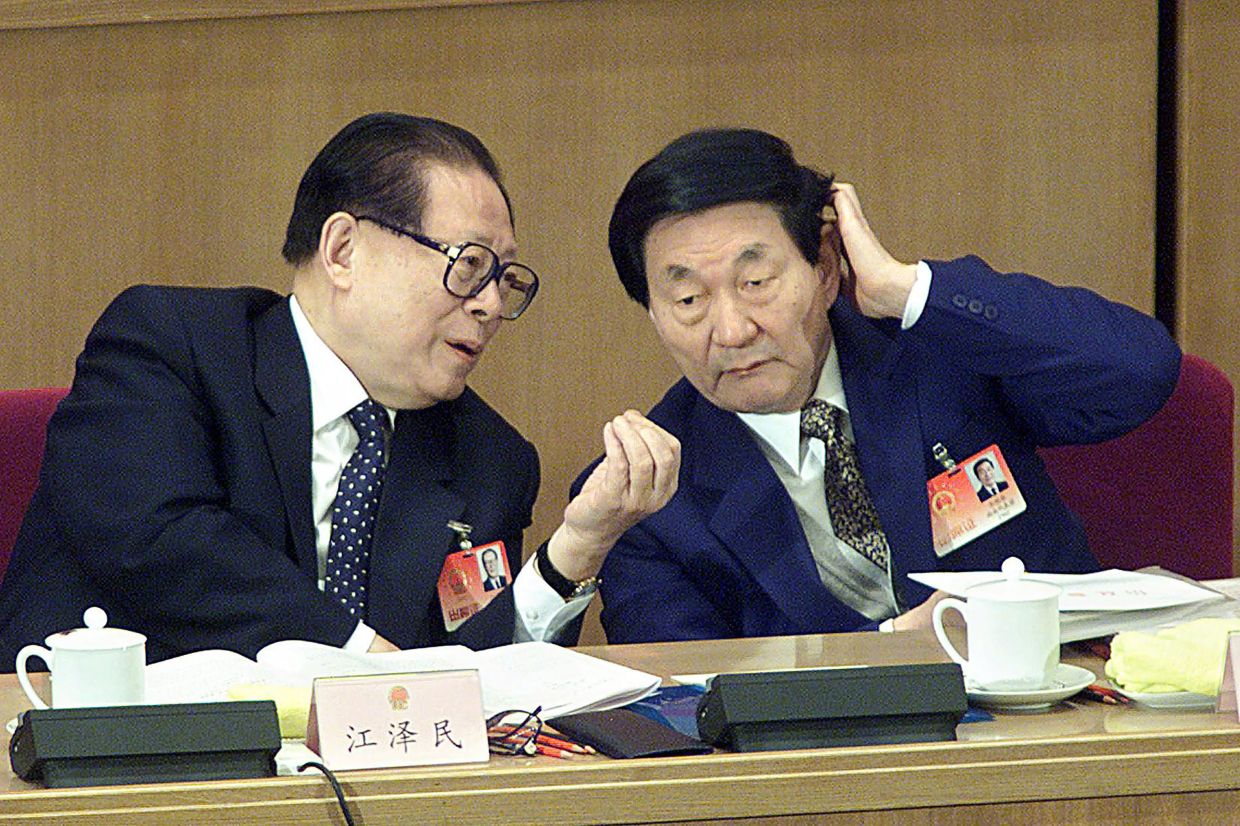
The timing of these parallel commemorations carried particular weight given the country's present economic headwinds. Jiang and Zhu governed together from 1998 to 2003, presiding over a period marked by rapid GDP growth, China's ascent as an economic powerhouse, and what many citizens recall as an era of expanding opportunity. The resurfacing of old photographs on Chinese social media—showing the two leaders in candid moments, leaning toward each other with genuine smiles—tapped into genuine nostalgia among ordinary Chinese who remember those years as fundamentally more hopeful than today. However, this wistfulness carried implicit criticism. The contrast between "a glimpse of tomorrow" thirty years ago and contemporary uncertainty around property-sector collapse, local government debt accumulation, and sluggish growth proved too pointed for Beijing's censors; an essay by economist Zhao Jian lamenting contemporary "emptiness and anxiety" was swiftly removed from WeChat, signalling official anxiety about such comparisons.
Observers of Chinese elite politics noted that the official framing deliberately avoided presenting Jiang or Zhu as viable alternatives to Xi's approach. Lee Jong-hyuk, an associate professor at South Korea's Sungkyunkwan University specialising in Chinese politics, observed that the dominant narrative positioned both leaders as contributors to the Party's continuous historical arc, with each era—Jiang's, Hu Jintao's, and now Xi's—represented as necessary chapters in an unfolding story of national rejuvenation. This rhetorical strategy served to neutralise the potentially destabilising effect of public nostalgia. By anchoring Jiang's legacy within a framework that culminates in Xi's "new journey" toward modernisation and party strength, Beijing effectively inoculated itself against the suggestion that earlier approaches might have merit worth reconsidering. The official obituary for Zhu reinforced this message, emphasising that the former premier had "resolutely supported" both Hu Jintao and subsequently Xi—a testament to institutional loyalty rather than independent judgment.
Yet the substance of Jiang's and Zhu's actual records reveals the complexity Beijing seeks to downplay. Zhu's tenure as premier proved transformative but costly. His aggressive restructuring of bloated state-owned enterprises and pursuit of World Trade Organisation membership modernised China's economy, but these reforms displaced more than 30 million workers in a society lacking robust unemployment protections or welfare systems. His 1994 tax-sharing reform, designed to strengthen central government finances, inadvertently incentivised local governments to rely heavily on land sales for revenue—a dependency that has metastasised into the current property crisis and municipal debt burden that now constrains Beijing's policy options. These consequences, largely absent from official commentary, illustrate how reform-era achievements came packaged with structural vulnerabilities that plague contemporary China.
Jiang's legacy similarly presented a mixed inheritance. As the beneficiary of Deng Xiaoping's intervention following the 1989 Tiananmen crackdown, Jiang navigated China through diplomatic isolation and maintained a volatile relationship with Washington without allowing bilateral tensions to spiral into open conflict. His "Three Represents" doctrine expanded Communist Party membership to include private business owners, a pragmatic recognition that China's emerging capitalist class needed incorporation into the political system rather than exclusion. Yet his 13-year presidency was also marked by pervasive corruption among officials and what many viewed as excessive suppression of dissent, including the sustained crackdown on the Falun Gong movement—legacies that remain contentious in Chinese civil society discussions beyond the reach of state media.
The political sensitivities surrounding these memorials were amplified by the upcoming Communist Party congress in late 2027, when major leadership reshuffles are expected. As analysts at the Mercator Institute for China Studies noted, Beijing's current preoccupation centres on image management and demonstrated loyalty ahead of critical succession considerations. The timing of Zhu's death—just one day before Jiang's centenary—created an unavoidable moment of reflection that party leadership could not control entirely, even as it sought to channel public sentiment in approved directions. The subtle references and nicknames used on social media by those paying tribute, such as calling Jiang "the Elder," represented an implicit acknowledgment that genuine expressions of mourning risked comparison with present circumstances—precisely what censors sought to prevent.
For Malaysian and Southeast Asian observers, these Chinese political dynamics carry broader implications. The tension between public nostalgia for earlier prosperity and official narratives emphasising continuity with present leadership reflects deeper anxieties about China's capacity to maintain growth and social stability. If Jiang and Zhu's era represented one model of economic dynamism—one now associated with considerable inequality, environmental damage, and structural vulnerabilities—and Xi's era represents a turn toward "Chinese-style modernisation" emphasising party control and technological self-sufficiency, the region must grapple with the implications of a China facing slower growth while under more assertive political centralisation. Beijing's management of these commemorations demonstrated that even symbolic displays of historical reflection have become subjects requiring careful political choreography, suggesting that internal anxieties about economic trajectory and governance legitimacy run deeper than official projections acknowledge.
The international dimension also warrants attention. Xi's invocation of Jiang's ability to navigate "domestic and external crises" deliberately evoked the 1998 Asian financial crisis and 1998 floods as examples of decisive leadership under pressure. Yet the Asia-financial crisis context differs markedly from current circumstances: China then possessed the advantage of rapid catch-up growth, expanding export markets, and Western eagerness to integrate it into global economic structures. Today, China confronts a world increasingly cautious about economic interdependence, geopolitical competition with the United States, and questions about whether its growth model remains viable. The lessons Jiang's era supposedly offered—about vision and courage in navigating crises—may prove less applicable to challenges of rebalancing an economy overdependent on property investment and export-driven manufacturing.
Ultimately, these dual commemorations revealed the paradox at the heart of contemporary Chinese politics: the Party requires the legitimacy derived from having produced transformative leaders and tangible prosperity, yet acknowledging the historical conditions that enabled that prosperity implicitly questions why similar conditions no longer prevail. Xi's response has been to absorb Jiang and Zhu's legacies into a narrative of Party continuity while simultaneously attempting to redirect public expectations toward different metrics of success—party unity, technological dominance, and national rejuvenation rather than wealth creation and individual opportunity. Whether this rhetorical strategy can sustain political legitimacy as growth rates continue moderating and property-sector problems remain unresolved will substantially influence not only China's domestic trajectory but also regional stability and the character of China's international engagement throughout the remainder of this decade.

