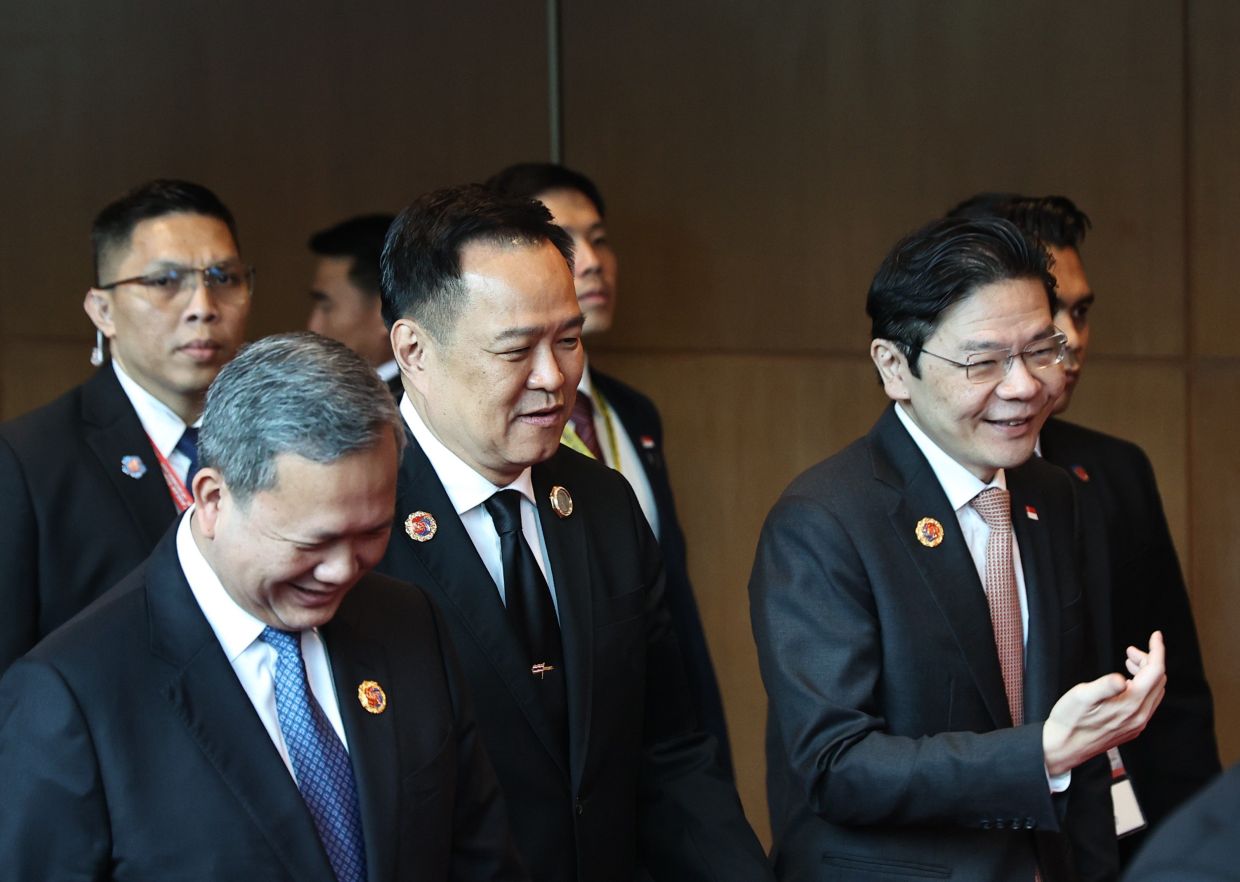
As Cambodia and Thailand grapple with mounting tension along their contested frontier, Beijing is emerging as a potential diplomatic intermediary. The prospect gained momentum this week when both nations' prime ministers visited China for the 2026 World Artificial Intelligence Conference, creating an unusual convergence of high-level engagement with Beijing on the border question.
Prime Minister Hun Manet used his July 16 meeting with Chinese Premier Li Qiang to update the Chinese leadership on the latest developments along the Cambodia-Thailand border. Though neither side's official statement explicitly mentioned mediation, the decision by Cambodia's leader to personally brief one of the kingdom's most trusted international partners on the sensitive issue reflects Phnom Penh's strategic priorities. Hun Manet took the opportunity to reaffirm Cambodia's foundational commitment to resolving the dispute through peaceful means, grounded in international law and existing bilateral treaties and agreements with Thailand.
Simultaneously, Thai Prime Minister Anutin Charnvirakul struck a notably flexible posture toward potential Chinese involvement. Speaking with Thai media representatives in Beijing, Anutin explicitly stated that Thailand had "not closed the door" to Chinese mediation, though he carefully qualified this by noting that Bangkok had not formally requested such intervention. This measured language reflects Thailand's desire to maintain diplomatic flexibility while signalling to China that its good offices would not be rejected outright. At the same time, Anutin reaffirmed Bangkok's preference for resolving differences through direct bilateral talks with Cambodia, a position that underscores the incremental nature of any potential Chinese role.
China's positioning on the matter reflects a carefully calibrated diplomatic strategy refined over several years. Last year, Chinese Foreign Minister Wang Yi publicly declared Beijing's willingness to "uphold an objective and fair position and play a constructive role for the harmonious coexistence between Thailand and Cambodia." That statement, made during separate meetings with counterparts from both nations at the Asean Foreign Ministers' Meeting, essentially established the parameters for Chinese engagement without committing Beijing to formal mediation. Wang urged both countries to pursue peaceful dialogue while emphasizing China's commitment to regional stability.
Since that initial signalling, Beijing has taken concrete steps to support stability between the two neighbours. China has hosted trilateral discussions bringing together senior officials from Cambodia, Thailand, and itself with the explicit aim of fostering confidence-building measures and maintaining the fragile ceasefire that has held between the two countries. This hands-on engagement demonstrates that Beijing views the border dispute as a matter touching its broader interests in Southeast Asian stability and its relationships with two important regional partners.
The significance of Hun Manet's briefing to Li Qiang lies in Cambodia's effort to keep Beijing comprehensively informed about the border situation. As one of Cambodia's closest strategic partners and a major source of investment and military support, China commands influence over Phnom Penh's decision-making that few other nations possess. By choosing to discuss the border issue at the level of premier-to-premier engagement, Hun Manet signalled both the importance Cambodia attaches to China's perspective and the expectation that Beijing will maintain its supportive stance.
For Thailand, Anutin's careful openness to Chinese mediation reflects Bangkok's own calculus about the dispute. While Thailand has consistently maintained that direct bilateral engagement remains the preferred mechanism for resolving differences, Thai officials recognize that having an outside facilitator could potentially help break diplomatic stalemates if they emerge. China's economic clout and its relationships with both nations make it a logical choice from Thailand's perspective, even if Bangkok continues to emphasize dialogue as the primary path forward.
The Cambodia-Thailand border has been a source of periodic tension for years, with flare-ups occurring sporadically along the poorly demarcated frontier. The disputes typically involve competing territorial claims and disagreements over historical agreements. Both nations have repeatedly committed to peaceful resolution, but the underlying disagreements have proven resistant to resolution through bilateral mechanisms alone. This intractability may explain why both governments are signalling receptiveness to third-party facilitation, even if they stop short of formally requesting it.
Cambodia has pursued a multifaceted approach to the border issue that extends beyond bilateral talks with Thailand. Phnom Penh has welcomed Asean observer missions and actively invoked international legal mechanisms to address the dispute, demonstrating a desire to build a broad international consensus around the principle of peaceful settlement. These efforts reflect Cambodia's understanding that while China's role could be valuable, a wider international framework grounded in regional norms and international law provides additional legitimacy and constraint.
The absence of a scheduled bilateral meeting between Hun Manet and Anutin during their simultaneous Beijing visits is noteworthy. Such an omission in normal diplomatic protocol suggests either that neither side felt the timing was opportune for direct talks, or that each preferred to conduct separate engagement with China before potentially reconvening. This pattern could indicate that Beijing is being positioned as a venue for indirect communication between the two neighbours, a classic diplomatic function that intermediaries perform.
Whether Beijing will ultimately formalize its mediation role remains an open question. Currently, neither Cambodia nor Thailand has submitted a formal request for Chinese intervention, and Beijing has not launched any announced mediation initiative. The current trajectory suggests a gradual escalation of Chinese engagement, with Beijing content to maintain its constructive posture while allowing both nations to determine the pace of any expanded role. For Malaysia and other Southeast Asian observers, the Cambodia-Thailand situation underscores how China is increasingly positioning itself as a regional problem-solver, leveraging its economic and diplomatic weight to influence the trajectory of disputes between its neighbours.

