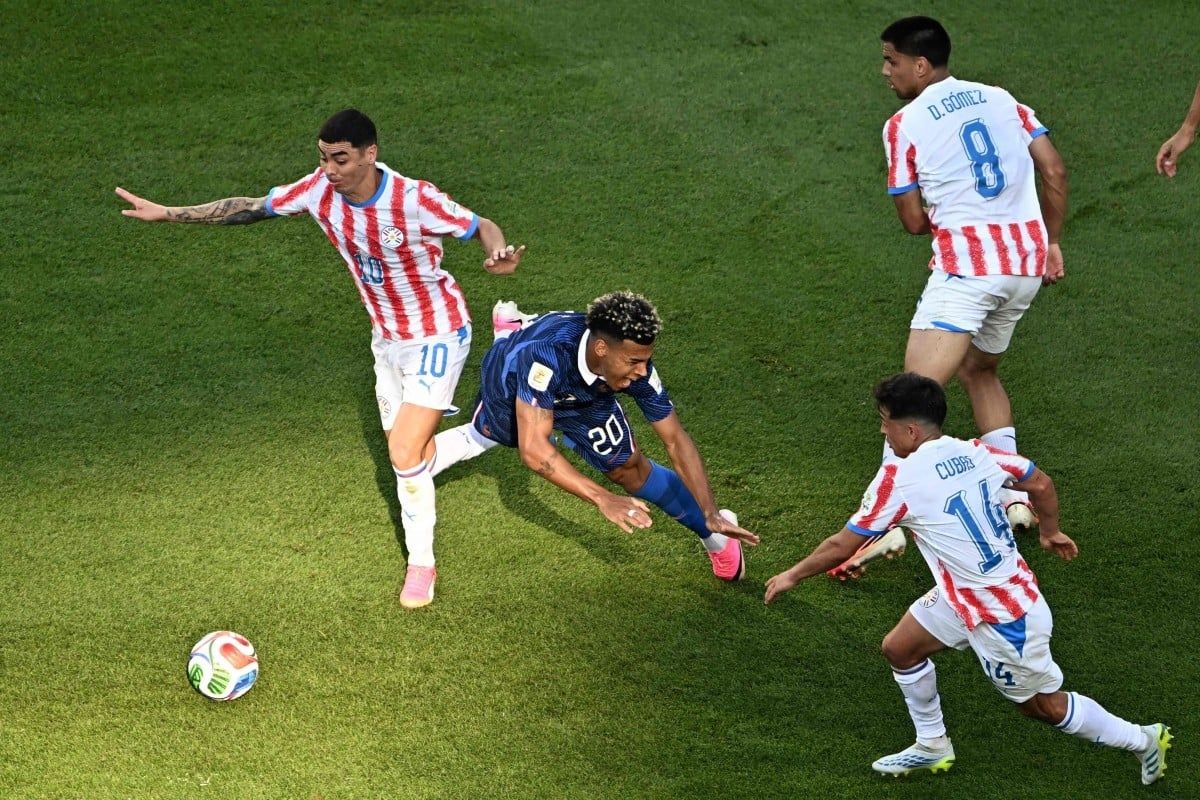
Chinese football enthusiasts have taken to social media to express their frustration over Paraguay's approach during their World Cup round-of-16 encounter against France in Philadelphia on Saturday, July 4. The match, which France won through a Kylian Mbappe penalty goal with 20 minutes remaining, was marked far less by quality football than by the Paraguayan side's apparent determination to engage in physical confrontations with their opponents. Rather than searching for genuine scoring opportunities, the South American team appeared focused on disrupting their more technically skilled rivals through aggressive challenges and niggling fouls throughout the contest.
The talking point among Chinese fans watching the fixture was not the quality of play but rather the vastly different approaches taken by the two officials involved. Ma Ning, the Chinese referee who has earned the nickname "card master" among supporters for his consistent willingness to brandish yellow and red cards, was contrasted sharply with Uzbekistan-based official Ilgiz Tantashev, who managed the Paraguay-France encounter. Tantashev's decision to distribute only four yellow cards across the entire 90 minutes—with three going to France—struck observers as surprisingly lenient given the number of contentious incidents that unfolded on the pitch.
One social media user posted what became a widely shared comment: "If Ma Ning was officiating the match, I guess Paraguay would only have their goalkeeper left in the match." This sentiment reflected a broader perception that the referee had failed to adequately control the match or impose consequences for rough play. Another commenter joked directly at Mbappe, suggesting the French striker should now understand how valuable strict refereeing could be. The conversation quickly evolved into a critique not just of individual decisions but of what Chinese fans perceived as a fundamental failure of match management by Tantashev, who has served as a FIFA-accredited official since 2013.
Opinions within the Chinese online community diverged on the underlying causes. Some attributed Paraguay's approach to wider patterns of play among South American football teams, characterizing physical intensity as part of their traditional style. Others, however, advanced a more conspiratorial interpretation, accusing Tantashev of bias in favour of the Paraguayan side. One commenter suggested the official was "on a mission to take France out," while another, noting Paraguay's earlier penalty-shootout victory over Germany, remarked that the lack of fouls in that match now seemed suspicious. "He was almost wearing a Paraguay jersey today," one particularly caustic observer wrote, implying a perceived favouritism that extended beyond mere inconsistency to active partisanship.
The broader debate highlighted how closely Chinese viewers scrutinize referee performance, particularly when contrasting international standards. "The fact that the focus of a match is entirely on the referee shows how poorly the referee is performing his job," one Weibo user reflected philosophically, pointing to the notion that dominant refereeing should recede into the background rather than dominate discussion. This observation cut to the heart of officiating philosophy: when fans remember a match primarily for the referee's decisions rather than the players' performances, something has gone awry in match management.
Mbappe himself addressed the rough treatment with a blend of pragmatism and steely confidence. The French captain acknowledged that his team had anticipated Paraguay's tactics and came prepared to match them physically if necessary. "We can also get our hands dirty," Mbappe stated, adding that France was willing to "play ugly football" when circumstances demanded it. Rather than presenting this as a lament over the quality of football on display, he framed it as tactical flexibility—an unwillingness to be bullied or outmaneuvered by opponents determined to disrupt rather than compete fairly. "Guess they were thinking we were going to show up in tuxedos, but we were ready," he remarked, suggesting France had anticipated and neutralized Paraguay's strategy.
France coach Didier Deschamps provided further insight into the broader pattern of conduct that extended beyond the playing field itself. The 57-year-old former World Cup-winning captain revealed that unsporting behaviour continued from the opposing bench, with staff members exchanging insults that he found unnecessary and demeaning to the sport. Deschamps acknowledged that both teams had played according to their respective styles and philosophies, but lamented that Paraguay's approach—encompassing rough play, sideline theatrics, and verbal provocation—represented exactly the kind of football that deterred spectators from attending matches. His comments reinforced the sense that what unfolded was not legitimate tactical intensity but rather an attempt to intimidate through any means available.
An incident involving Paraguay goalkeeper Orlando Gill exemplified the frustration that had accumulated. After France's victory, Gill threw a ball at Mbappe's back in what he later characterized as a heat-of-the-moment reaction following the French player's failure to acknowledge him at the final whistle. Chinese social media users rejected this explanation entirely, interpreting the action as evidence of Paraguay's unprofessionalism and poor sportsmanship. One commenter summarized the prevailing sentiment: "They didn't only lose the match, but also their characters, acting just like children." This response indicated that Chinese fans had moved beyond critiquing the referee or the tactics employed, instead questioning Paraguay's basic commitment to conduct befitting international competition.
The episode offers Malaysian and Southeast Asian observers a window into how football standards and expectations vary across cultures and regions. Chinese fans' emphasis on referee authority and consistency contrasts with how some football traditions valorize physicality as an acceptable expression of competitive intensity. The criticism also underscores a growing sophistication among Asian football audiences in distinguishing between hard-fought, legitimate competition and behaviour that crosses into intimidation and unsporting conduct. As Malaysia continues to develop its own football infrastructure and aspirations, such international debates about what constitutes acceptable play become increasingly relevant to domestic discourse and standards-setting.
France's progression to face Morocco in the quarter-finals left the broader questions about refereeing standards and sporting conduct largely unresolved. Yet the passion with which Chinese fans engaged the issue demonstrated that football, at its highest levels, carries expectations extending beyond goal-scoring and tactical cleverness. The manner in which a match is contested—and whether officials permit or curtail behaviour that undermines the sport's essential character—resonates powerfully across national boundaries, particularly among increasingly discerning audiences throughout Asia who demand football be played with both competitiveness and integrity.

