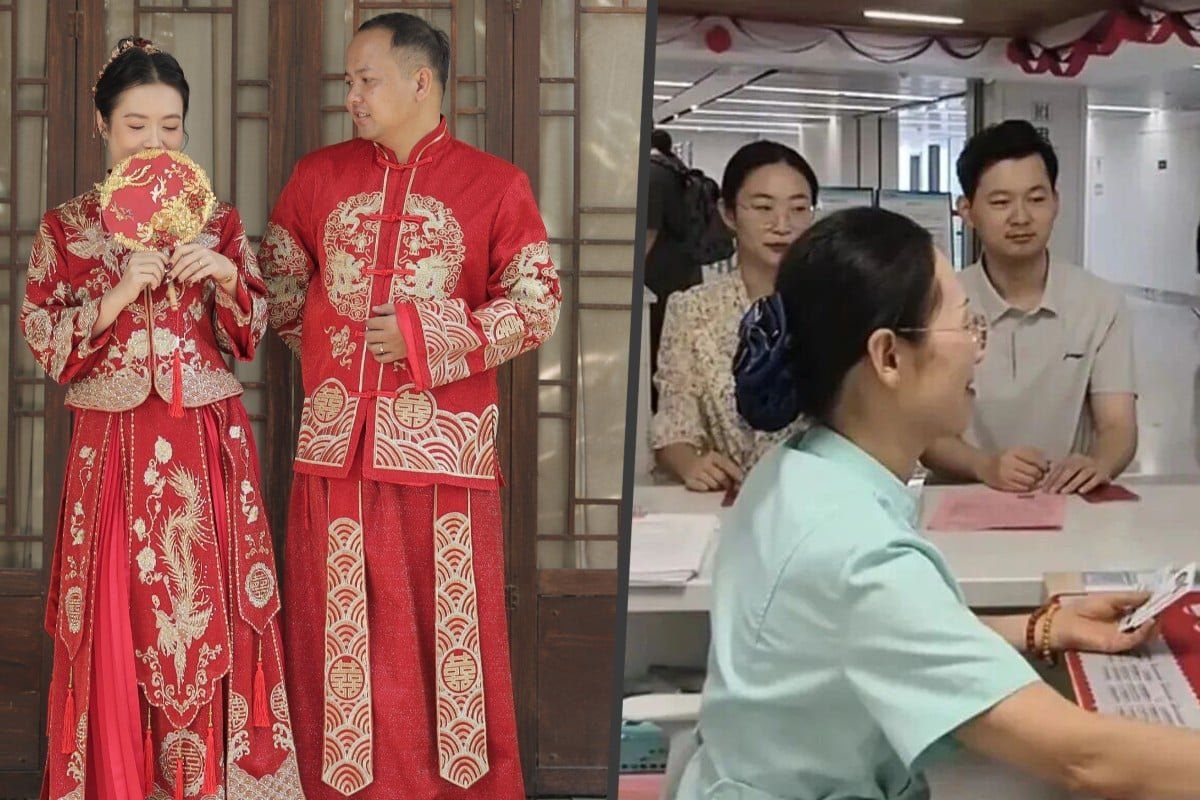
China is turning to unconventional venues in an ambitious effort to reverse its declining marriage rates, with financial institutions and healthcare facilities now joining temples, nightclubs, and airports in offering marriage registration services. The strategy reflects growing alarm among policymakers about plummeting nuptial numbers, which threaten demographic stability and economic growth in the world's most populous nation. This creative approach—while sometimes drawing public ridicule—demonstrates the lengths to which authorities are willing to go in attempting to make marriage more accessible and appealing to younger generations increasingly hesitant about taking the plunge.
The trend began gaining momentum following regulatory reforms introduced in May last year that fundamentally simplified China's marriage registration process. Previously, couples needed to present household registration documents and marry at their hukou location, creating bureaucratic barriers that discouraged some unions. The updated regulations eliminated these requirements, allowing couples to register marriages anywhere within the country without cumbersome documentation. This change opened the door for a proliferation of non-traditional registration venues, transforming marriage certification from an administrative chore confined to government offices into an experience that could be integrated into leisure activities and milestone moments.
The commercial sector quickly capitalized on these opportunities. In August, a branch of the Postal Savings Bank of China in Tianjin became the nation's first bank to offer marriage registration, combining financial services with romantic ceremonies. The unexpected pairing initially sparked mockery on social media, with observers joking that only a hospital could top such an unusual combination. Their predictions proved prescient when, during China's Qixi Festival on August 20, the Maternal and Child Health Hospital of Linzi District in Zibo, Shandong province, announced its own marriage registration service. The hospital framed the offering as a practical convenience, allowing newlyweds to complete registration, undergo premarital medical examinations, and receive preconception guidance under a single roof—a logical bundling that nonetheless highlighted the absurdity of the situation to many observers.
The expansion across sectors has been remarkable in scope. Guangzhou Baiyun International Airport became the nation's first airport to issue marriage certificates in January, sweetening the deal by offering newlyweds complimentary access to its observation deck for romantic plane-watching. Metro stations have joined the movement, with Hefei's transportation hub becoming the first rail facility to provide the service in August. Shanghai's civil affairs bureau partnered with a nightclub to host special certification ceremonies within the venue, merging nightlife with legal formalities. By May this year, approximately 500 standalone marriage registration sites operated outside traditional civil affairs bureaus, while more than 1,300 outdoor locations collaborated with authorities to issue certificates, transforming parks, temples, and other public spaces into wedding registry destinations.
The expansion strategy has yielded some encouraging short-term results. During the third quarter of last year, 1.61 million couples registered marriages—a 22.5 percent year-on-year increase that suggested the reforms were gaining traction. Full-year figures for last year showed 6.76 million registrations, up 657,000 from the previous year. However, these gains have already begun to evaporate. In the first half of this year, marriage registrations plummeted by 7.5 percent year-on-year to 3.28 million couples, suggesting that the convenience factor alone cannot sustain momentum against deeper demographic and cultural trends.
Public reaction to the government's efforts has been mixed, with widespread skepticism about whether removing procedural barriers addresses the actual reasons young people are forgoing marriage. Social media commentary has been particularly cutting, with users questioning whether complicated registration procedures were ever the genuine impediment. One widely-shared comment sarcastically suggested establishing divorce services atop Mount Everest, underlining the perception that authorities were treating symptoms rather than causes. Another observer pointedly noted that young people's reluctance stems not from difficulty finding registration locations, but from anxiety about financial security, family pressures, and the sacrifice of personal autonomy that marriage entails in modern Chinese society.
These critiques highlight a fundamental disconnect between policy interventions and demographic realities facing China's younger generations. Economic pressures have intensified dramatically over the past decade, with property prices reaching levels that make homeownership unattainable for many young workers without substantial parental assistance. The intense competitive environment created by China's education system leaves little time for relationship-building, particularly among the urban professionals who would be most likely to marry and establish stable households. Furthermore, shifting social attitudes have gradually eroded marriage's status as a non-negotiable life milestone. Women increasingly pursue careers and independence rather than viewing matrimony as their primary life goal, while both men and women express reservations about the traditional family structures and gender dynamics embedded within marriage.
The divorce dimension adds another complication to authorities' strategy. While the simplified registration process theoretically applies to divorce as well, most outdoor marriage registration sites do not provide divorce services, citing the need for more extensive documentation and oversight. This asymmetry reveals lingering government ambivalence about facilitating marriage dissolution, even as registration requirements have been loosened. The practical effect is that couples who married at unconventional venues must navigate the still-cumbersome divorce process through traditional civil affairs bureaus, creating procedural friction that authorities ostensibly sought to eliminate. This inconsistency undermines the government's stated commitment to simplifying matrimonial administration and suggests that genuine concern about marital stability continues to shape policy implementation.
For Malaysia and Southeast Asia more broadly, China's marriage crisis and policy responses offer instructive lessons about demographic transitions and the limitations of procedural reforms. While Southeast Asian nations have not yet experienced the dramatic marriage rate declines affecting China, regional economies face similar pressures around housing affordability, education costs, and work-life balance that discourage family formation. Thailand, Singapore, and South Korea have all grappled with comparable declining birth rates and shifting social attitudes toward marriage. China's experience demonstrates that merely removing bureaucratic obstacles cannot reverse deeply rooted structural factors driving marriage avoidance among younger generations with limited financial security, uncertain career prospects, and expanding alternative life paths.
The broader policy lesson is that demographic challenges require comprehensive interventions addressing economic security, gender equity, and work-family balance rather than administrative convenience alone. China's creative venue expansion represents a visible, media-friendly response to demographic anxiety, yet addresses none of the material obstacles preventing young people from committing to marriage and family formation. Without accompanying policies ensuring affordable housing, reasonable work hours, accessible childcare, and genuine equality within marriage, expanding registration to nightclubs and hospital maternity wards will likely remain a symbolic gesture rather than an effective intervention. As China struggles to reverse these trends, neighboring nations should examine whether their own procedural systems genuinely facilitate family formation or simply obscure the deeper structural impediments young people face.

