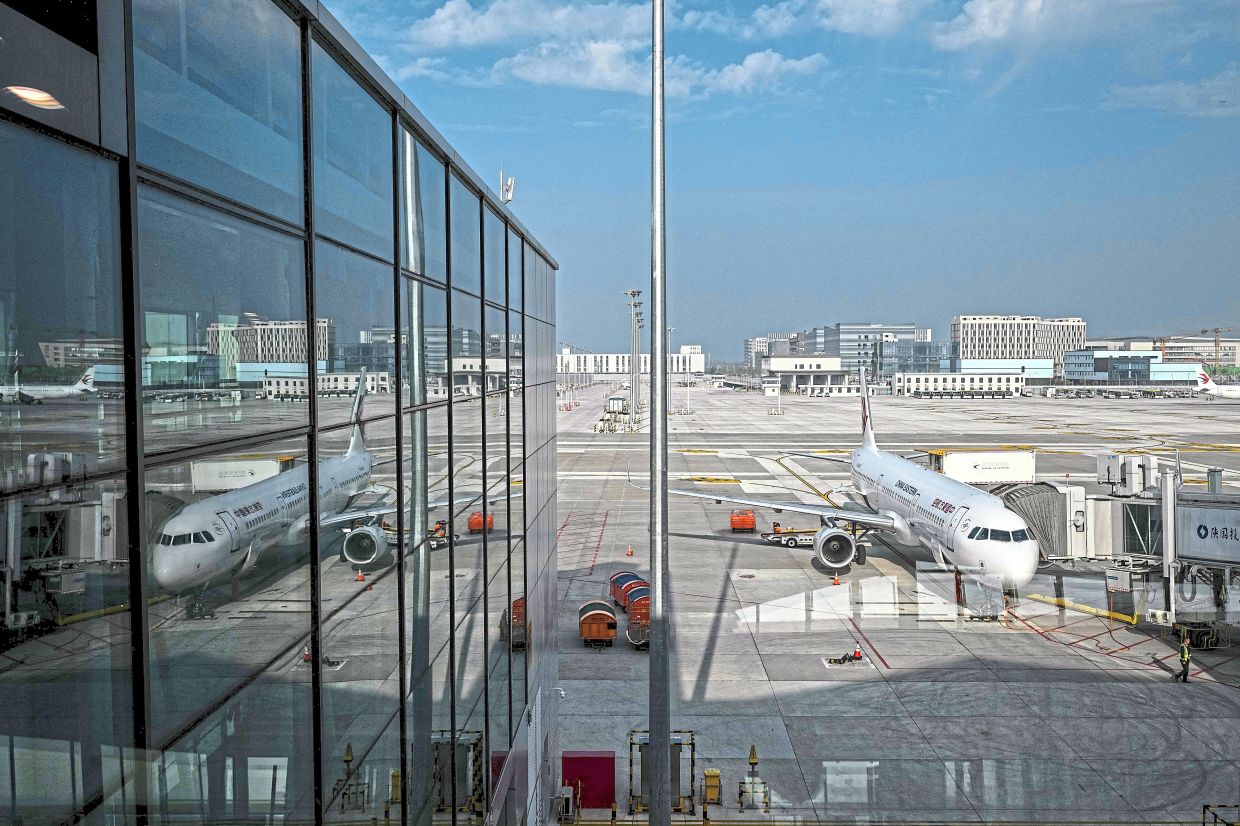
The three pillars of China's aviation industry are crumbling under the weight of persistent headwinds that show little sign of abating. Air China, China Eastern Airlines, and China Southern Airlines collectively reported net losses of approximately 8.2 billion yuan (US$1.22 billion) for the first half of 2026, extending an unprecedented streak of consecutive annual losses to seven years running. The results represent a sobering reality check for an industry that briefly enjoyed profit in the opening quarter, only to see those gains obliterated by the second half's mounting pressures. The collapse in earnings has rattled investor confidence, with all three carriers seeing their Shanghai-listed shares plummet at least 36 percent during the year.
The magnitude of the turnaround from first-quarter profitability to first-half losses encapsulates the fragility underpinning China's post-pandemic aviation recovery. Having posted a combined first-quarter net profit of 4.82 billion yuan buoyed by robust Lunar New Year travel demand, the carriers watched their fortunes reverse sharply in the subsequent months. Air China's net loss widened to 2.3 billion yuan from 1.81 billion yuan the previous year, while China Eastern slipped to a 2.2 billion yuan deficit compared with 1.43 billion yuan twelve months earlier. The deterioration was most acute at China Southern, which saw losses nearly triple to 3.7 billion yuan from 1.53 billion yuan year-on-year. This pattern of worsening performance across all three carriers simultaneously points to systemic industry challenges rather than isolated operational difficulties at individual airlines.
The primary culprit strangling profitability remains the relentless surge in jet fuel expenses. Across the trio, fuel costs climbed between 35 and 38 percent during the first six months, a spike directly attributable to geopolitical turbulence in the Middle East and the ongoing Iran conflict that has disrupted major shipping lanes and pushed crude prices higher. Unlike their counterparts among Asian and European competitors, Chinese carriers have historically eschewed comprehensive fuel hedging strategies, leaving them dangerously exposed to volatile oil markets. This strategic vulnerability became starkly apparent in filings, with China Southern explicitly acknowledging in its report that it currently possesses "no effective means available" to insulate itself from jet fuel price fluctuations. Although prices have retreated from their second-quarter peak, fuel costs remain more than 50 percent above pre-war levels, suggesting that relief may remain elusive for an extended period.
Yet the fuel shock alone does not account for the full magnitude of the crisis. Revenue growth across the board appeared robust, with Air China posting a 10.5 percent increase, China Eastern achieving 11.1 percent expansion, and China Southern registering 9.7 percent growth. This expansion was substantially driven by international route demand, particularly as European services benefited from passengers seeking alternatives to Middle Eastern hubs compromised by regional instability. However, the ability to translate topline growth into bottom-line improvements has been severely constrained by the structure of China's domestic market. Airlines have proven unable to implement the aggressive fare increases their American counterparts have successfully executed, as competition from high-speed rail networks and self-drive holidays has become increasingly fierce. Consequently, the carriers are caught in a squeeze: international revenue growth cannot offset domestic margin compression and the extraordinary fuel bill.
The outlook for the remainder of 2026 offers scant encouragement. The third quarter, which typically generates the strongest seasonal profits for Chinese carriers, has been hamstrung by an unusually intense typhoon season affecting the western Pacific Ocean and South China Sea. Meteorological records indicate 21 typhoons have already formed across these regions in 2026, substantially exceeding the historical average of 12 systems for the same timeframe. These weather disruptions have decimated domestic route operations precisely when demand peaks for summer travel. Flight Master, a leading aviation data firm, has projected that Chinese carriers will transport only 142 million passengers across domestic and international routes in July and August, representing a 3.6 percent year-on-year contraction. This would constitute the first decline in peak-season traffic since 2022, when strict pandemic lockdowns virtually paralysed travel demand across the country.
Analysts paint an even grimmer picture for the full year. HSBC economists have forecasted that China's three leading carriers will collectively accumulate losses of approximately 16.8 billion yuan throughout 2026, a dramatic divergence from market expectations of a combined profit of 1.3 billion yuan. The severity of this deterioration has prompted none of the three carriers to declare interim dividends, a clear signal of balance sheet stress and management caution about distributing capital when operational conditions remain so precarious. Shareholder sentiment has deteriorated correspondingly, with the sustained equity price declines reflecting deepening concerns that the industry faces a structural reset rather than a temporary cyclical downturn.
In this challenging environment, the carriers have pinned some strategic hopes on the continued expansion of fleets equipped with domestically manufactured COMAC C919 aircraft, marking China's ambitious push toward aviation independence. China Eastern expanded its C919 fleet to 17 narrow-body jets after accepting three additional deliveries during the period, while Air China and China Southern each operated 11 C919s following two and three new deliveries respectively. Nevertheless, even this proud symbol of Chinese industrial capability has encountered setbacks. China Eastern has revised downward its expected C919 deliveries between 2026 and 2028, now forecasting 13 fewer aircraft than previously announced. Air China has maintained its original delivery expectations while China Southern declined to provide updated guidance, suggesting continued uncertainty regarding the domestic aircraft program's trajectory.
For Malaysian and broader Southeast Asian observers, the tribulations of China's aviation sector carry significant implications. As the regional hub for international aviation, any sustained weakness in Chinese carriers' profitability will likely encourage aggressive capacity deployment in competing Southeast Asian markets, as carriers seek to compensate for domestic revenue losses through expanded international networks. The inability of Chinese airlines to sustain profitable operations also reinforces the competitive advantages enjoyed by regional carriers with more diversified revenue streams and stronger balance sheets. Furthermore, the demonstrated vulnerability of major Asian carriers to fuel price volatility raises questions about the adequacy of risk management practices across the region's airline industry more broadly.

