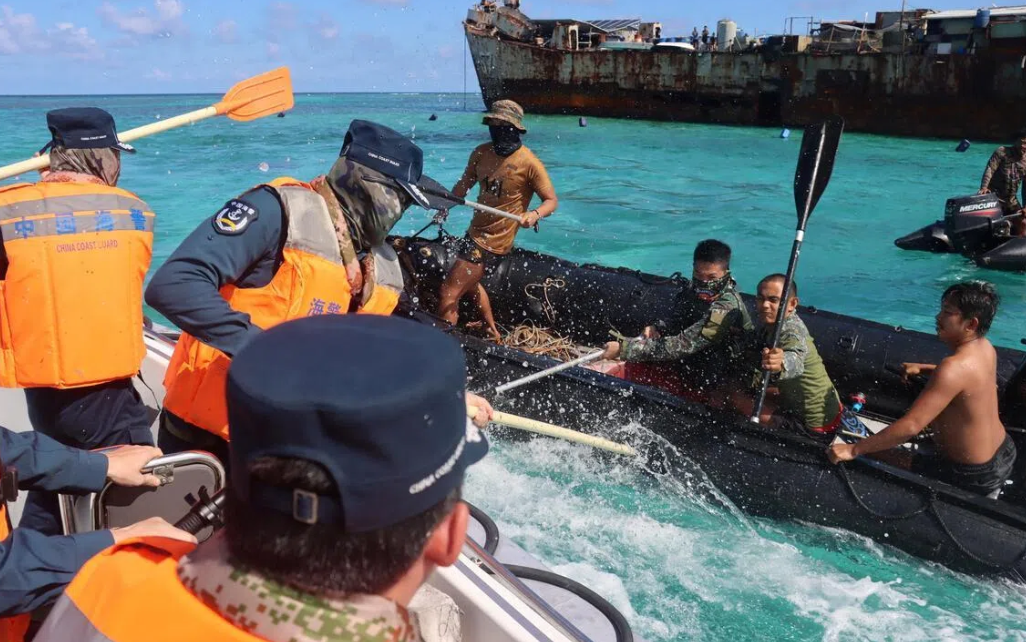
Beijing invoked diplomatic channels on Tuesday to lodge a formal complaint against the Philippines following a confrontation at a strategically significant reef in the South China Sea, underscoring the persistent volatility that characterises maritime disputes in one of the world's most contested regions. The incident, which allegedly occurred on Monday at Ren'ai Reef—also known as the Second Thomas Shoal—involved accusations that a member of the Philippine military was struck by a China Coast Guard operative. The summoning of the Philippine ambassador represents Beijing's standard response to such encounters, though the escalating pattern of incidents continues to draw scrutiny from major powers concerned about freedom of movement through these waters.
The confrontation highlights the fundamental disagreement between China and its Southeast Asian neighbours over territorial sovereignty and maritime rights in a body of water through which trillions of dollars in annual trade passes. Beijing maintains an expansive territorial claim that encompasses nearly the entirety of the South China Sea, a position that contradicts a 2016 international arbitration ruling which determined that China's historical claims lack legal standing under international law. Despite this judicial determination, Beijing has neither recognised nor substantially altered its de facto enforcement of these claims, creating persistent friction with countries whose own sovereignty assertions overlap with Beijing's stated boundaries.
The Philippines, as a coastal state with overlapping territorial interests, has become a focal point for these recurring tensions. The grounded vessel at the Second Thomas Shoal serves as a permanent Philippine military garrison and has been the site of numerous previous confrontations with Chinese maritime authorities. The alleged use of force against a Filipino sailor marks a particularly serious incident along what has become a well-worn flashpoint. The weapon allegedly employed—a baton—suggests tactical escalation beyond mere manoeuvring and positioning, the types of brinkmanship that characterise most encounters in these contested waters.
China's foreign ministry rejected Philippine characterisations of events, insisting that Manila initiated the provocation while simultaneously accusing the Philippines of misrepresenting facts and deliberately sensationalising the encounter. This narrative dispute reflects the broader communication battle that accompanies each such incident, with both sides framing their actions as defensive responses rather than initiating challenges. The pattern of competing claims about responsibility creates additional complications for regional peace and prevents the establishment of shared understandings about acceptable behaviour in these waters.
The diplomatic reverberations extended rapidly beyond the bilateral relationship between Beijing and Manila. Australia's Foreign Minister Penny Wong publicly criticised what she characterised as destabilising and dangerous Chinese conduct, joining Washington in expressing alarm about the escalating pattern of confrontations. These statements from Western powers signal their investment in maintaining open navigation through the South China Sea and their concerns that Beijing's enforcement tactics might eventually restrict access to an economically vital waterway.
US Secretary of State Marco Rubio's arrival in Manila on Tuesday coincided with preparations for an 11-member Association of Southeast Asian Nations summit, providing an immediate diplomatic platform to address the incident and broader regional security concerns. Although Rubio indicated openness to formal talks with Chinese Foreign Minister Wang Yi, who was also attending the Asean gathering, no substantive bilateral meeting was publicly confirmed in advance. The two foreign ministers had previously engaged in February during a Munich conference and again on the sidelines of an Asean meeting in Kuala Lumpur the previous year, suggesting that high-level dialogue channels, while strained, remain operative.
Rubio used a Philippine media op-ed to articulate Washington's strategic position regarding South China Sea navigation rights, framing American interests in terms of freedom of movement and the prevention of hegemonic control over these waters. His implicit reference to China's potential weaponisation of trade relationships spoke to broader concerns about economic coercion alongside military posturing. The secretary of state emphasised that unrestricted navigation serves not only American interests but also those of Asean member states, whose economic survival depends on unobstructed passage through these routes.
The incident reveals how thoroughly militarised maritime disputes have become in Southeast Asia, with coast guard vessels rather than naval warships serving as the primary instruments of enforcement and confrontation. This distinction allows both sides to maintain some diplomatic distance from direct military escalation while still projecting coercive power in contested zones. Yet as alleged instances of physical assault accumulate, the distinction becomes increasingly academic, raising questions about whether current mechanisms for conflict prevention remain adequate to the task.
For Malaysia and other Southeast Asian nations observing these dynamics, the situation presents particular complexity. While not directly involved in this specific incident, Malaysian territorial waters also overlap with China's claimed boundaries, and similar confrontations involving Malaysian authorities have occurred with increasing frequency over the past decade. The broader regional response to the China-Philippines clash will likely influence expectations about whether solidarity among Asean members can constrain Beijing's conduct, or whether individual states must manage relationships with China through bilateral rather than collective arrangements.
The summoning of the Philippine ambassador and the international responses it triggered exemplify the fragile equilibrium that currently governs the South China Sea. Despite nearly two decades of discussions about codes of conduct and confidence-building measures, the fundamental dispute about sovereignty remains unresolved, and enforcement patterns continue to test the boundaries of what constitutes acceptable state behaviour in these contested waters. As trade volumes through the region continue growing and as military modernisation advances among all parties involved, the stakes attached to each incident appear to heighten, suggesting that diplomatic mechanisms may eventually prove insufficient to manage the underlying tensions driving these repeated confrontations.

