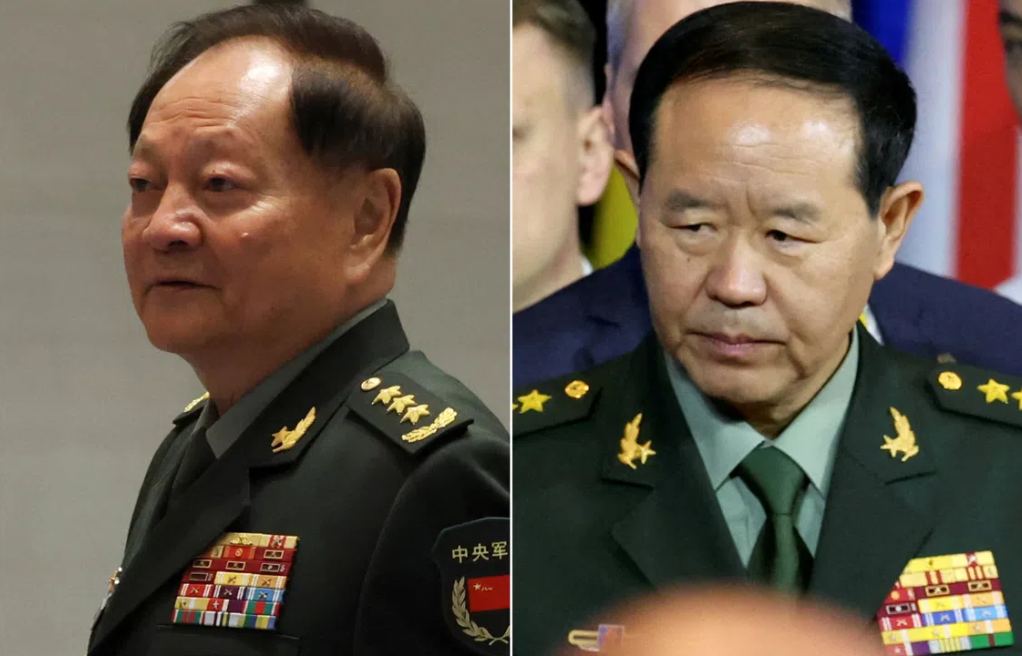
China has purged two of its most senior military officers from the state Central Military Commission, the nation's highest defence authority, following official investigations into what authorities characterised as serious breaches of discipline and law. The removals mark another significant escalation in President Xi Jinping's decade-long anti-corruption campaign within the armed forces, a sweeping initiative that has fundamentally reshaped the military's leadership structure and power dynamics.
General Zhang Youxia, who held the position of vice-chairman of the Central Military Commission and sat on China's elite Politburo as one of Xi's most trusted military lieutenants, has been stripped of his state commission seat. Alongside him, General Liu Zhenli, who served as a commission member and headed the CMC's Joint Staff Department—effectively the operational hub of China's military command apparatus—has similarly been removed. The simultaneous removal of these two prominent figures has left the state Central Military Commission with only two remaining active members, including Xi himself, a dramatic thinning of the institution that typically maintains seven positions.
The significance of Zhang's departure cannot be overstated within China's power structure. As vice-chairman, he occupied the second-highest military position in the country and represented the institutional continuity between Xi's political authority and military command. His elevation to Politburo status reflected his standing as one of the Communist Party's most influential military strategists. The investigation into his conduct therefore signals that even those closest to Xi are not immune to scrutiny under the broader anti-corruption framework, reinforcing the president's demonstrated willingness to dismantle power networks regardless of seniority or prior loyalty.
Xi initiated this comprehensive anti-corruption drive within the military in 2012 immediately upon consolidating power, targeting what he identified as systemic institutional decay and misconduct within the armed forces. The campaign has intensified substantially over recent years, with Xi explicitly calling on senior party leadership last month to deepen and accelerate the fight against corruption within military ranks. Since the initiative began, scores of high-ranking officers and senior military officials have faced investigation, removal from their posts, or outright purging, fundamentally transforming the composition of China's defence establishment.
The removal structure itself reflects the complexity of China's dual institutional framework, which maintains parallel Communist Party and state command hierarchies for the military. While Friday's announcement specifically concerned Zhang and Liu's positions within the state Central Military Commission—formally decided by the Standing Committee of the National People's Congress—their status within the Communist Party's own Central Military Commission remains technically separate, though the practical distinction has become increasingly blurred. Notably, they have not yet been publicly or formally stripped of their Communist Party positions, leaving open questions about the full scope of their expulsion from power.
The purge extends beyond the two most senior figures. The updated list of deputies published by China's parliament on Friday also indicates the removal of 10 additional lawmakers, including Lieutenant General Zhong Shaojun, a former director of the CMC General Office who oversaw administrative functions at the highest levels of military command, and General Ju Qiansheng, who previously led the Strategic Support Force, China's cyber and space warfare command. These removals suggest a systematic dismantling of particular networks or factions within the military hierarchy rather than isolated disciplinary actions.
The purge has extended beyond purely military personnel into the defence industry. Gao Shiwen, formerly the mayor of Nanchang in southern China, was included in the removals despite his primarily civilian administrative background. His prior tenure at China Aerospace Science and Technology Corporation, one of China's largest state-owned defence contractors, indicates that the anti-corruption campaign increasingly targets the nexus between military leadership and the defence-industrial complex. This signals Xi's determination to root out what authorities perceive as corrupt networks spanning both uniformed personnel and civilian defence sector management.
Separately, China's top political advisory body, the Chinese People's Political Consultative Conference, moved on Wednesday to strip Zhao Zongqi of his membership following investigations into his conduct. Zhao commanded the Western Theatre Command during the 2020 border clashes with India along the Line of Actual Control, positioning him as a central figure in one of the most significant military confrontations of recent years. His removal from advisory positions suggests that military officials involved in operations against neighbouring countries remain subject to scrutiny and removal regardless of their operational roles.
For Malaysia and the broader Southeast Asian region, these developments carry substantial implications for understanding China's military trajectory and strategic decision-making processes. The systematic purging of senior officers and their replacement with Xi-aligned personnel has consolidated civilian political control over military institutions to an unprecedented degree in post-reform China. This concentration of authority within Xi's personal network reduces institutional checks and balances within China's defence establishment, potentially affecting how military policy is formulated and executed regarding regional matters such as the South China Sea disputes, where Malaysian interests directly intersect with Chinese strategic ambitions.
The anti-corruption campaign simultaneously reflects internal fragmentation and competition within China's military-bureaucratic complex, with different factions and regional commands vying for influence and resources. The removal of Zhang Youxia, who represented continuity with previous military leadership, suggests that Xi has sufficiently consolidated power to dispense with figures who might represent alternative centres of authority. For Southeast Asia, a military structure more tightly integrated under Xi's personal control and ideological direction could imply greater strategic consistency but potentially less flexibility for diplomatic accommodation on regional disputes, as military commanders would have diminished autonomy to negotiate or moderate positions on contested territorial claims.
The unprecedented thinning of the Central Military Commission to just two active members raises questions about institutional capacity and decision-making efficiency at the highest levels of China's military command. With most positions now vacant, the commission's ability to manage complex defence operations, oversee military modernisation, and maintain institutional cohesion during succession planning remains uncertain. This structural attenuation of the supreme military body represents a distinctive feature of Xi's governance model, prioritising personal control and ideological alignment over institutional stability and distributed decision-making authority that characterised previous eras of Chinese military administration.

