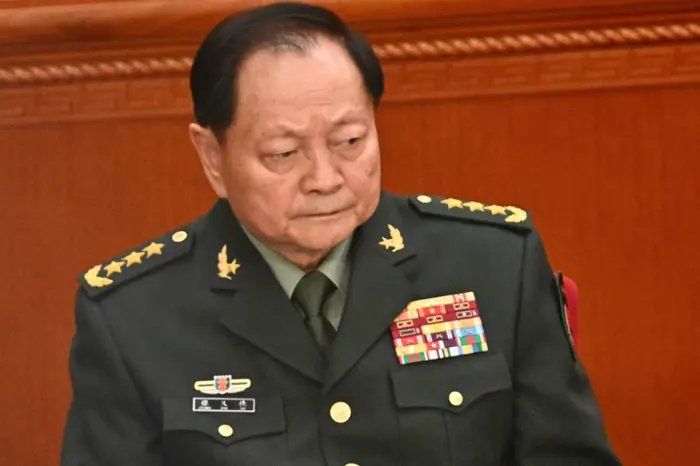
China's parliamentary standing committee has formally removed General Zhang Youxia from his position as vice chairman of the Central Military Commission, marking the culmination of a seven-month investigation into alleged corruption that has reverberated through the country's military hierarchy. State media confirmed the decision Friday, ending the tenure of an officer who had held one of the most powerful roles in the Chinese armed forces and stood among the most senior figures in the entire defence establishment.
Zhang's removal represents a dramatic fall from a position of considerable prominence. As the more senior of the Central Military Commission's two vice chairmen, he occupied China's highest-ranking military post, sitting atop the service branches and combat commanders. His authority extended across strategic planning, force deployment, and the management of the nation's defence apparatus during a period when Beijing has pursued increasingly assertive military policies in the South China Sea and across other regional flashpoints relevant to Southeast Asian security.
The investigation into Zhang's conduct commenced in January when the defence ministry announced that both he and Liu Zhenli, chief of staff of the CMC's joint staff department, were suspected of "serious violations of discipline and the law". This formulaic language, commonly employed in Chinese official pronouncements, conventionally signals allegations of corruption ranging from bribery and embezzlement to misuse of authority and illicit financial gain. The seven-month interval between announcement and removal allowed investigators to build their case while the military continued operating under temporary arrangements.
Zhang's predicament sits squarely within President Xi Jinping's broader anti-corruption agenda, which has fundamentally reshaped the Chinese political and military landscape since 2012. The campaign, initially framed as a necessary cleansing of party and state institutions, has evolved into a tool for consolidating power and neutralising potential rivals. Military figures have featured prominently in these investigations, with Xi's administration systematically removing commanders and defence officials who might pose institutional obstacles to his centralisation of authority.
What distinguishes Zhang's case is the sheer seniority of the individual involved and the widespread perception that he maintained close working relationships with Xi himself. Many observers interpreted Zhang's prominence as reflecting personal trust between the two men, making his downfall particularly surprising to analysts monitoring Chinese military politics. The episode demonstrates that even officers aligned with the highest leadership face vulnerability when investigations commence, suggesting that institutional loyalty provides no absolute protection within Xi's governance framework.
Liu Zhenli's simultaneous removal indicates that the investigation extended beyond isolated misconduct to systemic problems within military command structures. As chief of staff of the joint staff department, Liu oversaw combat planning and force coordination functions—sensitive operational domains where financial impropriety or mismanagement carries profound strategic implications. His removal signals that investigators identified concerning patterns throughout the defence establishment that required not merely individual accountability but structural intervention.
The timing of the formal removal holds significance for regional security dynamics. Southeast Asian nations, particularly those with maritime interests or territorial disputes with China, closely monitor the composition and stability of Beijing's military leadership. Transitions within the Central Military Commission can signal shifts in strategic orientation, defence spending priorities, or the relative influence of different service branches. Zhang's removal may thus prompt reassessment among regional governments regarding Chinese military decision-making processes and the durability of existing strategic preferences.
The investigation mechanism itself reveals aspects of how contemporary Chinese governance operates. The parliamentary standing committee's role in formally ratifying personnel decisions provides nominal oversight while actual investigations proceed through party channels, state security apparatus, and military discipline commissions functioning largely outside public view. This bifurcation between formal constitutional procedures and actual power dynamics remains a defining characteristic of Chinese political institutions.
Military anti-corruption campaigns present inherent tensions for any defence establishment. Effective armed forces require stability in leadership, coherent strategic vision, and institutional continuity. Simultaneously, genuine corruption undermines operational capability, morale, and the rule of law. Xi's administration has attempted to balance these considerations, conducting thorough investigations while maintaining military functionality. However, uncertainty regarding which officials face potential investigation can create risk-averse institutional cultures where commanders prioritise personal safety over operational innovation.
The removal of such a prominent figure also raises questions about succession and the distribution of power within China's military structure. The Central Military Commission comprises multiple vice chairmen and members, each representing different service branches or functional domains. Reshuffling senior positions inevitably affects established networks, command relationships, and institutional influence patterns. New appointees to vacated positions must establish legitimacy while rebuilding relationships disrupted by their predecessors' downfalls.
For Malaysia and the broader Southeast Asian region, these developments carry implications for how China's military establishment may evolve in coming years. Leadership changes within the CMC can influence the calculus regarding naval operations, air defence postures, or maritime resource competition. The stability and predictability of Chinese military decision-making affects regional states' strategic calculations regarding defence spending, alliance formation, and conflict management mechanisms.
Zhang's case ultimately exemplifies how Xi Jinping's centralisation of authority has extended thoroughly into military institutions traditionally buffered from direct political interference. The investigation and removal process, though formally consistent with institutional procedures, fundamentally reflects the preeminence of party leadership over all state and military structures. This subordination of the military establishment to party control remains one of the defining characteristics of contemporary Chinese governance.

