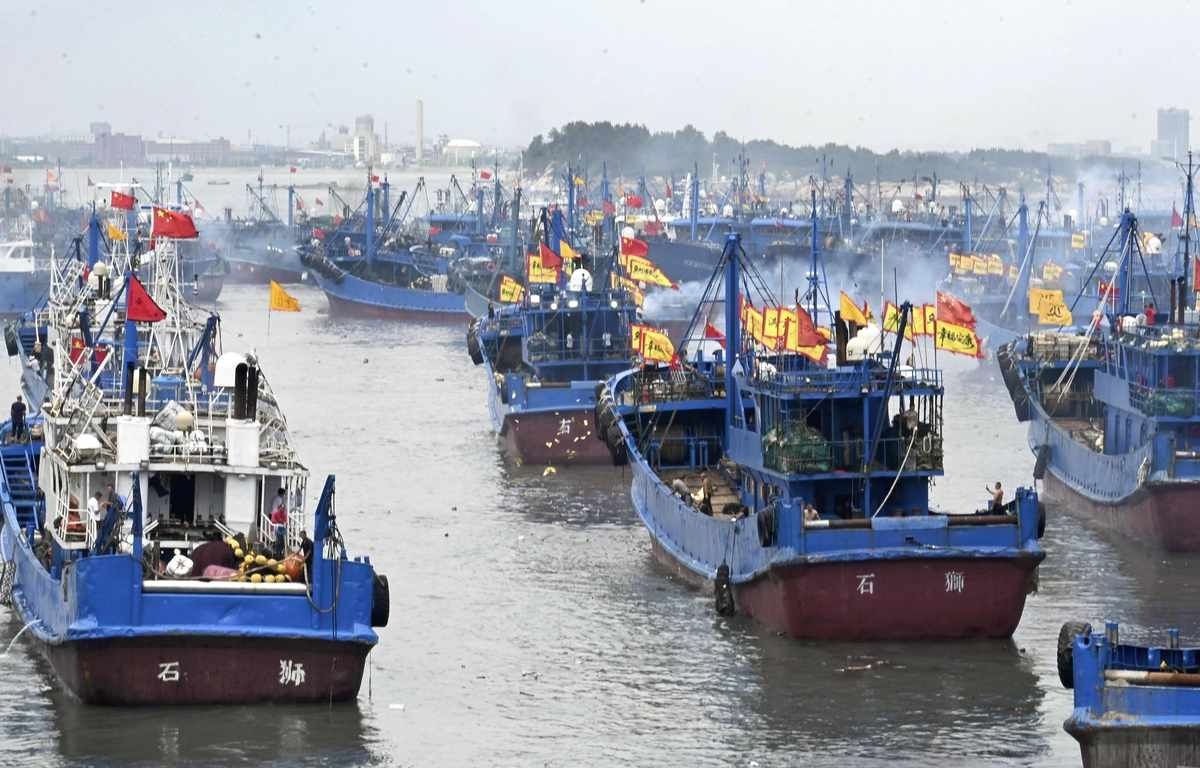
China's decision to lift its annual fishing ban in the East China Sea on Saturday, August 15, has set off immediate alarm bells in Tokyo, as hundreds of fishing vessels began departing from ports in Fujian Province. The timing and scale of the operation underscore the delicate balance between commercial maritime activity and geopolitical tensions in one of Asia's most sensitive maritime zones. A single port in the city of Shishi alone saw 654 vessels set sail on Sunday morning, according to local reports, with many displaying the Chinese national flag alongside traditional red and yellow banners invoking good fortune and abundant catches. The spectacle—complete with firecrackers echoing from departing boats—marks the official resumption of fishing operations that had been suspended since mid-May.
Japan's vigilance regarding this annual ritual is rooted in historical precedent. The disputed Senkaku Islands, which sit within Japan's Okinawa Prefecture, have been the flashpoint for an alarming pattern of Chinese maritime activity. In August 2016, a coordinated surge of Chinese fishing boats and Coast Guard vessels descended on the islands' waters, with confirmed incursions into Japanese territorial space. The scale was staggering—between 200 and 400 fishing vessels operating in apparent coordination with official government maritime forces. Tokyo registered a formal protest at the time, characterizing the episode as a unilateral escalation designed to test Japanese resolve and international response. Observers then believed the maneuver was retaliatory, following the Arbitral Tribunal in The Hague's July 2016 ruling that rejected China's expansive sovereignty claims in the South China Sea—a verdict Japan had championed.
The aftermath of that 2016 incident prompted Chinese local authorities to institute a quieter form of management. Rather than issuing explicit bans on fishing in specific areas, officials adopted what amounted to a soft constraint, instructing fishermen to avoid designated "sensitive waters" without necessarily prohibiting access outright. This approach allowed Beijing to maintain deniability while discouraging risky ventures that might trigger international incidents. The restraint appears to have worked: Japan Coast Guard warnings issued to Chinese fishing vessels entering Senkaku territorial waters plummeted from 81 in 2021 to just four in 2025, suggesting a marked decline in actual incursions or at least increased Chinese compliance with unspoken boundaries.
Yet the optics of restraint may be shifting. On August 7, authorities in Quanzhou—the administrative body overseeing Shishi—issued directives aimed at strengthening surveillance of sensitive waters. The language proved ambiguous: officials were tasked with monitoring, but the underlying intent remains unclear. Are Chinese authorities deploying surveillance to enforce compliance, or to provide cover for broader fishing activities? A fisherman interviewed by reporters on Saturday offered a telling perspective. In his mid-50s and speaking anonymously, the vessel operator acknowledged the extraordinary fertility of the waters surrounding the Senkaku Islands while articulating a calculation that has likely animated Chinese fishing strategy for years. "If we get too close to Japan, we'll be caught by Chinese authorities conducting surveillance," he explained. "However, we haven't been told outright not to go there."
That ambiguity reflects a deliberate recalibration in Beijing's public positioning. Examination of official notices issued during the ban period reveals subtle but significant linguistic shifts. In 2024, China's formal notice—typically issued around May each year—included explicit language warning against "cross-border fishing in sensitive waters such as those of South Korea, North Korea and Japan." Japan's inclusion was direct and unequivocal. This year's notice, released on April 30, maintained strict prohibitions on "fishing operations in the interim measures area between China and South Korea" but notably omitted any reference to Japan whatsoever. The erasure is unlikely to be accidental; official government notices undergo careful review before publication. The omission suggests either a deliberate diplomatic signal or a calculated removal of a written constraint that authorities no longer wish to enforce.
For Southeast Asian observers and policymakers, the implications extend beyond the bilateral Japan-China relationship. The Senkaku dispute sits within a broader pattern of maritime assertiveness that shapes regional security dynamics. China's management of its fishing fleets, and the degree to which those vessels operate as extensions of state power, establishes precedents that ripple across the South China Sea and beyond. The fishing ban itself—imposed seasonally to allow fish stocks to regenerate—is a legitimate conservation measure employed by multiple nations. However, the coordination between fishing fleets and state maritime forces, coupled with the deliberate use of civilian vessels to assert presence and test adversary responses, transforms routine economic activity into a tool of geopolitical competition.
The deteriorating state of Japan-China relations provides essential context. Both nations have struggled to contain frictions stemming from historical grievances, trade disputes, and technological competition. Against this backdrop, the fishing ban's termination carries symbolic weight beyond its immediate economic significance. It arrives at a moment when diplomatic channels have cooled and both sides have grown increasingly willing to adopt confrontational rhetoric. The absence of Japan from this year's official constraints could reflect Beijing's judgment that bilateral relations have already soured sufficiently that explicit restraint carries diminishing diplomatic value.
Japan's response will likely involve intensified maritime surveillance, particularly around the Senkaku Islands, with Coast Guard vessels positioned to monitor and document any incursions into territorial waters. Tokyo has shown consistent willingness to lodge formal protests and, when necessary, to forcibly discourage unauthorized entry. However, enforcement comes with risks of escalation, a consideration that has historically constrained Japanese responses. The fine line between national defense and provocation remains contested, particularly when civilian fishing vessels—rather than military assets—constitute the immediate threat.
For Malaysia and other ASEAN nations navigating great power competition, the Senkaku situation offers important lessons about maritime assertiveness and the militarization of fishing disputes. China's approach—deploying civilian vessels as force multipliers while maintaining official deniability—represents a strategy increasingly adopted across disputed waters. Understanding how Japan responds, and how international opinion coalesces around the incident, will inform regional calculations about acceptable behavior in contested maritime zones. The coming weeks will be critical in determining whether the lifting of China's fishing ban triggers a new spiral of confrontation or whether, despite rhetorical tensions, both Beijing and Tokyo opt for managed restraint in practice.

