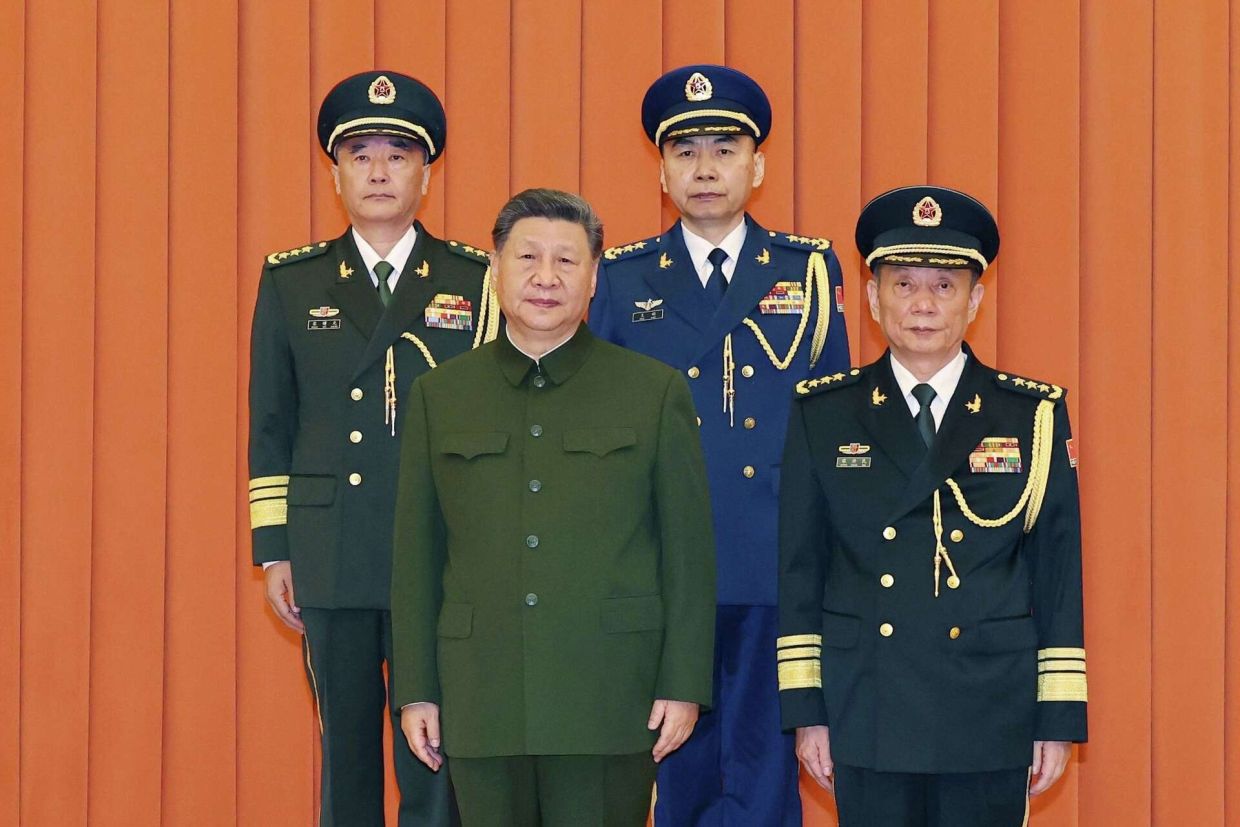
China's military has elevated two senior officers to the rank of general, a move that signals potential reorganisation within the armed forces following an extended anti-corruption sweep that has significantly depleted the leadership ranks of the People's Liberation Army. The promotions of Zhang Shuguang and air force commander Wang Gang were formally announced at a ceremony on Friday, July 3, with orders presented by Xi Jinping, who holds concurrent positions as general secretary of the Communist Party and chairman of the military's decision-making body.
The timing and nature of these appointments carry deeper implications for China's military governance structure. The promotions appear designed to address vacancies created by the ongoing anti-corruption investigations, which have systematically removed or sidelined several top-ranking officers. Zhang Shuguang's elevation carries particular significance, as he has simultaneously been appointed to head the division investigating corruption within the Central Military Commission, the paramount body overseeing China's armed forces. This dual role underscores the priority the leadership places on maintaining institutional control while rooting out what authorities characterise as misconduct and disloyalty within military ranks.
The Central Military Commission, technically the highest military authority in China, has been substantially hollowed out by the purge. The seven-member body has effectively been reduced to just two active participants following the removal or practical sidelining of multiple senior officers. Xi Jinping, as commission chairman, remains at the apex of this structure, but the scarcity of active members has created an operational challenge. Vice Chair Zhang Shengmin represents the only other functioning member of the commission, a dramatic contraction from its intended composition that reflects the scale of the anti-corruption operation.
The vacuum at the top of China's military hierarchy has not gone unnoticed by regional observers and defence analysts monitoring shifts in Beijing's strategic posture. The removal or effective removal of two former vice chairs, including the military's highest-ranking general, signals an unusually turbulent period for the People's Liberation Army's senior echelon. Such extensive turnover at this level is relatively uncommon in contemporary Chinese military history and suggests that the anti-corruption drive extends beyond routine administrative accountability into questions of political alignment and institutional loyalty.
This broader context reveals that the anti-corruption campaign targeting military leadership serves multiple strategic purposes beyond nominal ethics enforcement. The purge appears designed to consolidate Xi Jinping's personal control over the armed forces, ensuring that officers occupying positions of influence demonstrate unwavering loyalty to both his leadership and the Communist Party's broader agenda. By systematically removing or marginalising officers whose allegiances may be questioned or who represent institutional interests distinct from the party leadership's preferences, Xi has fundamentally reshaped the military's power structure.
The promotions of Zhang Shuguang and Wang Gang position them as potential candidates to fill vacancies on the Central Military Commission as the institution moves toward reorganisation. Analysts suggest that a comprehensive reshuffling of the commission's membership may occur in autumn of the following year, coinciding with the end of the current commission's five-year term. This timeline provides the leadership with an opportunity to formally restructure the body with individuals whose loyalty has been thoroughly vetted and whose commitment to Xi's vision for military modernisation and party control remains unambiguous.
For Southeast Asian nations, including Malaysia, these developments carry relevance to regional security calculations and China's military posture. The extent to which China's armed forces undergo internal reorganisation and leadership change can influence defence policies and military operations across the Indo-Pacific region. A military structure more tightly aligned with civilian party control and Xi's personal direction may affect how aggressively Beijing pursues territorial claims or military modernisation initiatives that impact neighbouring countries. The anti-corruption purge, while presented in institutional terms, ultimately represents a consolidation of political power that extends to military decision-making at the highest levels.
The strategic implications extend to China's engagement with regional partners and competitors alike. A military leadership that has undergone such extensive turnover requires time to establish operational cohesion and new command relationships. Simultaneously, the clear assertion of civilian and paramount leadership control over military institutions may influence how Beijing calculates risks and opportunities in regional military interactions. For countries in Southeast Asia monitoring China's military capabilities and intentions, understanding the internal dynamics of the People's Liberation Army remains crucial to assessing Beijing's strategic trajectory.
The anti-corruption campaign within China's military has also revealed the extent to which institutional reform can serve political consolidation. By framing the removal of senior officers as part of a principled anti-corruption effort, the leadership gains legitimacy for what amounts to a comprehensive purge of potential rivals and competing power centers. This model of institutional transformation through ethics-based campaigns demonstrates how authoritarian systems can restructure their hierarchies while maintaining the appearance of rule-based governance. The promotions of Zhang Shuguang and Wang Gang represent the next phase of this process, introducing officers whose advancement depends directly on the current leadership's favour and whose positions remain contingent on continued alignment with Xi's strategic vision for the military and the party.

