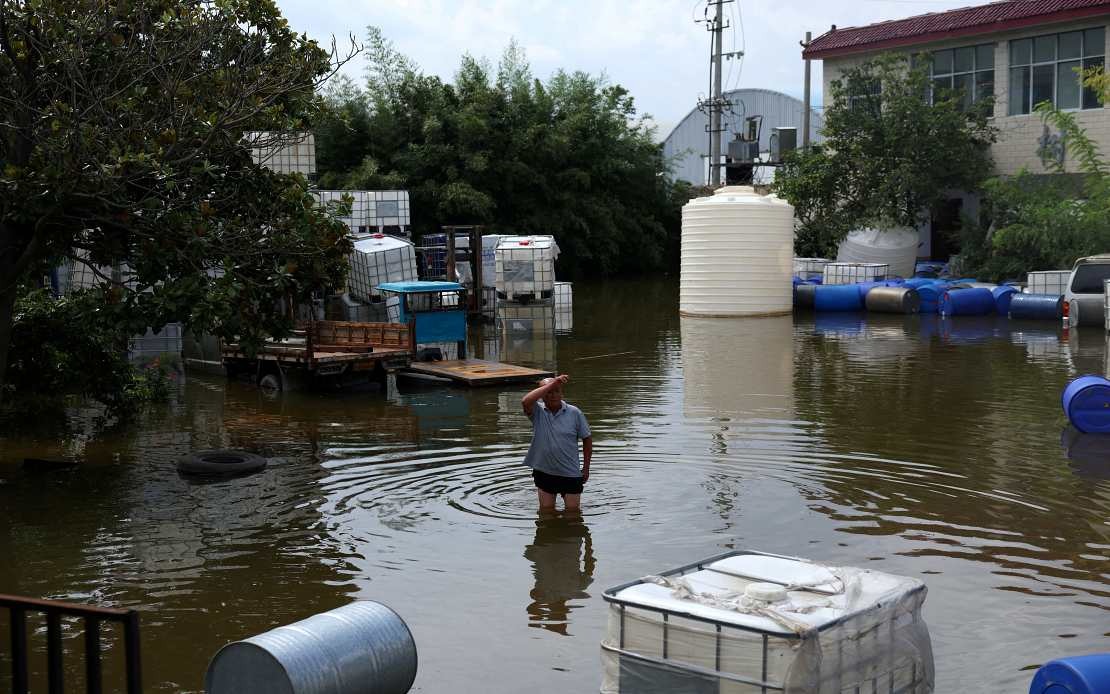
China's Ministry of Emergency Management has launched a coordinated emergency response to Zhoukou City in Henan Province after a critical infrastructure failure unleashed by tropical weather systems. The disaster unfolded Thursday evening when torrential precipitation from Typhoon Dolphin—the 13th typhoon of the year—saturated regional waterways to critical levels, ultimately breaching a major levee near midnight. Responding swiftly, authorities mobilized rescue teams and equipment to contain the humanitarian fallout from the infrastructure collapse and the subsequent flooding that engulfed surrounding communities.
The rescue contingent reflects the scale of the crisis. China's Ministry of Emergency Management coordinated the dispatch of 200 specialized engineering rescue personnel sourced from China Anneng Group, one of the nation's leading emergency response contractors. These teams arrived on Friday morning equipped with 110 sets of advanced large-scale engineering machinery designed to manage levee stabilization, water management, and victim recovery. The rapid deployment underscores Beijing's institutional capacity to mobilize resources across provincial boundaries when facing critical disasters, a capability that distinguishes China's disaster management infrastructure from many regional counterparts.
The government's activation of a Level-IV national disaster relief emergency response on Friday represents the formal recognition of Typhoon Dolphin's severity and the cascading consequences of the levee breach. China's National Commission for Disaster Prevention, Reduction and Relief made this determination following consultation with provincial authorities and real-time damage assessments. This classification triggers pre-positioned protocols, resource allocation mechanisms, and inter-agency coordination frameworks that streamline decision-making during the critical early phases of a humanitarian emergency. The Level-IV designation, while not the highest emergency tier, nonetheless signifies that central government resources and oversight would remain engaged throughout response and recovery operations.
Material assistance has already begun flowing to affected populations. The central government allocated 30,000 relief supply items for distribution across Zhoukou, Xuchang, and neighboring affected municipalities. These provisions encompass practical necessities including folding beds for temporary shelter, summer quilts for displaced residents, and family emergency kits containing essential survival items. The National Food and Strategic Reserves Administration coordinated dispatch of these supplies on Friday in conjunction with the ministry's office and the relief commission, reflecting the multi-agency coordination typical of China's disaster response architecture. Such pre-positioned supply stockpiles demonstrate advance planning for seasonal disaster patterns, though the specific trigger of this breach suggests infrastructure vulnerabilities that outlasted previous preparedness assumptions.
The levee failure carries particular significance for Southeast Asian observers monitoring China's water management challenges. Henan Province occupies a strategically important position within China's hydrological systems, and repeated flooding incidents in this region underscore the ongoing tension between rapid urbanization, aging water infrastructure, and intensifying extreme weather patterns. Climate projections anticipate that tropical cyclone precipitation will grow more erratic and intense, potentially straining existing levee systems designed to historical rather than contemporary rainfall intensities. For Malaysian policymakers and water resource managers, China's recurrent flooding crises offer cautionary lessons about infrastructure obsolescence and the necessity of regular upgrades to drainage and flood-containment systems.
Typhoon Dolphin's trajectory through central China highlights the regional interconnectedness of tropical weather systems affecting East and Southeast Asia. While this particular typhoon impacted primarily northern regions, its moisture-laden remnants demonstrated how these systems can travel vast distances inland, transforming into severe precipitation events that exceed the designed capacity of stationary infrastructure. Malaysian experience with monsoon precipitation and occasional tropical cyclone influences demonstrates comparable vulnerabilities. The speed with which Zhoukou's levee failed—occurring within hours of intense rainfall—suggests that infrastructure capacity margins in the region may be narrower than official assessments indicate, a concern relevant to communities throughout Southeast Asia facing comparable geographic and climatic conditions.
The response mobilization also reflects evolving patterns in how Beijing coordinates emergency management across provincial administrations. The dispatch of national-level assets and personnel to a provincial-level crisis indicates centralized decision-making authority combined with pre-established protocols for resource sharing. This contrasts with more decentralized emergency management systems where provincial governments bear primary responsibility for response mobilization. For regional observers, understanding China's integration of national disaster response mechanisms offers perspective on comparative institutional effectiveness, though it simultaneously raises questions about whether centralized coordination can respond adequately when multiple provinces face simultaneous crises.
The engineering focus of the rescue operation—emphasizing 200 specialized personnel and 110 pieces of large machinery—suggests authorities expect significant infrastructure reconstruction demands beyond immediate victim assistance. Levee repair and reconstruction typically requires sustained engineering effort, coordinated material supply chains, and sustained technical expertise. The deployment of this scale of equipment indicates that Chinese officials anticipate the breach will require comprehensive rebuilding rather than simple repairs, a determination that carries substantial resource and timeline implications for affected communities. This engineering-centric approach reflects prioritization of infrastructure restoration alongside humanitarian assistance, recognizing that durable recovery depends upon restoring the physical systems that enable normal community function.
For Malaysian observers monitoring disaster management practices and infrastructure resilience across the region, the Henan crisis underscores the importance of regular infrastructure audits and modernization initiatives. Levee systems in particular represent critical but often overlooked infrastructure categories where deferred maintenance and aging design standards can suddenly translate into catastrophic failures. The rapidity with which Typhoon Dolphin's precipitation overwhelmed Zhoukou's levee system suggests that historical design assumptions may no longer adequately reflect contemporary climate patterns. Malaysian water authorities managing similar flood-prone regions would benefit from undertaking comparable vulnerability assessments, ensuring that critical water management infrastructure incorporates adequate safety margins for emerging precipitation patterns rather than relying on historical climate normals.
The relief supply allocation methodology—distributing 30,000 items across multiple affected municipalities simultaneously rather than concentrating resources—reflects institutional experience managing geographically dispersed disaster impacts. By distributing supplies across Zhoukou, Xuchang, and neighboring areas within the same timeframe, authorities can respond to proportional needs across the affected zone while minimizing logistical concentration at single distribution nodes that might become bottlenecks. This distributed approach to supply chain management during emergencies represents an evolving best practice that regional disaster management agencies throughout Southeast Asia have increasingly adopted, recognizing that efficient relief delivery depends as much on logistics optimization as on supply quantity.

