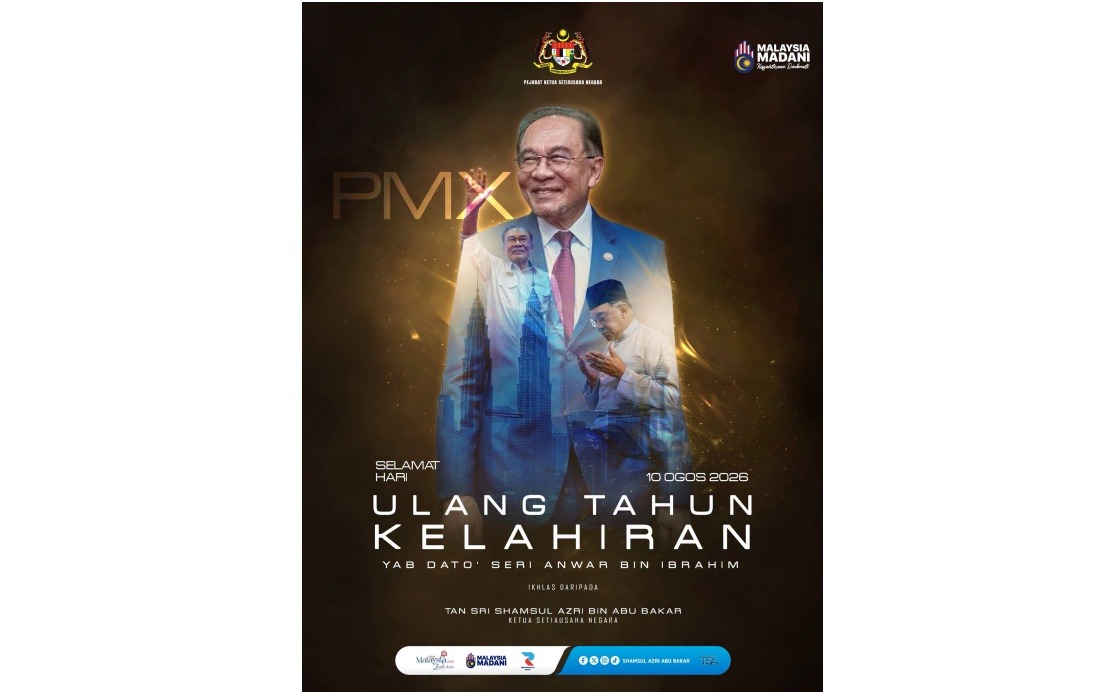
Prime Minister Datuk Seri Anwar Ibrahim marked his 79th birthday on August 10 with warm wishes from senior government figures and key state institutions, reflecting the leadership's confidence in his continued stewardship of the nation during a period of significant administrative reform. Chief Secretary to the Government Tan Sri Shamsul Azri Abu Bakar extended the official felicitations, underscoring both personal regards and institutional support for the Prime Minister as he navigates Malaysia's evolving governance landscape.
In his public statement, Shamsul Azri conveyed hopes that the Prime Minister would enjoy continued good health, physical strength, and the clarity of judgment essential to leading a diverse and complex nation. The birthday message carried particular significance given the Chief Secretary's role as the highest-ranking civil servant in Malaysia, responsible for coordinating the administrative machinery across all federal departments and agencies. His remarks emphasised that the broader civil service community stands ready to advance the government's agenda for public sector transformation, a commitment that speaks to the administration's emphasis on institutional renewal and professional excellence within the bureaucracy.
The Chief Secretary's statement specifically referenced Malaysia's public service reform initiatives, positioning the Prime Minister's birthday as an occasion to reaffirm the civil service's dedication to supporting the administration's vision. This framing highlights how birthday greetings in Malaysia's political culture often serve dual purposes: acknowledging the individual while simultaneously reinforcing institutional alignment with government priorities. The reference to supporting "the aspirations and reform agenda of the public service for the people and the country" signals continuity in the government's efforts to enhance bureaucratic efficiency and citizen-facing service delivery, areas that have featured prominently in policy discussions since Anwar Ibrahim assumed office.
The Prime Minister's Office similarly joined the chorus of congratulations through a specially produced video message shared across social media platforms, employing language rich with symbolism about perseverance and public trust. The phrase "Efforts continue, the trust is fulfilled, and to Allah SWT we place our trust" suggests both an acknowledgment of ongoing challenges and an expression of faith in divine guidance, a rhetorical approach common in Malaysian political communications that interweaves secular governance with Islamic values and terminology.
The Malaysia MADANI social media account, representing the government's signature developmental and administrative framework launched under the current administration, also extended formal greetings to the Prime Minister. The MADANI initiative, which encompasses objectives around institutional excellence, inclusive economic development, and technological advancement, underscores how contemporary Malaysian governance integrates personal political narratives with broader programmatic identity. The birthday wishes posted through this channel reflect how the government seeks to maintain a cohesive public messaging framework across multiple institutional voices and digital platforms.
Anwar Ibrahim's 79th birthday arrives at a juncture when Malaysia continues to address economic pressures, including inflation management, fiscal sustainability, and the need to maintain investor confidence amid regional uncertainties. The government's institutional messages on his birthday, while conventional in form, implicitly affirm continuity in leadership during a period when economic management and administrative competence remain central to public discourse. The emphatic commitments from the Chief Secretary and other agencies suggest confidence in the Prime Minister's capacity to steer the nation through contemporary challenges.
The coordinated nature of the birthday wishes from multiple government entities—spanning the office of the Prime Minister, the Chief Secretary's position, and the Malaysia MADANI administrative framework—demonstrates how Malaysia's political establishment maintains ceremonial functions and formal protocols even as it addresses substantive policy matters. Such institutional acknowledgments serve to reinforce the legitimacy of the office and the individual occupying it, particularly important in contexts where questions about governance capacity or political stability occasionally surface in public debate.
Birthday observations by senior government officials carry weight within Malaysia's political culture, where respect for leadership hierarchies and institutional protocols remains deeply embedded in administrative practice. The decision by high-ranking civil servants to issue formal statements, combined with social media amplification through official government accounts, creates a documented record of institutional backing that carries both symbolic and practical significance for ongoing governance initiatives. These messages become part of the administrative narrative and can influence perceptions about governmental cohesion and confidence in existing leadership arrangements.
The Prime Minister's advancing age, while numerically significant at 79 years, has not been treated as a matter of particular concern in Malaysian political discourse, where experience and continuity in leadership are generally valued. The birthday wishes emphasise vitality, continued engagement, and the ongoing capacity to serve rather than dwelling on any implications of age. This framing aligns with how Malaysia's political culture typically handles questions of leadership longevity, focusing on demonstrated capability and institutional support rather than chronological considerations. The widespread institutional acknowledgment of Anwar Ibrahim's birthday therefore serves as a subtle affirmation that the government's highest circles regard his continued leadership as both appropriate and desirable during the present period.

