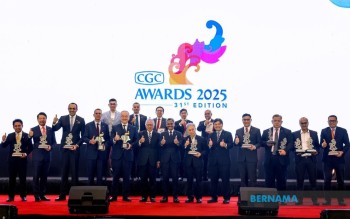
The Credit Guarantee Corporation Malaysia Bhd (CGC) celebrated the entrepreneurial achievements of the nation's micro, small and medium enterprises at its 31st awards ceremony in Kuala Lumpur, recognising 32 outstanding contributors to Malaysia's enterprise ecosystem. The recognition extended beyond individual businesses to encompass key financial institutions that have partnered with CGC to advance MSME development, underscoring the collaborative nature of sustainable economic growth in the country.
CGC chairman Datuk Mohammed Hussein articulated a nuanced understanding of business resilience during the ceremony, arguing that the ability to withstand economic pressures transcends mere access to funding. He contended that the character and discipline demonstrated by business owners, coupled with their capacity to adapt to shifting market conditions, constitute equally vital ingredients for enterprise survival. This perspective reflects a broader recognition within Malaysia's development community that financial support, while necessary, remains insufficient without corresponding improvements in business acumen and operational excellence.
The chairman's remarks carried particular significance for the Malaysian business landscape, where external vulnerabilities—including regional supply chain disruptions, currency fluctuations, and shifting consumer demand—regularly test enterprise durability. By emphasising character and adaptability, CGC signalled that sustainable MSME development requires a holistic ecosystem approach rather than reliance on single interventions. Hussein outlined this ecosystem vision explicitly, defining distinct roles for multiple stakeholders: government must establish a business-friendly regulatory environment; research institutions should facilitate the transition of technological innovations into commercially viable products; large corporations ought to open their supply chains to smaller partners; and financial institutions must provide appropriately structured capital for growth.
A particularly striking achievement highlighted during the ceremony involves CGC's deepening commitment to Bumiputera enterprise participation. The corporation channelled RM223 million in guarantee support to 27 Bumiputera-controlled companies during the preceding year, demonstrating tangible progress toward inclusive economic participation. This figure carries significance for Malaysia's broader socioeconomic agenda, as Bumiputera MSME development remains central to equitable wealth distribution and community economic empowerment across the country.
CGC's environmental, social and governance-linked guarantee portfolio reached RM1.2 billion, surpassing its RM1 billion target. This performance reflects growing alignment between Malaysia's enterprise financing and global sustainability imperatives, with businesses increasingly recognising that operational resilience depends partly on environmental stewardship and social responsibility. The achievement suggests that responsible business practices no longer represent peripheral concerns but rather integral components of competitive advantage and financial sustainability.
The awards distributed across three distinct categories, acknowledging excellence among both traditional financial institutions and emerging fintech platforms. Alliance Bank Malaysia Bhd and CIMB Islamic Bank Bhd shared the Best Financial Partner award, while OCBC Al-Amin Bank Bhd received recognition specifically for supporting Bumiputera enterprises. Maybank Islamic Bhd earned a Special Recognition award for its Bumiputera-focused initiatives, highlighting the increasingly prominent role of Islamic financing in supporting Malaysia's enterprise sector. The recognition of both conventional and Islamic financial institutions reflects Malaysia's position as a dual-track financial system where complementary financing mechanisms serve diverse business needs.
The Top Financial Institution Partner awards encompassed multiple institutional categories, acknowledging that MSME support flows through conventional commercial banks, Islamic banks, development financial institutions, and specialised platforms. Bank Simpanan Nasional and the Small Medium Enterprise Development Bank Malaysia Bhd received recognition within the development financial institution category, underscoring the continuing relevance of government-linked entities in addressing MSME financing gaps that commercial institutions alone cannot adequately serve. The inclusion of Peoplender Sdn Bhd (Fundaztic) as a Top Non-FI Partner demonstrated CGC's openness to alternative financing platforms that increasingly serve segments of the MSME ecosystem.
The ceremony marked the formal launch of two substantial guarantee schemes jointly developed by Bank Negara Malaysia and CGC. The Portfolio Guarantee (PG) and Portfolio Guarantee-i (PG-i) schemes collectively mobilise RM10 billion in guaranteed financing capacity, with projections suggesting support for approximately 12,100 MSMEs across key economic sectors. The schemes operate on a risk-sharing model, meaning participating financial institutions and CGC jointly absorb potential losses, thereby encouraging lenders to extend financing to borrowers who might otherwise fall outside their risk appetite. For Malaysian MSMEs seeking expansion capital, these mechanisms theoretically reduce financing barriers and lower borrowing costs through shared risk arrangements.
The new guarantee schemes specifically target businesses pursuing expansion, productivity enhancement, sustainability transitions, and competitiveness improvements. This multi-dimensional focus acknowledges that contemporary MSME development encompasses more than simple revenue growth; it encompasses operational modernisation, environmental adaptation, and market positioning. The emphasis on sustainability transitions carries particular resonance for Malaysia's commitment to net-zero emissions by 2050, suggesting that CGC views small businesses as essential participants in the nation's energy transition and circular economy initiatives.
CGC's articulation of its CGC Group 2030 strategic framework positioned financial inclusion and sustainable economic development as core organisational missions. The framework signals that the corporation views its mandate as extending beyond risk mitigation for financial institutions toward broader contributions to economic participation and environmental stewardship. This positioning aligns CGC's objectives with Malaysia's regional role as a developing economy increasingly focused on inclusive and sustainable growth models.
For Malaysian entrepreneurs and smaller business owners, the combined effect of the awards recognition and new guarantee schemes represents tangible progress toward improved financing access. The RM10 billion guarantee capacity theoretically reaches approximately 12,100 businesses, a numerically meaningful but limited subset of Malaysia's estimated 907,000 MSMEs. This gap suggests that while recent initiatives represent significant advancement, structural financing challenges for smaller enterprises remain substantial, particularly in underserved regions and sectors.
The recognition of diverse financial institution types—from traditional commercial banks to specialised fintech platforms—reflects evolving realities of enterprise financing in Southeast Asia. As Malaysian MSMEs increasingly operate in digital environments and leverage technology for business operations, financing pathways must diversify correspondingly. CGC's engagement with both conventional and alternative finance providers suggests institutional recognition that multiple pathways to capital serve the heterogeneous needs of Malaysia's enterprise sector.
Looking forward, the success of the Portfolio Guarantee schemes will significantly influence Malaysia's ability to achieve inclusive MSME development. The mechanisms represent attempts to overcome information asymmetries and risk perception barriers that traditionally disadvantaged smaller enterprises seeking financing. For Malaysian policymakers and business stakeholders, monitoring scheme uptake and assessing actual impact on business survival and growth rates will prove essential for evaluating whether current interventions adequately address structural financing constraints facing the nation's entrepreneurial base.

