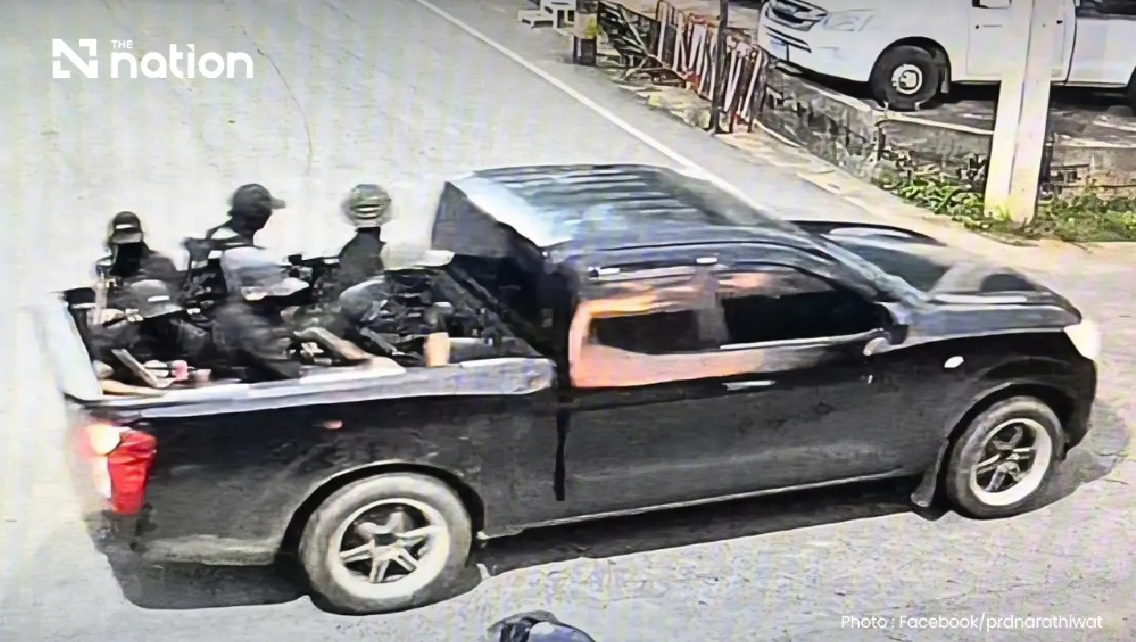
A brazen assault on a Thai paramilitary checkpoint in Narathiwat province has exposed the strategic sophistication of militant operations in Thailand's restive deep south, with closed-circuit television footage revealing a nine-member attack team executing the raid with military precision in just 90 seconds. The attack on the Bukeh Sami checkpoint on Wednesday evening, July 22, resulted in the deaths of five members of the 4509th Ranger Company under the 45th Ranger Regiment Task Force, while six civilians including a 10-year-old boy sustained injuries. The assault began at approximately 6.45pm at the checkpoint location in Village 7 of Tanyong Mat subdistrict, Ra-ngae district, shattering initial investigative assumptions that the perpetrators numbered only six individuals.
Camera footage from positions outside and across from the checkpoint installation provided investigators with crucial evidence of the attackers' operational structure and tactics. The assault force divided into two distinct teams, with the primary strike force consisting of seven personnel travelling in a black Nissan pickup truck bearing a Songkhla registration. One individual served as the vehicle operator while six others occupied the truck bed, all dressed in black attire resembling paramilitary uniforms and wearing wide-brimmed hats that obscured their facial features. A supporting team of two arrived on a red-and-white Honda Wave motorcycle that trailed the pickup, with the rider dressed in a white shirt and helmet reportedly equipped with an 11mm pistol, while the passenger wore a black women's hijab as a facial disguise and carried an AK-type rifle. This secondary team functioned as rear security as the convoy approached the checkpoint from the direction of Tanyong Mat market.
The tactical execution revealed in the footage demonstrates a coordinated approach typical of organised militant operations. Three paramilitary rangers were stationed at the roadside perimeter when the pickup vehicle decelerated near their position. Occupants in the truck bed immediately opened fire with M16 and AK-type rifles, rapidly neutralising the three officers. The vehicle halted and additional members dismounted, maintaining suppressive fire directed toward the main checkpoint building and its reinforced bunker where two additional rangers were positioned. The attackers methodically breached the post, conducting a search and extraction operation that yielded weapons and equipment before regrouping at the pickup. During the withdrawal phase, one assailant detonated a pipe bomb aimed at an elevated structure adjacent to the bridge beside the checkpoint. The entire group then fled toward Dusongyo subdistrict in Ra-ngae district, with both vehicles departing the scene.
All five rangers were killed in the operation, identified as Sergeant Major First Class Theerayut Somakerd, ranger volunteers Sakiriya Jena, Wimon Dabthong, Nattasit Kaewsena and Salahuding Pi. The casualties represent a significant security setback in Thailand's ongoing struggle to stabilise its southernmost provinces, which have experienced decades of intermittent violence related to the historical Pattani insurgency. The six civilian casualties, drawn from the immediate vicinity of the checkpoint, included a minor who required hospitalisation, underscoring the indiscriminate nature of the assault. Initial casualty reporting proved unreliable, with early accounts varying between two and five civilian injured before the confirmed total of six emerged.
Forensic and investigative teams mobilised rapidly following the attack, with Narathiwat Governor Boonchuay Homyamyen coordinating responses alongside Provincial Police Region 9 commissioner Pol Lt Gen Piyawat Chalermsri, Narathiwat police chief Pol Maj Gen Prayong Khot Sakha and Col Witthaya Sariya commanding the 45th Ranger Regiment Task Force. Overnight examination of the scene involved bomb-disposal specialists, tactical police units and forensic investigators working to document the assault and collect physical evidence. More than 100 spent cartridge cases lay scattered across the roadway, consisting of rounds consistent with M16 rifles, AK-type rifles and an 11mm pistol, along with additional ammunition apparently ejected during weapon malfunction remediation by the attackers. The bunker structure displayed extensive bullet impact marks, while evidence from the pipe bomb explosion was recovered near the bridge structure.
Weapon inventories compiled during the investigation indicated that assailants successfully removed four folding-stock AK-type rifles, one 11mm pistol, four ammunition magazines and four bulletproof vests from the checkpoint. Authorities acknowledged discrepancies in initial accounting, noting that comprehensive inventory verification remained incomplete due to conflicting early reports regarding the quantity and classification of confiscated items. The precision in weapon selection during the extraction operation suggests prior reconnaissance or intelligence gathering regarding the checkpoint's equipment holdings.
The Nissan pickup utilised in the attack was discovered subsequently in an abandoned and burned-out condition, appearing to represent a deliberate attempt to eliminate forensic evidence that might link the vehicle to the perpetrators. Security forces rapidly established multiple checkpoints and roadblocks along potential escape corridors throughout the region following the assault, though the attackers' successful withdrawal indicates either advance knowledge of defensive response patterns or advantage gained through the speed of execution. The attack's methodical character—executed within 90 seconds despite coordinated movement between two vehicles—reflects operational planning more characteristic of organised militant networks than spontaneous violence.
For Malaysian and regional security observers, the Narathiwat checkpoint attack serves as a stark reminder of the sophisticated capabilities retained by militant groups operating across Southeast Asia's border regions. Thailand's southern provinces remain historically volatile, with the conflict in Pattani, Yala and Narathiwat representing one of the world's longest-running insurgencies, attracting both separatist elements and transnational extremist networks. The coordination demonstrated in this assault—involving weaponry procurement, vehicle acquisition, personnel recruitment and tactical planning—suggests ongoing operational capacity despite years of counterinsurgency operations. The successful weapon extraction during the raid further indicates that supply lines serving militant organisations remain functional, with the accumulated equipment likely redistributed for subsequent operations.
The incident reflects broader Southeast Asian security challenges extending beyond Thailand's borders. Malaysia shares maritime and terrestrial borders with Thailand's southern provinces and has long confronted cross-border militant recruitment and weapon smuggling connected to the Pattani insurgency. The capability displayed in the Narathiwat attack aligns with patterns observed in Malaysia's own experiences with militant operations, suggesting a regional environment where organised groups maintain training infrastructure and resource networks across national boundaries. The presence of motorcycle-mounted personnel providing tactical support, consistent with Southeast Asian militant tradecraft, underscores how operational methodologies evolve and disseminate throughout the region.
Immediate security implications for Thailand involve accelerated defensive measures protecting additional checkpoints and installations throughout the southern provinces. The attack exposes vulnerabilities in checkpoint security postures and may prompt comprehensive reviews of ranger deployment patterns, fortification standards and response protocols. However, the attackers' successful 90-second execution and subsequent escape suggests that tactical responses alone may prove insufficient without addressing broader drivers of recruitment and militancy in Narathiwat province. The casualty toll—combining military deaths, civilian injuries and weapon losses—represents a significant operational success from the attackers' perspective, likely to encourage similar operations and potentially inspire emulation elsewhere in southern Thailand or neighbouring regions experiencing comparable insurgent pressures.

