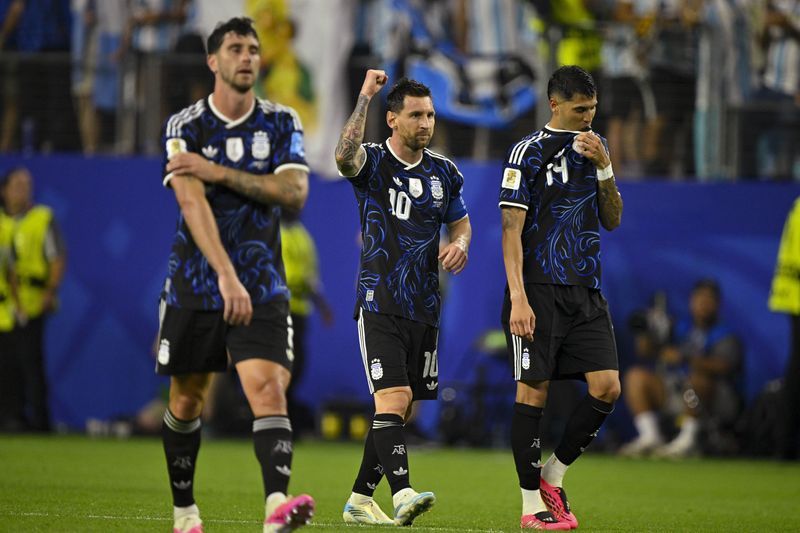
Cape Verde's manager Bubista has declared his squad will stick to their uncompromising blueprint when they face Argentina in Friday's knockout-stage encounter, refusing to be intimidated by the reigning world champions and their constellation of attacking talent. The Atlantic island nation, ranked 67th in FIFA's standings at the tournament's outset, has already defied expectations through an impressive group campaign that produced draws against Spain, Uruguay and Saudi Arabia—results that have vindicated Bubista's audacious tactical philosophy and emboldened his players ahead of their greatest challenge yet.
Speaking at Miami Stadium on Thursday, Bubista articulated a vision of controlled ambition rather than defensive caution, insisting that Cape Verde earned their place in the competition through merit during qualifying and have continued to validate that claim on the tournament's grandest stage. His consistency in messaging throughout the campaign has provided the squad with clarity of purpose and an organizational framework that has repeatedly allowed them to compete effectively against far higher-ranked opponents. The coach framed Friday's encounter not as an opportunity to merely participate, but as a genuine opportunity to advance—a mental posture that reflects genuine belief in his team's capacity rather than resigned acceptance of their underdog status.
Cape Verde's trajectory through the group stage has been remarkable by any measure. Rather than grinding out defensive victories or stealing wins through set-piece opportunism, they have competed with genuine attacking intent while maintaining the organizational discipline required to earn consecutive draws against world-class opposition. This approach has burnished their credentials and provided psychological momentum heading into a match where conventional wisdom would suggest their best outcome might be a respectable defeat. Bubista's insistence on "playing a good match" as his primary objective reflects a manager comfortable with his team's identity and unwilling to abandon the principles that have brought them this far.
The former centre-back's message to his players has centered on the synthesis of humility and ambition, a balance that explains how a small island nation has managed to perform consistently above their historical level. He has emphasized the importance of maintaining organizational structure and tactical discipline while pursuing victory with the courage that comes from believing genuinely in one's capacity to succeed. This duality—respecting opponents while refusing to be cowed by their reputation—represents a maturation in international football where smaller nations increasingly compete as tactical equals rather than supplicants grateful for participation.
Bubista's refusal to construct elaborate game plans specifically designed to neutralize Lionel Messi reveals confidence in his team's general approach and an understanding that attempting to bottle up one player often exposes vulnerabilities elsewhere. Instead, he has emphasized adaptation without compromise, the ability to adjust tactically to each opponent's specific strengths while remaining true to the fundamental principles that have guided Cape Verde's campaign. This flexibility within structure has proven the key to their success against Spain, Uruguay and Saudi Arabia, each of whom presented distinct tactical challenges requiring specific adjustments rather than wholesale strategic overhauls.
Argentina represents an escalation in difficulty, though not fundamentally a different challenge in structural terms. Lionel Scaloni's side possesses undeniable quality, led by Messi's genius and supported by attacking depth that few nations in international football can match. Yet Cape Verde has already demonstrated that superior ranking and reputation do not automatically translate into superior performance when tactical organization and collective effort are applied intelligently. The match will ultimately turn not on whether Cape Verde can neutralize Argentina's attack—a seemingly impossible task—but rather on whether they can maintain the balanced approach that has brought them to this point.
The psychological dimension of Cape Verde's position cannot be understated. Having qualified for a World Cup for the first time and then navigated a group containing multiple elite opponents, the squad has already achieved something historically significant for their nation. This achievement provides freedom rather than burden, allowing them to approach Friday's match without the suffocating pressure that accompanies genuinely expected outcomes. They arrive as the world's seventh-ranked team in this tournament's context—not in terms of FIFA standings, but in terms of the eight participants competing for four places in the quarter-finals—meaning advancement remains statistically possible despite Argentina's superior pedigree.
Cape Verde's qualification for the World Cup itself represents a watershed moment for African football beyond the continental confederation. Smaller African nations have occasionally reached global tournaments, but few have genuinely competed within the group stage, and fewer still have demonstrated the tactical sophistication and mental resilience that Bubista's squad has displayed. Their performances have implications for the sport's development trajectory in regions where institutional resources remain limited compared to wealthier footballing nations, suggesting that organization and clarity of purpose can partially compensate for differences in financial investment.
The match carries particular resonance for Southeast Asian football observers, where similar challenges around building competitive national sides from limited resource bases mirror Cape Verde's experience. How smaller nations with rich footballing traditions but modest global rankings approach world-class opposition becomes a case study in competitive achievement against the odds. Bubista's emphasis on trusting their working methods and maintaining identity resonates beyond Cape Verde's borders, offering a philosophical template for how emerging football nations might pursue credibility on the global stage.
For Malaysia and Southeast Asian football development specifically, Cape Verde's campaign offers both inspiration and practical lessons. The model of maintaining tactical identity while remaining adaptable to individual opponents, the emphasis on collective organization compensating for individual disadvantages, and the psychological approach of pursuing genuine victory rather than celebrating participation—these represent transferable principles relevant to regional qualifying campaigns. Cape Verde demonstrates that geographical size and limited historical pedigree need not condemn a nation to perpetual underdog status when strategic planning and unified organizational purpose are applied consistently.
The match against Argentina on Friday will likely determine whether Cape Verde's tournament becomes a celebrated example of principled overachievement or a near-miss narrative emphasizing how desperately close they came to something historic. Bubista's refusal to adjust his fundamental approach suggests the former outcome interests him more than the latter. Whether that conviction translates into advancement remains to be seen, but Cape Verde has already rewritten expectations for what an outsider nation can achieve when entering a World Cup for the first time with clarity of vision and organizational discipline.

