Cape Verde's journey to the Round of 32 of the World Cup represents one of football's most improbable success stories, yet the African island nation refuses to accept the role of sacrificial lambs when they face Argentina on Friday. Despite bookmakers and statistical analysts giving them minimal odds of progressing, the Cape Verdean camp exudes a quiet confidence born from their group-stage accomplishments—consecutive draws against two former World Cup winners that secured their spot in the knockout rounds as the tournament's least populous nation ever to reach this stage.
Assistant coach Humberto Bettencourt articulated this unwavering self-belief during the team's pre-match preparation in Tampa, rejecting the notion that playing the tournament's defending champions represents anything less than an opportunity. His comments reveal a philosophical approach to underdog football that prioritizes ambition and collective strength over the probability matrices that overwhelmingly favor Argentina. The former pundits gave Cape Verde a one percent chance before the tournament commenced, yet even the modestly improved four percent odds heading into this encounter hold no sway over the tactical mindset of Bettencourt and his players.
The mathematics of World Cup football have repeatedly yielded unexpected results throughout history, Bettencourt emphasized to gathered reporters, suggesting that the unpredictable nature of sport within the confines of the pitch supersedes any theoretical framework developed from historical data. This sentiment encapsulates the mentality required for any underdog to threaten an elite opponent—a commitment to process and tactical integrity rather than capitulation before the game even begins. Cape Verde's achievement in drawing with Spain and Uruguay demonstrated both defensive solidity and creative organization that no opponent, regardless of pedigree, can dismiss.
The composition of Cape Verde's squad itself underscores the diaspora networks connecting the island nation to global football talent pools. Players representing the national team were born across multiple continents—the Netherlands, Portugal, France, the United States, and Ireland—creating a cosmopolitan workforce that brought diverse footballing influences to strengthen the collective. Notably, a substantial contingent maintains familial or ancestral connections to Argentina itself, adding an intriguing subplot to Friday's encounter beyond the mere pursuit of qualification.
Bettencourt made clear that Cape Verde's approach to containing Argentina will not involve wholesale tactical adjustments or the defensive suffocation tactics sometimes deployed against supremely gifted individual players. Rather than assigning a dedicated marker to shadow Messi throughout the match, the Cape Verdean coaching staff views the diminutive Argentine as merely one component within Argentina's broader attacking architecture. This perspective allows Cape Verde to maintain defensive shape and compactness while remaining alert to the interplay and combinations that create space for the world's most dangerous creative talent.
The composition of Cape Verde's available personnel provides some optimism despite uncertainty around midfielder Telmo Arcanjo, whose leg injury places his participation in considerable doubt. Arcanjo's skill set would have provided valuable contributions to Cape Verde's midfield operations, yet his absence will force tactical adjustments. Conversely, combative left back Sidny Lopes Cabral returns from a one-match ban, having accumulated yellow cards during the group phase encounters against Spain and Uruguay. His reintroduction adds defensive robustness to Cape Verde's backline at a moment when such stability becomes invaluable against elite attacking options.
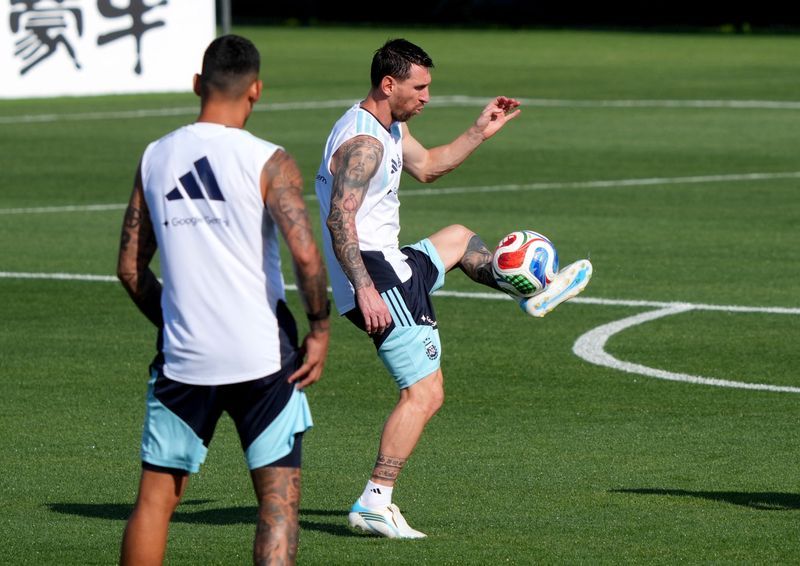
Argentina's preparation appears more straightforward on the surface, with coach Lionel Scaloni positioned to restore Messi to the starting lineup after deploying him as a substitute during the final group match against Jordan. That tactical decision—rotating the tournament's most dangerous player—underscores Argentina's dominance through the opening stage, with three consecutive victories maintaining an unblemished record. Messi's introduction in the 3-1 victory yielded immediate impact, with the Paris Saint-Germain forward scoring his sixth goal of the tournament and demonstrating the sharpness required during the knockout phase.
Scaloni must determine the optimal combination from Argentina's array of world-class attacking talent to dismantle a Cape Verdean defensive system that, despite humble ranking and limited experience, has proven remarkably resilient against superior opponents. The Argentine tactician inherited a squad stacked with quality throughout the pitch, and the elimination of Cape Verde presents a test of systems and personnel deployment rather than an existential challenge. Nevertheless, the vagaries of tournament football have produced shocking results, and any complacency regarding an opponent that has already surpassed realistic expectations invites disaster.
For Cape Verde and indeed all of African football, this Round of 32 encounter represents far more than a single match. The visibility and international attention generated by their improbable run extends beyond the football pitch, raising the profile of a small island nation to unprecedented heights. Success in previous rounds came through collective discipline, tactical clarity, and psychological resilience—precisely the qualities required to produce perhaps the tournament's greatest upset should they navigate past Argentina's considerable talent. Conversely, even defeat would consolidate their maiden World Cup experience as a transformative achievement for a nation competing against the sport's elite.

