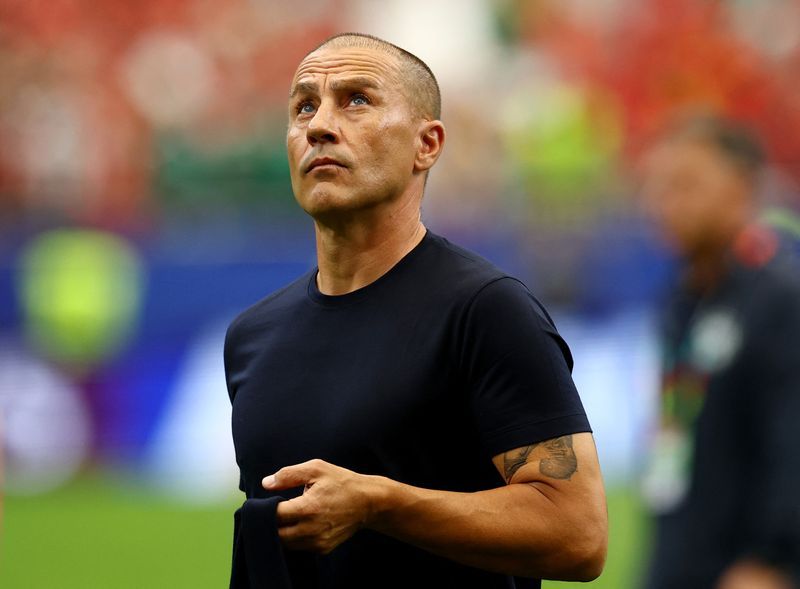
Uzbekistan coach Fabio Cannavaro has accepted personal accountability for his nation's devastating 5-0 defeat to Portugal in their World Cup Group K fixture on Tuesday in Houston, yet maintained that the experience would ultimately strengthen the Central Asian side. The Italian tactician, who lifted the World Cup with Italy in 2006, stressed that despite the catastrophic scoreline, his players demonstrated sufficient effort and commitment, and that the responsibility for the tactical deficiencies lay squarely with him rather than the squad.
The defeat has left Uzbekistan in a precarious position at their maiden World Cup appearance. Already reeling from a 3-1 loss to Colombia in their opening match, the team must now secure victory against the Democratic Republic of Congo on Saturday to harbour any mathematical possibility of progressing to the knockout stages. With two consecutive defeats already on their record, Uzbekistan's World Cup dream hangs by an increasingly fragile thread, and the margin of their loss to Portugal has intensified scrutiny on both team selection and in-game adjustments.
During his post-match address to journalists, Cannavaro displayed the measured demeanour expected of an experienced manager, acknowledging the bitter circumstances while framing the occasion as a developmental milestone for Uzbek football. He noted that his players had demonstrated commitment throughout the encounter despite the overwhelming quality disparity, and urged observers to recognise that this tournament represented a significant learning curve for a nation competing at the World Cup for the first time. His public backing of the squad underscored an understanding that morale preservation would be crucial for the remainder of the campaign.
The 51-year-old coach's willingness to absorb blame reflects a philosophical approach grounded in his own distinguished playing career. Having captained Italy to World Cup glory in Germany sixteen years prior, Cannavaro drew parallels between player development and the nurturing of competitive belief, emphasizing that coaches must create psychological conditions where athletes feel empowered to take risks rather than paralysed by fear of error. This perspective explains his conviction that tactical adjustments, rather than player selection or individual deficiencies, should account for the heavy defeat.
A critical moment that shifted the psychological momentum came when Azizjon Ganiev's goal was disallowed for a foul deemed to have occurred during the build-up play. Cannavaro pointed to this incident as the juncture at which his team's confidence visibly deteriorated, transforming what had been a competitive first half into a capitulation. The decision appeared to deflate Uzbekistan's fighting spirit, and Portugal subsequently inflicted a comprehensive defeat that obscured the structural improvements the team had attempted to implement following their Colombian loss.
Cannavaro articulated a deliberate coaching philosophy centred on encouraging boldness and technical expression rather than defensive caution. He revealed that he had explicitly instructed his players that minor technical errors and wayward passes were acceptable consequences of adopting an ambitious approach, provided they maintained the courage to attempt creative solutions. This mindset represents a significant departure from the risk-averse football often associated with teams lacking World Cup experience, and suggests Cannavaro's intention to prioritise long-term development of Uzbek football culture over immediate tournament survival.
The coach's framing of the tournament as an experience-gathering exercise for a developing football nation carries particular resonance in the Central Asian context. Uzbekistan's qualification for the World Cup was itself a substantial achievement, and while elimination now appears likely, the infrastructure and exposure gained through participating in the tournament could benefit the national team's progression for years ahead. Cannavaro's emphasis on learning from adversity rather than seeking excuses demonstrates a commitment to establishing sustainable standards of professional accountability.
Regarding the final fixture against the Democratic Republic of Congo, Cannavaro maintained that mathematical elimination had not yet occurred, and he would continue demanding maximum effort and belief from his squad. This rhetorical stance serves multiple purposes: it preserves dressing-room unity, prevents psychological capitulation before the final whistle, and maintains the professional standards expected of international competitors regardless of circumstance. For Malaysian and broader Southeast Asian observers, Cannavaro's handling of this disappointment offers instructive lessons in coaching resilience and long-term perspective building.
The contrast between Cannavaro's measured response and the scale of the defeat underscores the maturity expected of established international coaches when navigating tournament adversity. Rather than attributing failure to external factors, inadequate preparation, or player weakness, he has opted for transparent self-criticism and commitment to methodology refinement. This approach may ultimately prove more valuable to Uzbekistan's football development than tournament progression itself, establishing cultural foundations upon which future competitive efforts can be constructed within Central Asian football.
For Uzbekistan's World Cup campaign to extend beyond Saturday's fixture, a combination of personal redemption and Portuguese mercy would be required, scenarios Cannavaro acknowledges as increasingly improbable. Nevertheless, his insistence that the team will extract value from their tournament participation, coupled with his shouldering of tactical responsibility, suggests the federation has invested in a coach capable of preserving institutional development through disappointment. The remaining weeks of the tournament will reveal whether this philosophy translates into improved performances against Congo.