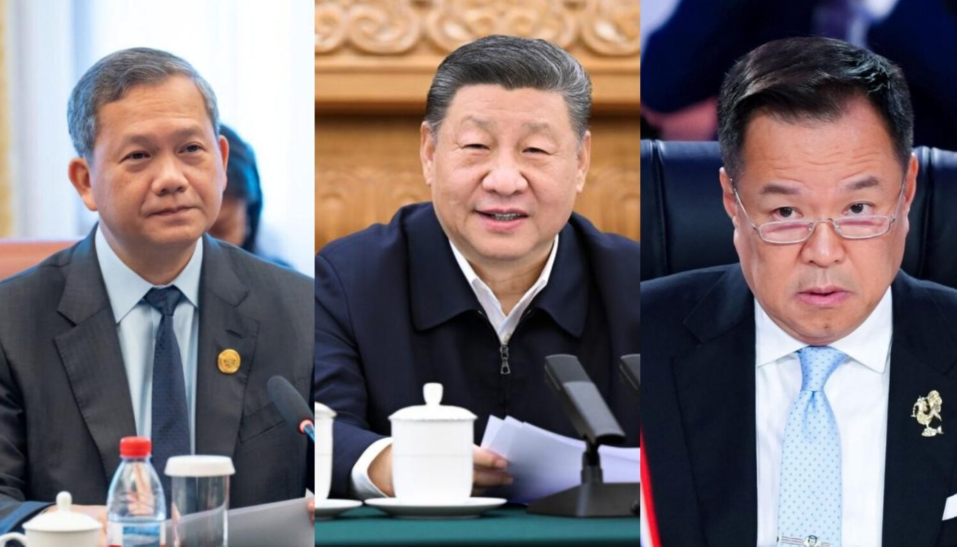
Cambodian Prime Minister Hun Manet and his Thai counterpart Anutin Chanvirakul are set to converge on Shanghai later this month for the World AI Conference 2026, where both leaders will hold separate audiences with Chinese President Xi Jinping. The dual summits, scheduled around the opening session on July 17, present a rare diplomatic opportunity in a region increasingly defined by frozen negotiations and territorial tension. Yet observers remain uncertain whether Beijing will seize the occasion to mediate one of Southeast Asia's most intractable disputes or simply orchestrate the ceremonial photo opportunities that have become routine at such gatherings.
Hun Manet's delegation, departing July 15-17, carries considerable institutional weight beyond the prime minister himself. Foreign Minister Prak Sokhonn and Defence Minister Tea Seiha will accompany him, signalling Phnom Penh's intention to discuss security matters at the highest level. The inclusion of Sun Chanthol, first vice-chairman of Cambodia's Council for the Development of Cambodia, underscores the economic dimensions of the visit. Thailand's representation will similarly extend beyond Anutin, with Foreign Minister Sihasak Phuangketkeow expected to attend. The composition of these delegations suggests both governments regard the Shanghai engagement as substantive rather than purely ceremonial.
The geopolitical backdrop to this summit cannot be overstated. Cambodia and Thailand have not conducted formal border negotiations since December, a six-month hiatus that reflects deepening frustration in Phnom Penh over Thai military actions along their contested frontier. The last significant diplomatic moment—a handshake between Manet and Anutin at the ASEAN Future Forum in Hanoi in early June—produced no tangible progress on the underlying dispute. That encounter served primarily as a public relations gesture, a reminder that diplomatic channels remain nominally open even as substantive talks remain suspended.
Kin Phea, director of the Royal Academy of Cambodia's International Relations Institute, has articulated the central paradox facing both nations. While civilian governments may harbour genuine commitment to resolving disputes through negotiation, he argues that Thailand's military establishment operates with considerable autonomy from civilian oversight. This institutional disconnect has permitted Thai forces to maintain their presence in disputed territory and, according to Phea, to engage in what Phnom Penh characterizes as encroachment on Cambodian sovereignty. The allegation carries weight when considering that approximately 20,000 Cambodian civilians remain displaced from occupied areas, unable to return to their homes.
China's leverage in this equation derives from its position as a major trading partner and investor across both nations. Analysts increasingly suggest that Beijing could translate this economic interdependence into diplomatic pressure, compelling both sides to resume formal negotiations. The precedent exists in Beijing's successful brokering of the Fuxian Consensus reached in December 2025, an agreement that ostensibly committed both nations to peaceful resolution through diplomatic means and international law. Yet implementation has been selective at best, with Thai authorities accused of failing to respect the accord's provisions.
The expectation that China might play an active mediatory role reflects broader regional dynamics. As a self-designated arbiter of regional stability, Beijing has consistently positioned itself as a neutral facilitator capable of managing disputes between smaller powers. Whether Xi Jinping will adopt this role during the Shanghai meetings remains speculative. Chinese diplomatic statements, while emphasizing friendship and cooperation, have historically maintained formal neutrality on bilateral border matters. However, the convergence of both prime ministers in Shanghai, combined with escalating tensions that threaten regional stability, may provide Beijing with sufficient incentive to intensify its diplomatic involvement.
Kin Phea's assessment offers a roadmap for what productive Chinese intervention might accomplish. He advocates for Beijing to pressure Thailand to withdraw military forces from occupied territory, restore civilian governance authority over border operations, and return both nations to the negotiating table. He specifically calls for renewed engagement within the Joint Boundary Commission framework, the institutional mechanism designed to manage such disputes. This prescription assumes that external pressure—particularly from a power with significant economic interests in Thailand—could override military resistance to negotiated settlement.
The economic cooperation frameworks referenced in official statements—Cambodia's Diamond Cooperation Framework with China and the Comprehensive Strategic Partnership proclaimed by both Phnom Penh and Bangkok—create potential leverage points. For Cambodia, deepening ties with Beijing represent strategic hedging against regional isolation. For Thailand, Chinese investment and trade remain strategically important despite the nation's traditional alliance with Washington. Thus both governments face constituencies and interests that value their relationships with China, creating space for Beijing to exercise influence if it chooses to do so.
Yet scepticism about Shanghai's prospects remains warranted. Previous high-level summits have failed to produce movement on the border dispute. The military establishment in Thailand, as Phea emphasizes, may resist external pressure regardless of civilian government preferences. Additionally, Chinese diplomatic tradition privileges non-interference in bilateral disputes between allies, a posture that protects Beijing from accusations of favouritism while simultaneously limiting its effectiveness as a mediator. The line between facilitating talks and actively arbitrating disputes remains politically sensitive for both Beijing and Bangkok.
For Malaysian observers and Southeast Asian analysts more broadly, the Cambodia-Thailand situation represents a cautionary tale about festering disputes within ASEAN. The 20,000 displaced Cambodians constitute a humanitarian crisis largely overlooked in regional discourse. Should China prove unable or unwilling to catalyse meaningful progress during the Shanghai meetings, the stalemate will likely deepen further, setting precedent for other nations to assume more passive positions on border disputes. Conversely, successful Chinese mediation might establish new regional norms where powerful nations actively intervene in their neighbours' conflicts—a development carrying both promise and peril for the broader Southeast Asian order.
The Shanghai conference therefore serves as a critical test of both Chinese diplomatic capability and international commitment to peaceful conflict resolution. Whether it produces substantive movement toward negotiation or merely another round of formal courtesies will significantly influence how neighbouring states perceive the viability of settlement through regional mechanisms in coming years.

