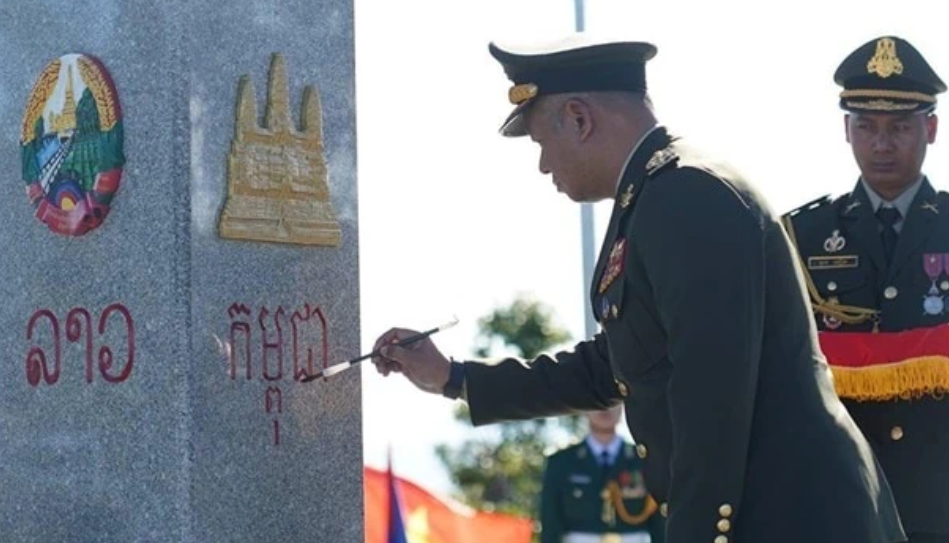
Prime Minister Hun Manet has doubled down on Cambodia's commitment to constructing a direct road connection to the Dragon's Tail, the country's remote northwestern tip where the borders of Cambodia, Laos and Vietnam converge. Speaking during a provincial visit to Stung Treng on Wednesday, the Cambodian leader positioned the infrastructure project not merely as an economic development initiative but as a matter of territorial integrity and national control. His framing represents a significant strategic pivot—one that may have implications for how Southeast Asian nations approach border management and regional cooperation frameworks in an era of heightened geopolitical sensitivity.
The centrepiece of Manet's vision is Route 78½, which would extend from Banlung in Ratanakiri province northeastward to Cambodia's most isolated territory at the tri-border junction. Currently, residents and visitors wishing to access this remote area face significant logistical challenges, with existing travel routes requiring passage through neighbouring Vietnamese territory—a practical reality that Manet characterises as fundamentally unacceptable for a sovereign nation. The terrain itself is formidable: dense forests, mountainous geography and inadequate existing infrastructure have long made direct overland connection from the Cambodian heartland economically unviable. Yet the Prime Minister has declared that such obstacles cannot deter the government's determination to establish sovereignty over every corner of Cambodian territory through physical connectivity.
The ideological underpinning of this project reveals a sophisticated understanding of how infrastructure and territorial claims interact in the contemporary Southeast Asian context. Manet employed striking metaphorical language during his speech, comparing roads to blood vessels coursing through a nation's body, carrying life-giving economic activity to previously dormant regions. This organic imagery—roads as circulatory systems that nourish development wherever they reach—reflects a worldview in which physical connection equals political control, economic opportunity and demographic stability. Where infrastructure exists, Manet suggested, communities flourish, residents establish roots and government authority becomes tangible rather than theoretical. The implication is clear: a Cambodian road to the Dragon's Tail represents something far more consequential than merely improved transportation.
The northeastern provinces of Stung Treng, Ratanakiri, Mondulkiri and Kratie represent particularly sensitive territory for Cambodia. These regions, home to indigenous highlander populations and historically remote from the lowland Khmer centres of power, have long occupied an ambiguous position in Cambodia's national consciousness. Following the devastation of the 1975-1998 civil war, these provinces remained profoundly isolated and underdeveloped compared with other parts of Cambodia. The absence of robust infrastructure effectively meant that these territories, while nominally Cambodian, lacked the practical integration into the national economy and polity that characterises more developed regions. Manet's vision of northeastern development thus carries implications extending beyond simple road construction—it represents an attempt to cement these territories more firmly within Cambodia's effective sphere of governance and economic activity.
The timing and context of this announcement cannot be divorced from Cambodia's withdrawal from the Cambodia-Laos-Vietnam Development Triangle Area (CLV-DTA) in September 2024, a decision that generated considerable domestic controversy and public debate. Launched in 1999 as a multilateral cooperation framework, the CLV-DTA was intended to facilitate coordinated development across 13 provinces spanning the three nations' borders, with Cambodia's participation involving Kratie, Stung Treng, Mondulkiri and Ratanakiri—precisely the regions now targeted by Manet's infrastructure agenda. The framework was designed to improve cross-border trade, investment flows and living standards in chronically underdeveloped areas. However, critics raised significant concerns about whether participation in a trilateral mechanism might compromise Cambodian sovereignty or even result in territorial loss, allegations that the government consistently rejected but which ultimately contributed to the political decision to withdraw.
By embracing an independent, unilateral approach to northeastern development through Route 78½ and complementary infrastructure projects, Manet appears to be offering a nationalist response to the CLV-DTA debate. Rather than pursuing development through multilateral frameworks that might implicate Cambodia's sovereignty (according to critics' framing), the government now advocates for development through distinctly Cambodian initiatives that emphasise national control and territorial integration. Manet explicitly revisited the CLV-DTA controversy during his August 12 address, acknowledging that some observers had portrayed the framework as a threat to Cambodia's territorial integrity while reiterating that such interpretations misunderstood the original cooperative intent. Nevertheless, his pivot toward unilateral infrastructure development sends a clear political signal: Cambodia will develop its northeastern frontier on its own terms, under its own authority and with direct physical connection to the national core.
For Malaysian and broader Southeast Asian observers, Cambodia's approach illuminates the persistent tension between regional integration and national sovereignty in a neighbourhood where colonial border legacies, ethnic complexity and development disparities create persistent friction. The Dragon's Tail project exemplifies how governments navigate this tension: by emphasising infrastructure, connectivity and economic opportunity while simultaneously reasserting territorial control and national agency. The decision to build Route 78½ unilaterally rather than through multilateral frameworks reflects not merely technical preferences but fundamentally different visions of how development should proceed in sensitive border zones. This approach resonates with nationalist constituencies concerned about external influence but may also limit access to international financing, expertise and cooperative efficiency that multilateral frameworks can provide.
The practical feasibility of constructing Route 78½ remains an open question. The estimated costs of developing highway infrastructure through Cambodia's most challenging terrain have not been publicly disclosed, and questions persist about Cambodia's capacity to fund, maintain and effectively utilise such a connection if completed. The Dragon's Tail region contains minimal population and economic activity; the road would essentially connect Cambodian territory to Cambodian territory through territory that currently generates minimal economic output. Whether the infrastructure can justify its costs through induced economic development or whether it will function primarily as a symbolic expression of territorial sovereignty remains unclear. International development partners, particularly those concerned about strategic positioning in Southeast Asia, will likely watch closely to determine whether and how Cambodia pursues this ambition.
The broader implications for regional stability warrant consideration. Cambodia's withdrawal from the CLV-DTA and corresponding embrace of unilateral infrastructure development could influence how other Southeast Asian nations approach cross-border cooperation frameworks. If multilateral mechanisms are perceived as threats to sovereignty rather than mutually beneficial arrangements, incentives for regional cooperation may diminish precisely when Southeast Asia faces significant external pressures and development challenges requiring coordinated responses. Conversely, if Cambodia's experience demonstrates that nations can pursue independent development strategies while maintaining cooperative relationships with neighbours, it may provide a model for other governments navigating similar tensions between sovereignty concerns and regional integration imperatives.
Manet's characterisation of connectivity as inseparable from sovereignty represents an important statement about how contemporary Southeast Asian leaders conceptualise national power and territorial integrity. The Dragon's Tail project, whatever its ultimate practical significance, embodies a political philosophy: that true sovereignty requires not merely legal claims to territory but tangible, physical presence and the capacity to move goods, people and government authority freely throughout national space. This vision extends beyond Cambodia, reflecting broader regional preoccupations with ensuring that remote border areas remain genuinely integrated into national economies and political structures rather than existing as theoretical territorial claims. As Cambodia pursues this ambitious infrastructure agenda, the success or difficulties encountered will likely influence how other nations in Southeast Asia approach their own remote frontier development challenges.

